
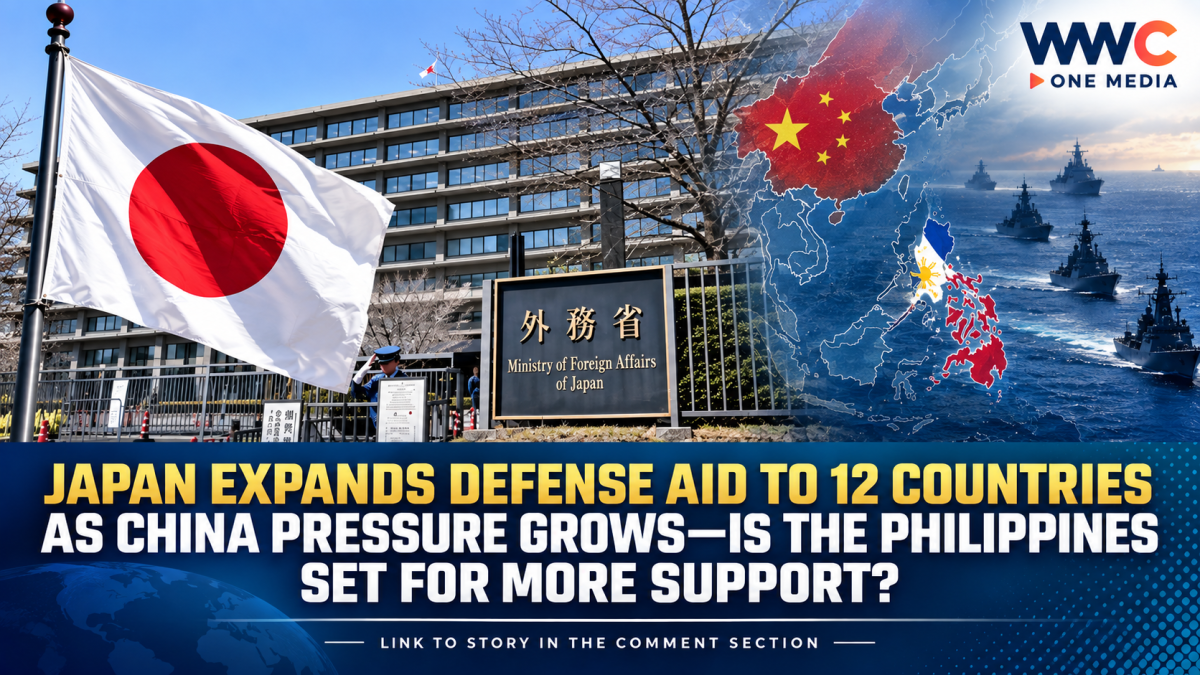
TOKYO — Japan is significantly expanding its security assistance program, planning to provide defense equipment and other support to about 12 countries in fiscal year 2026, up from eight recipients the previous year. The move comes as Tokyo seeks to strengthen security cooperation with like-minded partners amid growing strategic tensions in the Indo-Pacific.
The expansion is being carried out through Japan’s Official Security Assistance (OSA) program, a framework launched in 2023 to help partner countries improve their security and deterrence capabilities.
According to reports from Jiji Press carried by Nippon.com, Japan intends to add countries including Kenya and Cambodia to this year’s list, while Vietnam and Timor-Leste are also being considered. Cambodia is expected to receive communications equipment and patrol boats.
The program is increasingly focused on maritime security, surveillance and monitoring—areas that have become more strategically important as competition intensifies across the East and South China seas.
Japan doubles down on security assistance
Japan has allocated approximately ¥18.1 billion (about US$114 million) for OSA in fiscal 2026, more than double the roughly ¥8 billion provided for the previous fiscal year, according to Kyodo reporting cited by the South China Morning Post.
The expansion reflects Tokyo’s broader effort to strengthen the security capabilities of partners across the Indo-Pacific and beyond. Japan’s Cabinet-level planning has also emphasized larger and more advanced projects, particularly those involving maritime surveillance and security.
Japan’s OSA framework has traditionally concentrated on equipment that improves monitoring, surveillance and disaster-response capabilities rather than providing conventional offensive weapons.
However, Tokyo is now considering a broader range of completed defense equipment as it revises its defense-transfer policies. The shift represents a notable evolution from Japan’s traditionally restrictive approach to defense exports.
The Nation Thailand reported that the 2026 program could include fully assembled defense equipment for the first time, although restrictions remain on certain weapons and lethal capabilities.
The Philippines remains an important partner
The Philippines is particularly significant in Japan’s expanding security network.
Manila has already benefited from Japan’s OSA program, including the delivery of five coastal surveillance radar systems in February 2026.
The radar project originated from a ¥600-million OSA agreement finalized during former Japanese Prime Minister Fumio Kishida’s 2023 visit to Manila. The equipment is intended to strengthen the Philippine Navy’s ability to monitor maritime activity and improve the country’s maritime domain awareness.
Philippine Defense Secretary Gilberto Teodoro Jr. has said the Japanese radar systems can be integrated with existing Philippine military radar capabilities, potentially improving the country’s overall surveillance network.
Japan’s assistance to the Philippines has also expanded beyond individual equipment deliveries.
In January 2026, Manila and Tokyo signed an Acquisition and Cross-Servicing Agreement (ACSA) designed to facilitate the reciprocal provision of supplies and services between the Armed Forces of the Philippines and Japan’s Self-Defense Forces.
The agreement covers logistical support such as fuel, food, transportation, medical services and spare parts, helping facilitate joint exercises, humanitarian assistance and disaster-relief operations.
The agreement subsequently entered into force on August 22, 2026, following the exchange of diplomatic notes between the two governments.
Why the South China Sea matters
Japan’s decision to expand OSA comes against the backdrop of increasingly complicated security dynamics in the Indo-Pacific.
Tokyo has become more concerned about China’s growing military and maritime activity around the East China Sea and South China Sea. Japan’s official OSA strategy places particular emphasis on strengthening maritime surveillance and the ability of partner countries to monitor developments in their surrounding waters.
For the Philippines, the assistance could have particular significance because of its strategic position and ongoing maritime security challenges in the West Philippine Sea, the country’s designation for portions of the South China Sea within its maritime jurisdiction.
Philippine officials have repeatedly highlighted the importance of stronger surveillance, information-sharing and partnerships as Manila seeks to protect its maritime interests while avoiding unnecessary escalation.
Armed Forces of the Philippines chief Gen. Romeo Brawner Jr. previously described Japan as a key partner in addressing emerging security challenges, including coercive and aggressive actions affecting Philippine sovereignty.
Japan’s defense policy is changing
The OSA expansion is also part of a much wider transformation in Japan’s defense posture.
In April 2026, Japan revised its Three Principles on Transfer of Defense Equipment and Technology and related implementation guidelines, easing longstanding restrictions on defense-equipment transfers.
The changes allow Japan to consider exports of a broader range of military equipment, including systems with lethal capabilities, although restrictions remain for countries involved in active conflicts and other circumstances.
Philippine officials welcomed the change.
Teodoro said the revised policy could give the Philippines access to high-quality Japanese defense equipment while supporting Manila’s defense resilience and regional deterrence efforts.
President Ferdinand Marcos Jr. likewise welcomed Japan’s evolving defense-export policy, saying it could strengthen bilateral security cooperation and support the modernization of the Armed Forces of the Philippines.
What comes next?
Japan’s latest move signals that OSA is becoming a more important component of Tokyo’s broader Indo-Pacific strategy.
The immediate focus remains surveillance, maritime security, communications and other capabilities that can strengthen partner countries without automatically translating into direct military intervention.
But the direction is clear: Japan is moving from a narrowly defined security-assistance model toward a broader network of defense cooperation.
For the Philippines, that could mean deeper access to Japanese technology, surveillance capabilities, logistical support and potentially more sophisticated defense equipment in the years ahead.
And with Japan identifying maritime security as a priority and Manila positioned at the center of some of the Indo-Pacific’s most sensitive strategic waters, one question is likely to attract increasing attention:
Will the Philippines become one of the biggest beneficiaries of Japan’s expanding defense partnership network?




Leave a Reply