
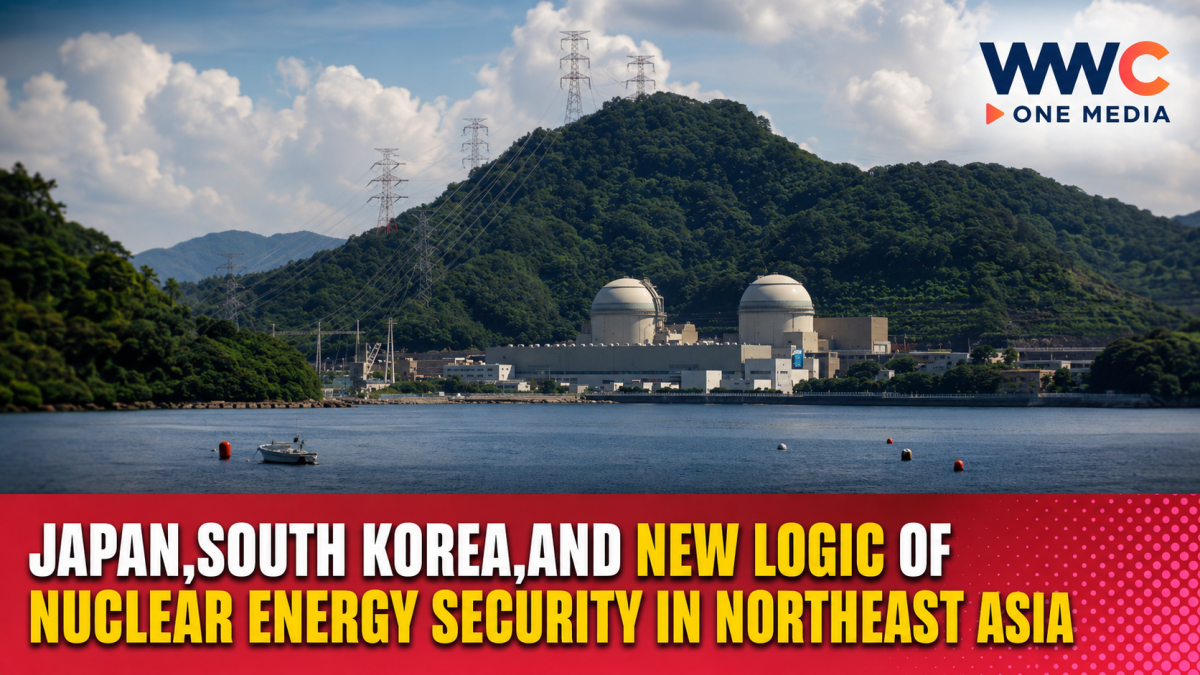
TOKYO/SEOUL — Japan and South Korea are quietly changing the way Northeast Asia thinks about nuclear energy.
For decades, nuclear power in the region was largely discussed through the lenses of electricity costs, climate policy and nuclear safety. Today, a different calculation is emerging: energy security itself is becoming a strategic security issue.
Japan is restarting nuclear reactors after the Fukushima disaster, while South Korea is maintaining plans for new reactors and pushing aggressively into small modular reactor (SMR) technology. At the same time, Tokyo and Seoul are working with Washington to expand civilian nuclear cooperation across the Indo-Pacific.
The shift is significant because both countries remain heavily dependent on imported energy and vulnerable to disruptions in global fuel markets.
And that vulnerability has become harder to ignore.
THE NEW ENERGY SECURITY EQUATION
Japan imports the overwhelming majority of its primary energy. South Korea faces a similar structural problem, relying heavily on imported oil and gas to power its highly industrialized economy.
That makes LNG and other seaborne fuels vulnerable to geopolitical shocks, shipping disruptions and sudden price increases.
A recent analysis by the Center for Strategic and International Studies argued that instability surrounding the Middle East and the Strait of Hormuz has strengthened the case for nuclear energy in Japan and South Korea, both of which are highly dependent on maritime energy imports.
The lesson for policymakers is increasingly straightforward:
If imported fossil fuels can become a strategic vulnerability, domestically generated nuclear electricity can become a strategic asset.
That does not make nuclear power risk-free. But it changes the political calculation.
JAPAN’S POST-FUKUSHIMA REVERSAL
Japan’s nuclear policy has undergone one of the most dramatic reversals in the developed world.
Following the 2011 Fukushima Daiichi accident, Japan shut down its commercial nuclear fleet. Nuclear power subsequently fell sharply as the country relied more heavily on imported LNG, coal and other fuels.
But energy-security pressures, decarbonization targets and rising electricity demand have pushed Tokyo back toward nuclear power.
Japan’s Seventh Strategic Energy Plan, approved by the Cabinet in February 2025, calls for nuclear power to account for about 20% of the country’s electricity mix in fiscal 2040, alongside a 40–50% target for renewable energy. The government says the strategy is designed to simultaneously address stable energy supplies, economic growth and decarbonization.
The change became particularly visible in January 2026, when Tokyo Electric Power Company restarted Unit 6 at the Kashiwazaki-Kariwa nuclear plant, the world’s largest nuclear power complex by capacity and the operator of Fukushima Daiichi. Reuters described the restart as a major milestone in Japan’s post-Fukushima nuclear policy.
But Japan’s nuclear comeback still faces obstacles.
Public concern over safety remains strong, and the country continues to face difficult questions surrounding spent fuel, long-term waste disposal and the economics of restarting or constructing reactors.
Japan’s own energy ministry has acknowledged the need to address concerns about nuclear safety and unresolved “back-end” issues involving nuclear fuel and waste.
SOUTH KOREA IS MOVING IN THE SAME DIRECTION
South Korea’s nuclear trajectory is also shifting.
The government has maintained plans to build two additional large nuclear reactors by 2037–2038 under the country’s 11th Basic Plan for Electricity Supply and Demand.
The country’s long-term electricity plan projects nuclear power to provide approximately 35.2% of electricity generation by 2038, while renewables are projected at roughly 29.2%.
The reason is not simply climate policy.
South Korea’s economy is increasingly electricity-intensive. Semiconductor manufacturing, artificial intelligence infrastructure and advanced industries require enormous amounts of reliable power.
That creates a strategic problem for Seoul: how can the country simultaneously expand electricity supply, reduce carbon emissions and protect itself from volatile imported fuel markets?
Nuclear power is increasingly being presented as one answer.
SEOUL IS ALSO BETTING ON SMALL MODULAR REACTORS
South Korea’s ambitions go beyond building conventional reactors.
In August, President Lee Jae-myung’s government identified nuclear energy and fusion among seven strategic technologies intended to become future economic growth engines.
The government wants to commercialize a domestically developed small modular reactor by 2035, while simultaneously developing next-generation nuclear and fusion technologies.
That is important because SMRs could eventually offer smaller, more flexible nuclear installations for countries that cannot or do not want to build conventional gigawatt-scale plants.
And this is where Northeast Asia’s nuclear story becomes international.
JAPAN, SOUTH KOREA AND THE U.S. ARE TAKING THE NUCLEAR RACE ABROAD
In July 2026, Japan, South Korea and the United States signed a memorandum establishing a framework for cooperation on deploying SMRs in other countries, particularly across the Indo-Pacific.
According to Yonhap, the agreement is intended to help reduce project risks, achieve economies of scale, attract private investment, streamline licensing and strengthen nuclear supply chains.
Washington also committed more than $10 million to support technical assistance and regional training for countries considering SMR deployment.
That transforms nuclear energy from a purely domestic issue into a component of regional economic and strategic competition.
Japan and South Korea are no longer simply asking:
“How much nuclear power do we need?”
They are increasingly asking:
“Who will supply the nuclear technology that powers Asia’s next generation of industry?”
THE CHINA-RUSSIA FACTOR
That question carries geopolitical weight.
China and Russia have become major players in the global nuclear export market. For developing countries looking for nuclear technology, financing and construction expertise, their companies can offer an alternative to Western suppliers.
The emerging Japan-South Korea-U.S. framework provides another option.
For Washington, deeper nuclear cooperation with Tokyo and Seoul could strengthen the position of U.S.-aligned suppliers in the Indo-Pacific.
For Japan and South Korea, it could create new export opportunities for their own nuclear industries.
And for countries considering nuclear power, it could mean more competition between suppliers — potentially improving financing, technology and project choices.
NUCLEAR ENERGY IS NOW PART OF THE SECURITY CONVERSATION
The development is happening alongside deeper Japan-South Korea-U.S. security coordination.
In July, the three countries reaffirmed cooperation on North Korea, deterrence and regional stability while also discussing nuclear energy, critical minerals, advanced technology and supply-chain resilience.
That overlap is significant.
The same countries coordinating against nuclear and missile threats from North Korea are simultaneously cooperating on civilian nuclear technology.
The distinction between energy security, economic security and national security is becoming increasingly blurred.
North Korea’s continued nuclear weapons development makes that trend even more consequential.
Pyongyang recently reiterated its intention to strengthen its nuclear capabilities, while Japan, South Korea and the United States prepare for another trilateral military exercise focused on North Korean nuclear and missile threats.
BUT THERE IS A PROBLEM NOBODY CAN IGNORE
The nuclear comeback comes with a major unresolved question:
What happens to the waste?
Both Japan and South Korea have struggled with long-term spent-fuel management and permanent disposal.
Japan continues research into geological disposal, but it does not yet have an operating permanent deep geological repository.
South Korea faces its own political and technical challenges over long-term storage.
That creates a paradox.
The region wants more nuclear power because it wants greater energy security.
But expanding nuclear generation also increases the amount of radioactive material that must ultimately be managed safely for extremely long periods.
The success of Northeast Asia’s nuclear revival may therefore depend on something less politically exciting than reactor construction:
whether Japan and South Korea can build public trust around nuclear waste, safety and long-term stewardship.
THE BIGGER PICTURE
The nuclear revival in Japan and South Korea is not simply a comeback for an old technology.
It reflects a new strategic reality.
Energy supplies can be disrupted by war.
Shipping lanes can become dangerous.
LNG prices can surge.
Artificial intelligence and semiconductor manufacturing can dramatically increase electricity demand.
And governments increasingly view reliable electricity as essential infrastructure for national competitiveness.
That is why nuclear power is being reconsidered.
For Japan, it offers a way to reduce exposure to imported fossil fuels while meeting its decarbonization goals.
For South Korea, it provides a stable electricity source for an economy increasingly dependent on semiconductors, AI and advanced manufacturing.
For the United States, cooperation with both countries creates another tool for competing in the Indo-Pacific’s rapidly developing nuclear-energy market.
But the most important question may be what happens next.
If Japan and South Korea succeed in combining nuclear energy, advanced technology and supply-chain security, Northeast Asia could become one of the world’s most important centers of a new civilian nuclear industry.
If they fail to solve the safety, waste and public-trust problems that have haunted nuclear power for decades, the region’s nuclear revival could face a very different future.
The nuclear race in Northeast Asia may no longer be about who has the most reactors.
It may be about who can make nuclear energy secure enough — politically, economically and environmentally — to power the next Asian century.
WWC ONE MEDIA G.A


Leave a Reply