
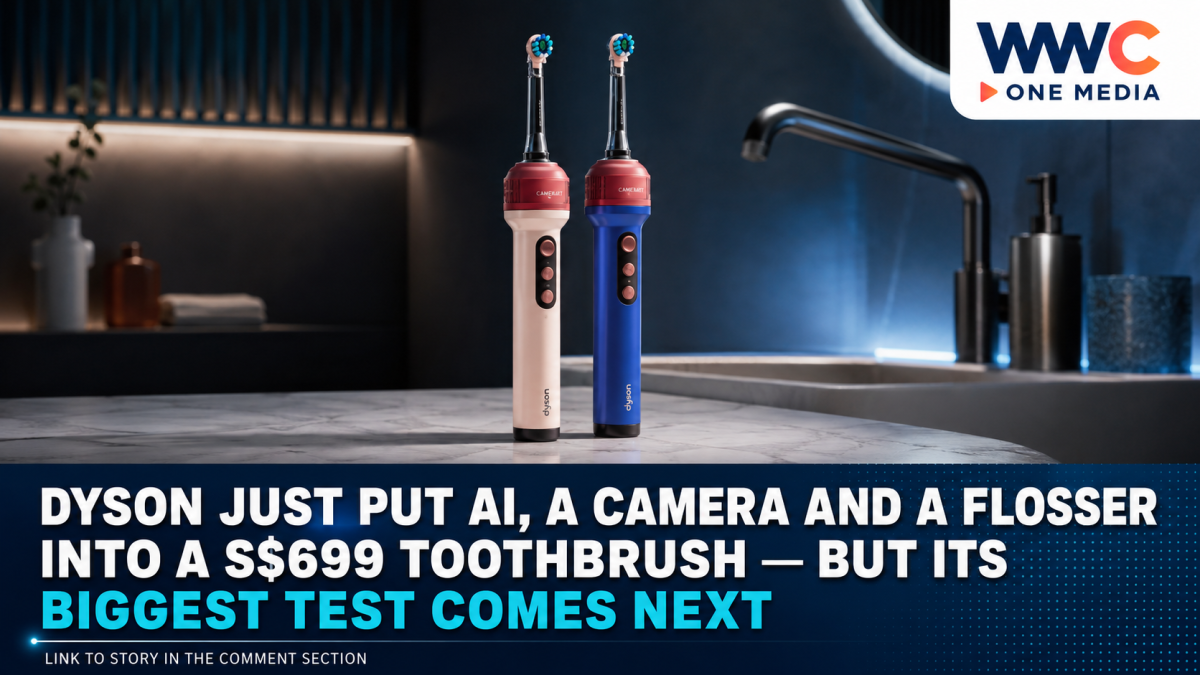
SINGAPORE — Dyson has built its reputation by turning ordinary household products into expensive engineering showcases. After vacuum cleaners, hair dryers, air purifiers and headphones, the Singapore-headquartered technology company is now making one of its boldest bets yet: reinventing the toothbrush.
The company launched the Dyson CameraJet, its first electric toothbrush, on September 1, 2026, bringing a built-in camera, machine-learning technology and a precision mouthrinse jet into a single oral-care device.
In Singapore, the CameraJet is priced at S$699 and is available in Ceramic Pink and Ceramic Ultra Blue through Dyson stores, its website and selected retailers.
That price immediately places the device at the luxury end of the electric-toothbrush market.
But Dyson is betting that consumers will pay a premium for something conventional toothbrushes cannot do: actually see the spaces between teeth and automatically target them while the user brushes.
A tiny camera is watching where you brush
At the heart of the CameraJet is a 100,000-pixel macro camera connected to Dyson’s proprietary “Gap Optical Targeting” system.
The camera analyses 28 images every second, while a machine-learning algorithm identifies and tracks the gaps between a user’s teeth. When one is detected, the toothbrush can automatically fire a controlled jet of mouthrinse toward that space.
Dyson describes the system as “precision flossing,” although consumers should distinguish the technology from conventional string flossing. The device essentially combines powered brushing with targeted liquid interdental cleaning.
The camera can also work like a miniature intraoral viewer.
Connected through Wi-Fi and Bluetooth to the MyDyson app, users can watch a live view from inside their mouth and receive information about brushing coverage and technique. Dyson says users can select automatic or manual jetting as well as different brushing intensities.
It is the kind of technology that raises an obvious question: Do people really want a camera inside their toothbrush?
Dyson says your mouth isn’t being recorded
Privacy has quickly become part of the conversation surrounding the launch.
Dyson says the CameraJet’s camera operates only when the live-view feature or automatic jet function is being used. According to the company, images are not recorded or stored on the toothbrush or in the cloud.
CNA Lifestyle reported mixed online reaction following the announcement, with some users questioning whether the technology is necessary while others viewed it as an interesting application of machine learning to an everyday product. Business Insider also highlighted the privacy question created by putting yet another connected camera-equipped device into people’s homes—and, in this case, their mouths.
For Dyson, convincing consumers that the camera is useful rather than intrusive could become almost as important as proving that its cleaning system works.
Six years, hundreds of engineers and one problem Dyson wanted to solve
The CameraJet was not a quick experiment.
Multiple reports say the toothbrush was developed over roughly six years with the involvement of 661 Dyson engineers. The Independent reported that the device is covered by 38 patents.
The engineering challenge centered largely on an unglamorous problem: people frequently fail to clean properly between their teeth.
The CameraJet contains a 12.5ml mouthrinse reservoir and uses a diaphragm pump and pressure chamber designed to keep liquid flowing even when the toothbrush is tilted or held horizontally.
Instead of the narrow stream associated with many oral irrigators, Dyson designed a wider, cone-shaped spray intended to cover more of the interdental area at lower pressure.
The dock does more than charge the toothbrush. Reports from The Verge and other technology outlets say it can also refill the mouthrinse reservoir in about three seconds.
The brush head itself has separate bristle zones intended for tooth surfaces and the gumline, while an RFID chip tracks brush-head use and can alert owners when replacement is due.
But can a S$699 toothbrush justify itself?
This is where Dyson’s newest experiment becomes more interesting.
The company makes several performance claims for CameraJet, including improved plaque removal and gum health compared with a manual toothbrush. Dyson’s Singapore product information says one clinical comparison involved 71 participants over four weeks of twice-daily use, while some additional performance claims come from laboratory testing.
Those distinctions matter.
Early technology reviews have been positive about the concept. TechRadar described the combined brushing and liquid-flossing approach as effective during its initial testing, while Allure editors also reported favorable first impressions.
But both a polished user experience and impressive engineering are different from proving that most consumers need a S$699 toothbrush—or that it is the best interdental-cleaning option for every person.
The American Dental Association recommends brushing twice daily and cleaning between the teeth once a day with floss or another interdental cleaner. It recognises water flossers and other powered interdental cleaners as legitimate categories, while noting that the appropriate cleaning method can depend on an individual’s teeth, gum condition and needs.
In other words, Dyson may have engineered a sophisticated solution to a genuine dental-care problem, but a camera-equipped toothbrush does not eliminate the fundamentals of oral hygiene—or the value of professional dental advice.
Dyson is really selling convenience
The CameraJet’s strongest argument may therefore be less about artificial intelligence and more about human behaviour.
Traditional brushing and interdental cleaning require separate steps. Many people simply skip the second one.
Dyson’s strategy is to collapse multiple actions—brushing, interdental cleaning, mouthrinse delivery and technique monitoring—into one connected routine.
That helps explain why founder and chief engineer James Dyson has focused on flossing as the problem the company wanted to tackle. The technology attempts to automate one of the easiest parts of oral hygiene to neglect.
It is also consistent with a larger trend in consumer technology: turning simple personal-care products into connected, sensor-filled devices capable of collecting information and coaching their users.
Forbes reported that the CameraJet costs about US$499 in the United States, underscoring Dyson’s decision to position it as a premium product rather than a mass-market replacement for an ordinary toothbrush.
A toothbrush—or Dyson’s next category-defining gamble?
Dyson has done this before.
Its Supersonic hair dryer challenged the idea that consumers would never spend hundreds of dollars on a hair dryer. Its cordless vacuum cleaners helped reshape another established appliance category.
Not every experiment has worked equally well, however, making the CameraJet an intriguing test of just how far the Dyson brand can stretch.
The engineering is undeniably ambitious: a camera watching the teeth, machine learning identifying gaps, a liquid jet reacting almost instantly, sensors analysing technique and an app showing users what is happening inside their own mouths.
But the question that will determine CameraJet’s future is much simpler.
Will enough people believe that solving the daily problem of flossing is worth S$699?
Dyson has built the technology.
Now consumers will decide whether the humble toothbrush really needed reinventing.
WWC ONE MEDIA MJE




Leave a Reply