
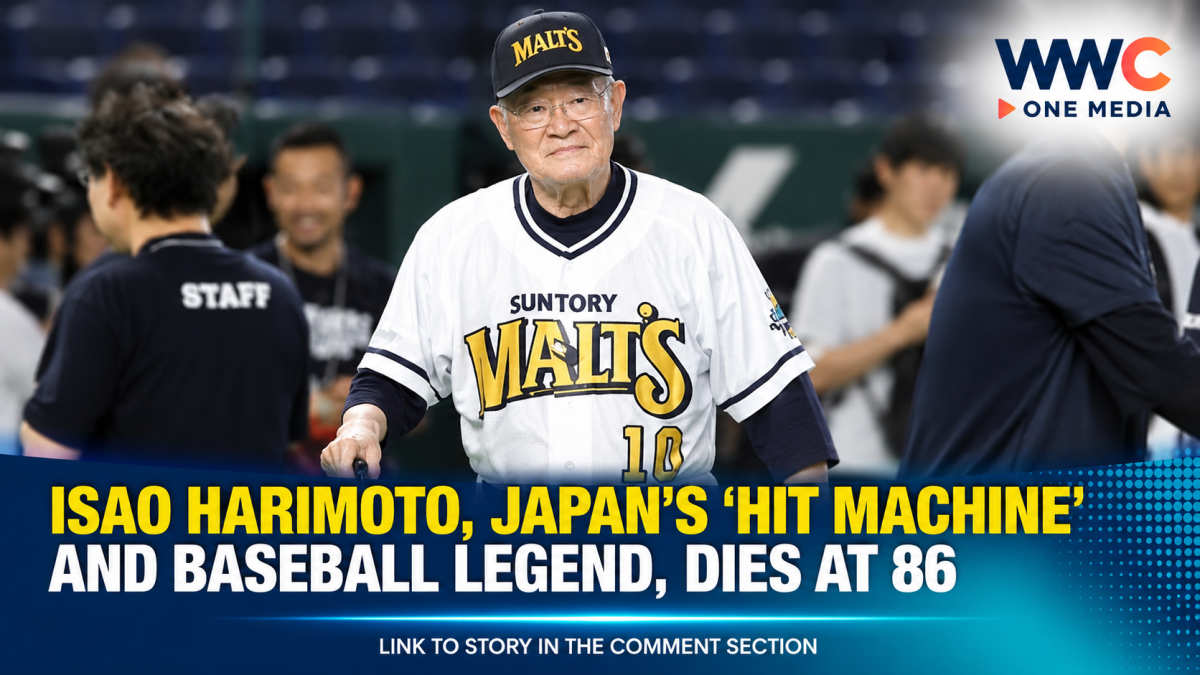
Japanese baseball has lost one of its most recognizable figures.
Isao Harimoto, the legendary outfielder known as Japan’s “Hit Machine,” died in a Tokyo hospital on September 9, 2026, at the age of 86, according to Japanese media reports. Harimoto had been one of the defining hitters in the history of Nippon Professional Baseball (NPB), finishing his career with a record 3,085 hits.
His death closes the career of a player whose influence stretched far beyond his statistics. Harimoto was not only one of Japan’s most productive hitters but also a prominent television baseball commentator after retiring from the game.
A record that stood above generations
Harimoto’s greatest legacy was his extraordinary consistency at the plate.
Across a 23-season NPB career, he collected 3,085 hits, a record that made him the first player in Japanese professional baseball to reach 3,000 career hits. He also hit 504 home runs, drove in 1,676 runs and finished with a career batting average of .319.
He played for the Toei Flyers, Yomiuri Giants and Lotte Orions before ending his playing career in 1981.
His combination of longevity and production made him one of the most accomplished hitters in Japanese baseball history.
Harimoto was also an 18-time All-Star and won seven Pacific League batting titles. He was inducted into the Japanese Baseball Hall of Fame in 1990.
From Hiroshima to baseball immortality
Harimoto was born in Hiroshima on June 19, 1940, and grew up during one of the most difficult periods in modern Japanese history.
As a five-year-old, he survived the atomic bombing of Hiroshima on August 6, 1945. His experience of the bombing remained an important part of his life, and he later spoke publicly about his memories and became involved in efforts connected to the hibakusha community.
His story would eventually take him from postwar Hiroshima to the highest levels of Japanese professional baseball.
A trailblazer with Korean roots
Harimoto was born Jang Hun and was a second-generation Korean-Japanese. His background made his rise in Japanese professional baseball particularly significant during an era when ethnic identity could create additional barriers.
He spent his entire professional playing career in Japan and became one of the country’s biggest baseball stars.
His achievements eventually transcended those early barriers, although his Korean-Japanese identity remained an important part of his personal history.
More than an athlete
Harimoto’s public profile did not disappear after his retirement.
He became a familiar television personality and baseball analyst, best known to a later generation for his appearances on the long-running Japanese program “Sunday Morning.”
His direct, sometimes outspoken commentary made him a recognizable figure well beyond the baseball stadium.
That second career ensured that generations who never watched him play still knew his name.
The numbers tell only part of the story
Harimoto’s 3,085 hits remain perhaps the clearest symbol of his greatness.
But his significance goes beyond a single record.
He was a seven-time batting champion, a multiple-time All-Star and a member of the Japanese Baseball Hall of Fame. His career batting average of .319 over more than two decades illustrates the remarkable consistency that earned him the nickname “An’da Seizo-ki,” or “Hit Machine.”
He also became one of the rare Japanese players to combine more than 3,000 hits with more than 500 home runs.
A baseball era comes to an end
Harimoto played during a transformative period for Japanese professional baseball, when the sport was becoming an increasingly powerful part of the country’s popular culture.
His career connected several generations of fans—from the postwar expansion of professional baseball to the modern era.
Even after his playing days ended, his name remained attached to one of the most difficult records in Japanese baseball to match.
Isao Harimoto is gone at 86, but the 3,085-hit mark that defined his extraordinary career remains a lasting monument to one of Japan’s greatest hitters.
WWC ONE MEDIA G.A




Leave a Reply