
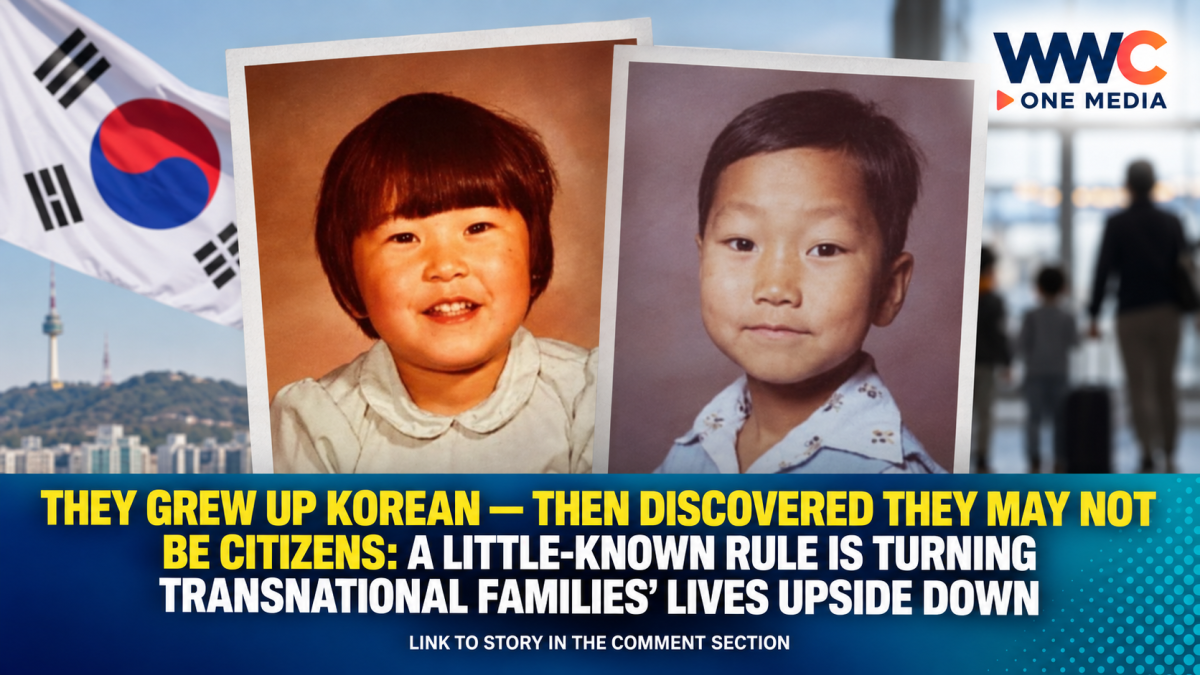
SEOUL — Imagine being born and raised in South Korea, speaking Korean, attending Korean schools and building your entire life around the country — only to discover years later that you may no longer legally be a South Korean citizen.
That is the reality confronting some children of transnational and multicultural families in South Korea, after a little-known provision in the country’s nationality law left families scrambling to understand whether their children still hold Korean citizenship.
The issue centers on Article 15 of South Korea’s Nationality Act, which generally provides that a Korean national who voluntarily acquires a foreign nationality loses Korean nationality at the time the foreign nationality is acquired.
The problem is particularly complicated for children born to Korean and foreign parents.
A SECOND PASSPORT CAN CHANGE EVERYTHING
One case highlighted by Channel NewsAsia involves a 21-year-old man from Suwon who was born and raised in South Korea but acquired Russian nationality after his parents registered him for it when he was just two years old.
He now faces uncertainty over whether he remains a Korean citizen.
For years, his family apparently had no reason to believe that obtaining another nationality could affect his Korean status.
Another family in Busan encountered an even more serious situation.
A Korean father and his Australian wife had two children born in South Korea. The family believed the children could legitimately hold both Korean and Australian nationalities.
The children even used Australian passports when entering Australia and Korean passports when returning to South Korea.
But after the family sought clarification from immigration authorities in 2023, the children were reportedly treated as having lost their Korean nationality.
The mother and children were ordered to leave South Korea. They subsequently returned using their Australian passports — this time entering the country as foreigners — while beginning the process of recovering their Korean nationality.
The family also said they were asked to repay approximately 15 million won (about US$11,000) in childcare subsidies and health-insurance benefits.
WHY FAMILIES SAY THEY WERE CAUGHT OFF GUARD
The controversy is not simply about the wording of the law.
Some families say they received conflicting information from government agencies about whether their children would retain Korean nationality after acquiring a foreign nationality.
In one case, a father from Ansan contacted the Immigration Contact Center about his child. He was reportedly told that a child born in Korea to a Korean parent and registered with a foreign government could be considered a dual national from birth.
However, when the family later contacted the Justice Ministry’s Nationality Division, they were reportedly told that Article 15 could apply if the child acquired the foreign nationality after birth.
That distinction — whether nationality exists automatically at birth or is subsequently acquired through an application or registration — can have enormous consequences.
South Korea’s Justice Ministry has acknowledged the underlying legal issue. In an official explanation concerning similar Korean-Australian families, the ministry said that children born in Korea can initially acquire Korean nationality but may lose it when they subsequently acquire Australian nationality through an application and approval process.
THE LAW IS ALREADY UNDER REVIEW
The Korean government is now moving toward changing the rules.
The Justice Ministry has proposed legislation aimed at protecting children of international marriages who acquire a parent’s foreign nationality after birth.
Under the proposed approach, certain minors whose foreign nationality is obtained through a required application, registration or confirmation process could be treated as having multiple nationalities rather than automatically losing Korean nationality.
This is significant because the existing framework can produce a strange legal outcome: a child may have a Korean parent, grow up in Korea and identify completely with Korean society, yet later find that acquiring the other parent’s nationality has changed their legal status.
The Justice Ministry has also said that people in comparable cases can apply for restoration of Korean nationality, with the government indicating that some applications can be processed quickly.
But affected families argue that restoration is not enough.
Lawyer Kang Seok-jun, who represents around 40 Korean-Russian families, told CNA that his clients want recognition that they legitimately possessed both nationalities rather than simply having their Korean citizenship restored after losing it.
THE ISSUE IS GROWING AS MULTICULTURAL FAMILIES INCREASE
The citizenship controversy comes as South Korea’s multicultural population continues to grow.
Official Korean statistics show that 13,416 babies were born into multicultural families in 2024, an increase of 10.4% from the previous year. Such births represented 5.6% of all births recorded in the country that year.
Among those births, children of Korean fathers and foreign mothers accounted for 61%, while children of Korean mothers and foreign fathers accounted for 21.9%.
That demographic shift makes the nationality question increasingly important.
Academic research has also highlighted how citizenship can become an intergenerational issue for children of cross-national families. Researchers studying citizenship pathways in Asia have found that children with parents of different nationalities can face complex decisions involving legal status, family identity, belonging and the practical value of different citizenships.
A CITIZENSHIP SYSTEM FACING A NEW REALITY
South Korea’s nationality framework already recognizes circumstances in which people can hold multiple nationalities, while imposing rules governing when and how nationality must be chosen. Korean law also generally treats people with multiple nationalities as Korean nationals when applying Korean laws.
The controversy highlighted by these families, however, lies in what happens after birth — particularly when a Korean child acquires another nationality through a parent.
For families who were unaware of the distinction, the consequences can extend far beyond paperwork.
Citizenship can determine a person’s immigration status, access to government programs, health-insurance arrangements and other rights and obligations.
And for young people who have spent their entire lives considering South Korea home, being told they are legally foreign can become a profound question of identity as well as nationality.
South Korea’s proposed legal changes could eventually close part of that gap.
But for families already caught in the system, the question remains painfully simple:
If you were born in Korea, grew up in Korea and believed you were Korean — what happens when the law suddenly tells you otherwise?




Leave a Reply