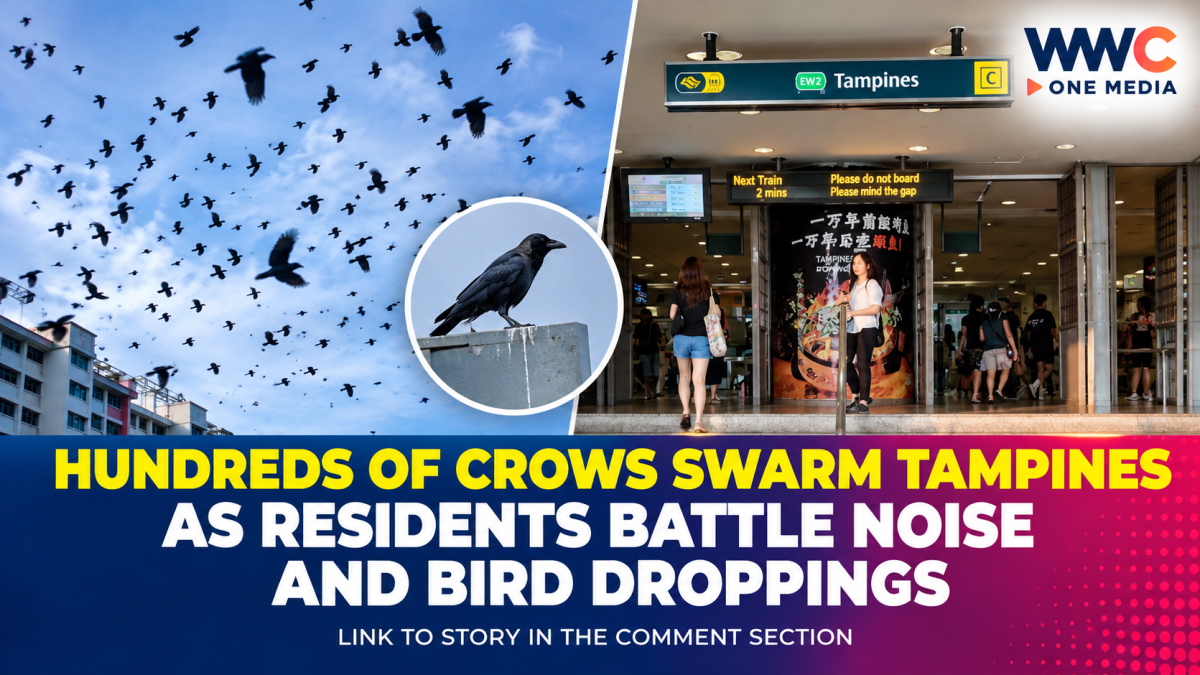
Residents living near Tampines MRT station are dealing with a growing crow problem, with hundreds of birds gathering around HDB blocks, rooftops and trees each evening, creating persistent noise and leaving bird droppings on clothes, cars and other surfaces.
Residents estimate that as many as 500 to 600 crows can gather in the area. During a visit on Sept. 13, large numbers were seen congregating around Block 242, nearby rooftops and trees. When startled, the birds reportedly take flight together, forming what residents described as a “black cloud” overhead.
Some residents said the problem has been developing for years. One 68-year-old resident said crows have been gathering in the area for almost a decade, while another resident complained that the birds can be particularly noisy in the early morning and around dusk when they return to roost.
The nuisance goes beyond the noise. Residents said bird droppings frequently land on laundry hung outside their homes and on vehicles parked nearby. Some residents have also expressed concern about being approached or attacked by crows, particularly when the birds are startled or protecting their young.
Singapore’s National Parks Board (NParks) said it is aware of the concerns around Block 242 and Tampines Community Plaza. The agency received an average of about 35 feedback cases a year relating to crows in the area between 2023 and 2025, and has already received more than 30 cases this year.
NParks said its observations show that the area around Block 242 serves as a pre-roosting site. The crows subsequently move to nearby locations, including Tampines Community Plaza and Tampines Skate Park, where they spend the night.
Authorities have already tried several measures, including pruning trees, removing nests and deploying crow traps. Residents, however, said the results have been inconsistent, with the birds continuing to return.
The Tampines situation comes amid a much larger rise in Singapore’s crow population. NParks has estimated that the country’s house crow population reached about 160,000 in 2024, compared with roughly 7,300 in 2016. The house crow is considered an invasive species and can affect native biodiversity.
Food availability is considered an important factor behind the population increase. A separate review by wildlife and conservation experts has pointed to accessible food waste in urban areas as one possible contributor to the growth of crow numbers.
NParks advises residents not to feed, chase, corner or approach crows, as this can cause them to become defensive. People who encounter an injured or distressed crow are advised to contact the Animal Response Centre rather than attempting to handle the bird themselves.
For Tampines residents, the issue now extends beyond an occasional nuisance. With large flocks repeatedly returning to the same urban areas, authorities and the town council are reviewing whether existing measures are effective enough to reduce the disruption caused by the birds.