
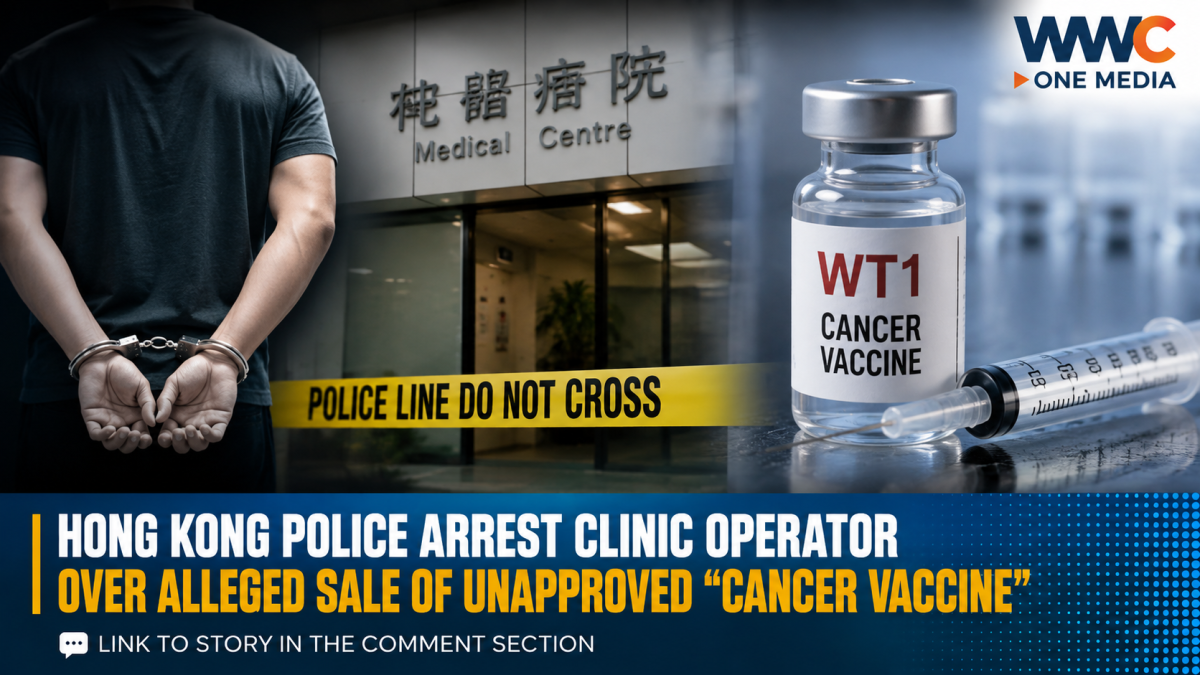
Hong Kong authorities have arrested a 28-year-old man linked to a clinic accused of selling or administering an unregistered product promoted as a vaccine capable of preventing more than 20 types of cancer.
The case has triggered a wider investigation involving the Hong Kong Department of Health (DH) and police, with authorities searching more than a dozen premises and seizing more than 50 suspected unregistered injections.
🚨 The product at the centre of the investigation
The product was marketed as a “WT1 cancer vaccine”, referring to Wilms’ tumour 1 (WT1), a protein that is legitimately studied as a target in cancer research.
But Hong Kong’s Department of Health has made clear that there is no registered WT1 vaccine in Hong Kong. The department also said it has found no relevant registration record for such a pharmaceutical product with drug regulators in mainland China or overseas.
According to authorities, the substance allegedly administered to customers was a German laboratory chemical containing WT1 intended for research purposes—not an approved medicine for injection into patients. The chemical itself is not registered as a medicine anywhere in the world, according to the SCMP report.
🔎 More than 50 injections seized—but authorities have NOT found the WT1 product
This is a critical distinction in the developing case.
Investigators searched more than 13 premises linked to the company and seized more than 50 suspected unregistered injections. However, Assistant Director of Health Frank Chan said the seized products were mostly vitamin-type healthcare products, and authorities had not yet located the suspected WT1 vaccine during the operation.
The seized injections were classified as Part I poisons under Hong Kong law.
Authorities said the investigation remains ongoing and more arrests could follow.
💰 A “one shot, multiple cancers” claim
The investigation follows reports that medical centres were advertising WT1 as a treatment or preventive vaccine against numerous cancers.
Hong Kong media investigations reported claims that the treatment could prevent more than 20 types of cancer, prevent recurrence and even combat cancer spread. One investigation reported a package priced at approximately HK$120,000 for three injections. Those claims have not been established by Hong Kong health authorities as legitimate medical treatment.
The Department of Health has specifically warned that advertising an unregistered product as protection against cancer can be misleading and potentially fraudulent, while healthcare professionals who mislead patients about its cancer-prevention or treatment effects could face professional consequences.
⚠️ Why health officials are concerned
The issue isn’t simply whether a product is registered.
The Department of Health warned that misleading cancer-treatment claims could cause patients to delay proven medical treatment, potentially putting their health at risk. The department has urged people to consult registered doctors and avoid injections involving unknown or unverified substances.
The case has also been referred to Hong Kong’s Medical Council because it may involve the professional conduct of registered medical practitioners. Customs has separately been notified over possible illegal importation of unregistered pharmaceutical products.
Important clarification
Despite the dramatic “cancer vaccine” claims, authorities have not said that anyone became ill after receiving the alleged WT1 product. As of September 2, officials said there had been no reported adverse reactions.
They are also still investigating exactly where the WT1 product came from and have not yet seized the alleged WT1 vaccine itself.
The 28-year-old suspect has been arrested, not convicted. Any allegations against him and other parties remain subject to investigation and due legal process.
🔍 The bigger question
Hong Kong’s crackdown raises a much larger concern: how many people may have been persuaded to pay for an unregistered cancer treatment before authorities intervened?
With investigators continuing to examine the clinics, products and advertising network, the full scale of the operation may not yet be known.
WWC ONE MEDIA J.M.D




Leave a Reply