
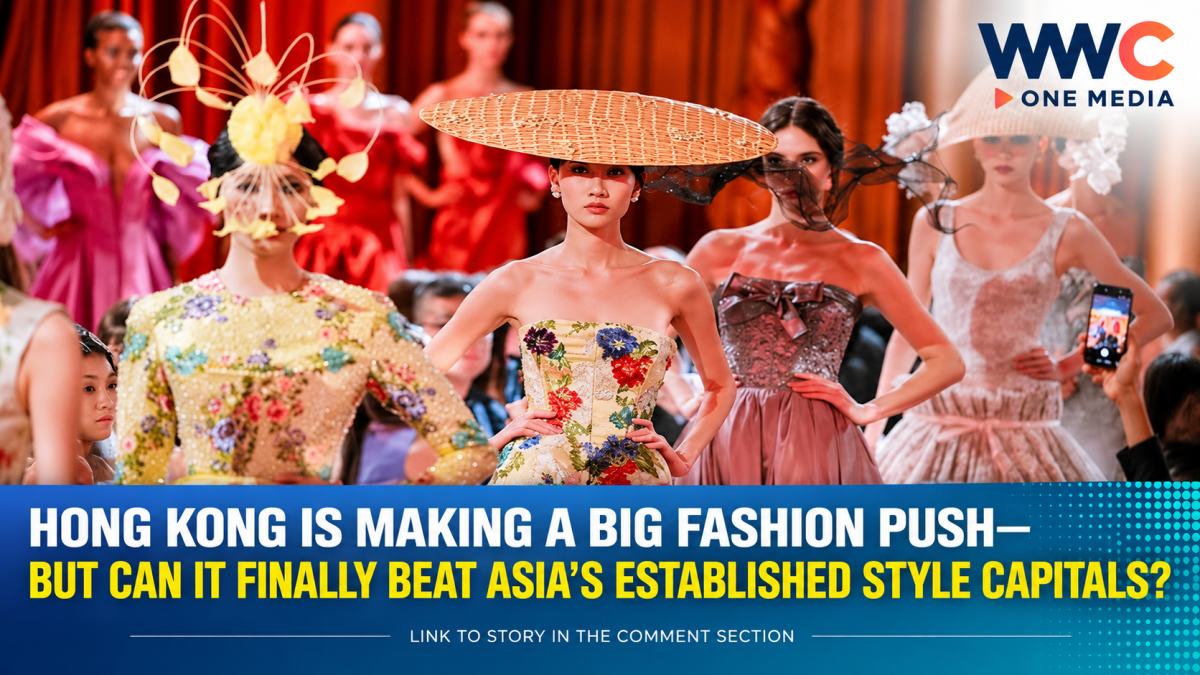
HONG KONG — Hong Kong is making an ambitious bid to strengthen its position as one of Asia’s leading fashion capitals, and a growing calendar of international showcases is giving the city a powerful new platform to prove it can compete with the region’s established fashion powerhouses.
The latest push comes through the third Hong Kong Fashion Fest, a two-week programme running from September 1 to 14, 2026, bringing together local and international designers, fashion labels, retailers, manufacturers and sustainability advocates across the city.
Organised under the Hong Kong government’s Cultural and Creative Industries Development Agency, the festival features eight flagship programmes and, for the first time, has been combined with CENTRESTAGE, the major fashion trade event organised by the Hong Kong Trade Development Council.
The strategy is straightforward: Hong Kong wants to transform its existing strengths in international business, retail, manufacturing and East-meets-West cultural exchange into a stronger fashion-design ecosystem.
But turning that ambition into a lasting global fashion reputation may be much harder.
A 270-brand showcase puts Hong Kong in the spotlight
One of the biggest attractions is CENTRESTAGE 2026, which ran from September 2 to 5 at the Hong Kong Convention and Exhibition Centre.
The event brought together around 270 brands from 24 countries and regions, with more than 40 events, including over 30 fashion shows, according to the Hong Kong Trade Development Council.
The scale is significant because Hong Kong is not simply trying to host another fashion exhibition.
Officials are positioning CENTRESTAGE and the wider Fashion Fest as a bridge between design, retail and business—giving designers a chance not only to showcase collections but also to meet buyers and potentially turn creative work into commercial opportunities.
That was one reason authorities shifted Hong Kong Fashion Fest to September this year, aligning it with CENTRESTAGE.
The goal, officials said, is to create greater synergy between fashion showcases and actual business opportunities.
Hong Kong designers are getting a bigger stage
The festival’s appeal isn’t limited to international brands.
Hong Kong designers including Mountain Yam, Angus Tsui, Kit Wan and Zidi have been among the local names featured during this year’s programmes.
At the Fashion Hong Kong runway show, the four labels presented Spring/Summer 2027 collections under the theme “Hong Kong Dopamine,” drawing inspiration from the city’s architecture, streets, cultural memories, lights and everyday urban life.
For designers, that creates an opportunity to turn Hong Kong itself into part of the fashion story.
The city has long had an international image, but the challenge has been converting that global exposure into a distinctive design identity that can travel beyond Hong Kong.
Mountain Yam, who has operated his label independently for more than a decade, told the South China Morning Post that Hong Kong’s combination of international exposure and understanding of the Chinese market gives local designers an advantage.
The government is betting on an East-meets-West advantage
Hong Kong’s pitch is different from simply trying to imitate Paris, Milan, London, Tokyo or Seoul.
Its strongest selling point is its position between mainland China and international markets.
The official Hong Kong Fashion Fest strategy describes the city as an “East-meets-West” centre capable of connecting designers and brands from Hong Kong, mainland China and overseas markets.
That positioning is also being reflected in this year’s programmes.
The “10 Asian Designers to Watch” initiative brings emerging talent from across Asia to Hong Kong, while Fashion Asia Hong Kong has expanded its programme to include exhibitions, runway presentations, awards and industry discussions.
Meanwhile, Fashion Summit Hong Kong 2026 focused on sustainability, innovation and technology, with industry leaders discussing how fashion can evolve alongside new technologies and environmental pressures.
But Hong Kong has a serious problem to solve
The biggest challenge is not attracting fashion events.
It is building an ecosystem that allows homegrown designers to survive, scale and become internationally recognisable brands.
Hong Kong has attempted to strengthen its fashion industry for years. Earlier assessments of the sector identified difficulties faced by independent designers, including the need for stronger business expertise, international market access and clearer industry direction.
Those challenges remain relevant even as the city’s fashion calendar becomes increasingly ambitious.
The competition has also become tougher.
Seoul, Tokyo and Shanghai have developed powerful fashion identities of their own, while global fashion brands increasingly have direct access to mainland China’s enormous consumer market.
That means Hong Kong cannot rely solely on its traditional role as a gateway to China.
It needs designers and brands that consumers around Asia—and eventually the world—actively seek out.
Seoul and Tokyo show how difficult the race is
The competition is particularly visible elsewhere in Asia.
Seoul Fashion Week continues to combine fashion with the enormous global reach of Korean pop culture, attracting thousands of visitors and using technology, entertainment and design to reinforce Seoul’s international creative identity.
Tokyo, meanwhile, continues to nurture emerging designers while trying to strengthen its international reach through global buyers, awards and overseas opportunities.
Hong Kong therefore faces a race in which fashion is no longer simply about clothing.
It is about culture, entertainment, technology, tourism, retail, social media and global storytelling.
Hong Kong is already taking its designers overseas
The city is also trying to ensure that its fashion ambitions don’t stop at the Hong Kong border.
In February, the Hong Kong Trade Development Council brought four Hong Kong labels to London Fashion Week, where the Fashion Hong Kong runway attracted more than 300 international buyers, media representatives and fashion professionals.
That international strategy could prove crucial.
A successful fashion hub needs more than impressive runway events at home. Its designers need international buyers, retail distribution, press coverage and customers willing to pay for their products.
A new retail experiment could bring fashion closer to consumers
Another new element of this year’s Fashion Fest is “Wear’s HK,” a city-wide fashion pop-up running from September 1 to 14.
The initiative brings 20 Hong Kong designer brands into six major shopping and fashion locations, effectively taking runway fashion directly into retail spaces.
The concept is built around a simple idea: see it, try it, wear it and buy it.
That connection between creative talent and consumers could be one of the most important pieces of Hong Kong’s fashion strategy.
The real test begins after the runway lights go out
The Hong Kong Fashion Fest has undoubtedly increased the city’s fashion visibility.
This year’s event has attracted hundreds of brands and created platforms for local designers, international labels and emerging Asian talent.
But a successful fashion capital is ultimately measured by what happens after the show.
Can Hong Kong designers build sustainable companies?
Can they expand into overseas markets?
Can they create brands with identities that consumers recognise without needing the words “Hong Kong” attached to them?
And can the city turn its unique combination of Chinese-market access and international connectivity into a fashion advantage that competitors cannot easily replicate?
Those questions will determine whether Hong Kong’s fashion push becomes a lasting transformation—or simply another impressive event on an already crowded Asian fashion calendar.
For now, however, the signal is unmistakable:
Hong Kong is no longer quietly talking about becoming Asia’s next fashion hub. It is building the runway to try to make it happen.
Why this story matters
Hong Kong’s fashion strategy is significant because the city is attempting to move beyond its traditional reputation as a shopping and commercial centre and strengthen its position as a creator of fashion, design and cultural influence.
The 2026 Fashion Fest is particularly notable because it brings together eight programmes, more than 300 local and international design entities, and CENTRESTAGE’s 270 brands from 24 countries and regions.
The government is also explicitly linking fashion to the broader creative economy, international cultural exchange and business opportunities.



Leave a Reply