
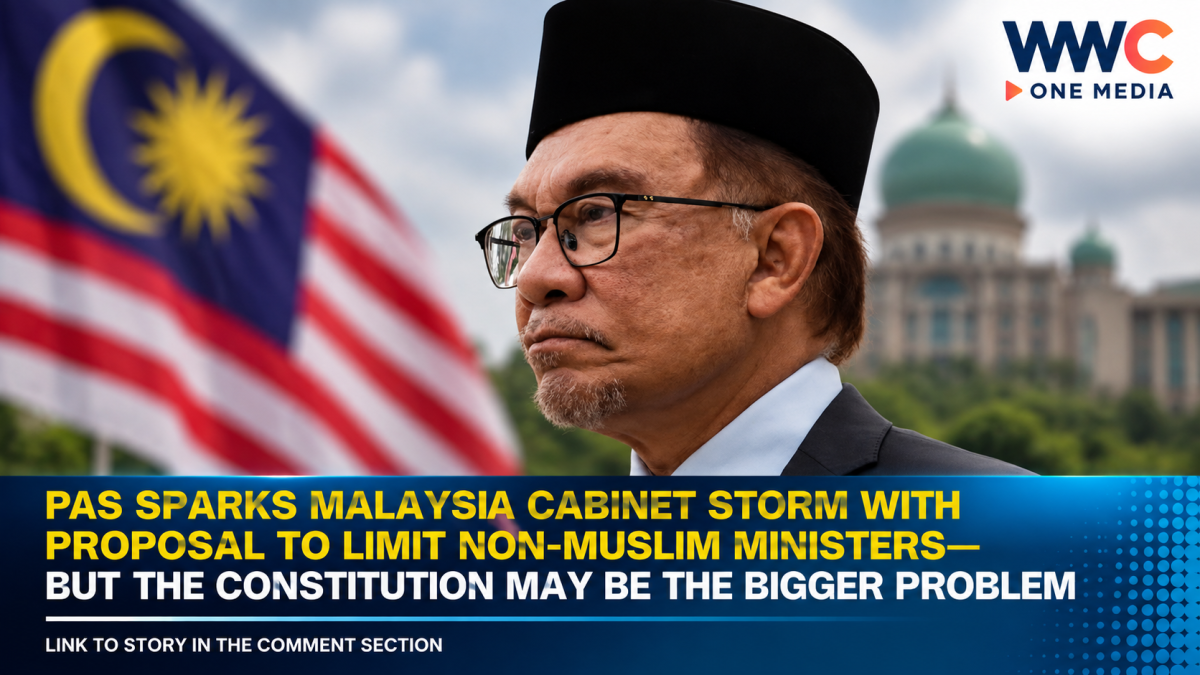
KUALA LUMPUR — Malaysia’s Islamist opposition party Parti Islam Se-Malaysia (PAS) is facing growing criticism after party president Abdul Hadi Awang said non-Muslims could serve as ministers under a PAS-led government, but should not control ministries responsible for formulating policies affecting Muslims.
The proposal, made during PAS’s 72nd annual muktamar in Kota Bharu, has triggered a fierce political and constitutional debate over whether ministerial responsibilities in Malaysia could legally be divided according to religion.
Hadi’s comments have drawn criticism from lawmakers and a major interfaith coalition, while PAS figures have defended the party’s position and said non-Muslims would not be excluded from government.
The controversy is significant because PAS is positioning itself for greater federal power ahead of Malaysia’s next general election.
What Hadi actually proposed
Hadi said a future PAS government would allow non-Muslims to become ministers, but their responsibilities would be limited to portfolios focused on implementing government policies rather than formulating policies affecting Muslims.
He cited the Works and Forestry ministries as examples of positions that could be held by non-Muslims.
Hadi argued that ministries involving the implementation of Islamic law would have to be headed by Muslims.
That distinction is at the heart of the controversy.
Critics say it effectively creates two categories of ministers—those who can determine government policy and those who can primarily execute it.
PAS says non-Muslims would not be sidelined
PAS has pushed back against the interpretation that its proposal would exclude non-Muslims from government.
Political aide and PAS leader Syahir Sulaiman said Hadi’s comments were open to interpretation and that the Works and Forestry portfolios were examples rather than a definitive list of ministries available to non-Muslims.
He also said that forming a Cabinet would require considering the views and agreement of different stakeholders.
The PAS Non-Muslim Supporters Wing has also defended Hadi’s position.
Its chief, BK Kumaresan, said the group was not offended and maintained that PAS would treat people fairly if it came to power.
PAS deputy president Tuan Ibrahim Tuan Man has likewise stressed that the party’s push for ummah unity should not be interpreted as sidelining the rights of non-Muslims.
Critics say the Constitution does not make such a distinction
The proposal has nevertheless triggered a sharp response from opposition lawmakers.
DAP leader Ramkarpal Singh, a former deputy law minister, argued that there is no constitutional basis for dividing Cabinet responsibilities according to race or religion.
He pointed specifically to Article 43 of Malaysia’s Federal Constitution, which provides for the formation of the federal Cabinet, and Article 8, which establishes equality before the law.
Ramkarpal described Hadi’s proposal as divisive and argued that Malaysia’s Cabinet has historically reflected the country’s multiracial character.
He also challenged non-Muslim parties within Perikatan Nasional, including Gerakan, to state publicly whether they support Hadi’s position.
Interfaith council raises constitutional concerns
The Malaysian Consultative Council of Buddhism, Christianity, Hinduism, Sikhism and Taoism (MCCBCHST) has gone further, calling Hadi’s proposed restrictions unconstitutional.
The council argued that Malaysia’s constitutional framework protects equality and minority rights and said a government structure based on separate religious roles would conflict with those principles.
It also pointed to earlier statements by Hadi, including his reported 2018 discussion of a possible two-Cabinet arrangement under a PAS government.
Importantly, those are the council’s legal and political arguments, not a court ruling that Hadi’s latest proposal itself is unconstitutional.
Why the Federal Constitution matters
Malaysia’s Federal Constitution is the country’s supreme law, and questions involving the limits of federal and state legislative powers have repeatedly reached the courts.
In the landmark Nik Elin case in 2024, Malaysia’s Federal Court struck down 16 provisions of Kelantan’s state Syariah criminal enactment after finding that the state legislature had exceeded its constitutional lawmaking powers.
The case is relevant to the current debate because it reinforced the principle that Islamic lawmaking powers are still subject to the constitutional division of powers.
It does not, however, directly decide whether Hadi’s proposed Cabinet arrangement would be lawful.
That question would depend on the actual constitutional and legal mechanism used by any future government.
PAS is looking beyond its traditional strongholds
The controversy comes as PAS seeks to strengthen its position as a potential national governing party.
The party has been increasingly focused on federal power and on expanding its appeal beyond its traditional Malay-Muslim base.
CNA has reported that PAS is positioning itself for the next general election while attempting to widen its national appeal.
That makes the Cabinet debate particularly politically sensitive.
Malaysia is a multiethnic and multireligious country, and questions involving Islam, political representation and the rights of non-Muslims can quickly become national political issues.
PAS currently holds substantial political influence through the opposition Perikatan Nasional coalition and controls several state governments, giving its proposed model of governance greater significance than a purely theoretical policy discussion.
Hadi has raised similar ideas before
The current controversy also echoes Hadi’s earlier statements.
In 2018, he was reported as saying that a PAS government could have one Cabinet responsible for national policy and another executive structure involving non-Muslims to implement those policies.
The latest proposal is therefore not entirely new.
What has changed is the political environment.
PAS is now openly campaigning for a larger role in federal government, making its ideas about Islamic governance subject to much greater national scrutiny.
The political calculation behind the proposal
For PAS, the issue reflects a broader question: how far can the party push its Islamic governance agenda while convincing non-Muslim Malaysians that they would still have a meaningful role in government?
For its opponents, the concern is different.
They argue that restricting ministerial authority based on religion could undermine Malaysia’s established system of coalition politics and power-sharing.
The debate could also put pressure on PAS’s partners within Perikatan Nasional, particularly parties seeking support from non-Muslim voters.
What happens next?
Hadi’s remarks do not automatically change Malaysia’s Cabinet structure.
PAS would first have to win enough parliamentary support to form a federal government. It would then have to operate within the Federal Constitution and the existing legal framework.
The controversy is therefore about PAS’s proposed model of governance, rather than an immediate change to Malaysia’s Cabinet.
But the political implications could be substantial.
If PAS gains greater federal power at the next general election, questions about who can formulate policy, who can hold major ministries and how Islamic governance would interact with Malaysia’s constitutional framework would move from campaign rhetoric into actual government policy.
For now, Hadi’s proposal has opened a much bigger question:
Can PAS pursue a more explicitly Islamic model of government while maintaining Malaysia’s constitutional commitment to a multiracial and multireligious political system?
That question could become one of the country’s defining political battles ahead of the next election.




Leave a Reply