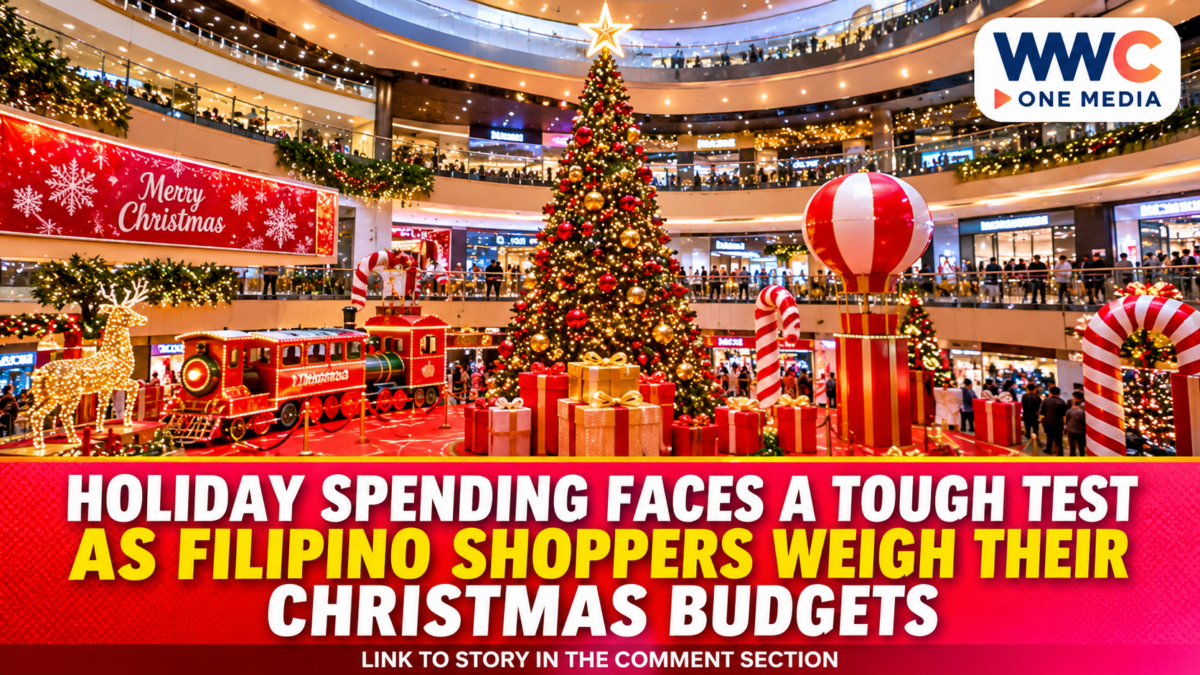
The public records point to a more measurable story than a simple prediction about Christmas sales: SM Investments reported higher nine-month revenue and profit, while the latest official inflation data show that household purchasing power remains under pressure. I’m grounding the article in those disclosures rather than treating comments reported elsewhere as verified company statements.
SM Investments Corporation’s latest financial disclosures show that its retail business entered the final quarter of 2026 with higher sales and earnings, even as Philippine households faced rising prices and slower economic growth. The company’s results offer a useful measure of how major retail operations are performing ahead of the Christmas shopping period.
The figures reveal a mixed picture: SM Retail’s revenue increased by 5.4% in the first nine months, but national household consumption grew by only 2.4% in the third quarter, while inflation accelerated to 7.8% in October.
For shoppers, the numbers point to a holiday season in which purchases may continue, but household budgets remain an important constraint. For retailers, the challenge is converting seasonal demand into actual sales without assuming that stronger store traffic automatically means bigger spending per customer.
SM Retail’s Sales and Earnings Move Higher
SM Retail recorded ₱335.3 billion in revenue for the first nine months of 2026, up 5.4% from ₱318.1 billion in the same period last year, based on the financial disclosures of parent company SM Investments Corporation.
Its net income increased 7.2% to ₱13.1 billion, while operating income rose 12.4% to ₱20.8 billion.
The performance indicates that the retail business maintained growth across a period marked by economic uncertainty. It also shows that the company was able to increase earnings faster than revenue during the reporting period.
Food retail remained a major contributor. The food group recorded ₱202.2 billion in sales, up 6.5%, with net income rising 7.5% to ₱8.4 billion.
Specialty stores generated ₱68.1 billion in sales, a 5% increase, while net income climbed 10.6% to ₱4.3 billion.
The SM Store reported ₱75 billion in sales, up 2.3%, with growth led by its kids category. Its net income increased 11.7% to ₱2 billion.
These results suggest that demand was not limited to one type of merchandise. Essential goods, household products and selected discretionary categories all contributed to the retail group’s performance.
However, the figures cover January to September. They do not establish how much Filipinos will spend during November and December, traditionally important months for retailers.
Holiday Spending Meets a More Expensive Household Budget
The latest inflation figures provide a reason to be cautious about expectations for holiday spending.
The Philippine Statistics Authority reported that headline inflation accelerated to 7.8% in October 2026, from 7.2% in September. Average inflation from January to October reached 5.6%.
Transport prices were a major source of pressure, with the transport index rising 20.1% year on year. Housing, water, electricity, gas and other fuels increased 9.3%.
Food and non-alcoholic beverages recorded 6.1% inflation, slower than September’s 6.7%, but prices in the category were still higher than a year earlier. Philippine Statistics Authority+1
For households, this distinction matters.
A slower increase in food prices does not mean groceries have become cheaper. It means prices are rising at a slower pace than before.
Families dealing with higher transport, electricity and food expenses may have less money available for clothing, gadgets, dining and other holiday purchases.
That pressure could encourage shoppers to compare prices more closely, prioritise necessities and wait for promotions before making larger purchases.
WWC ONE MEDIA previously examined how demand for affordable groceries has become more important as household budgets tighten in its report on O!Save’s expansion to 1,000 stores amid rising inflation.
Household Consumption Is Growing More Slowly
The broader economic picture also highlights the challenge facing retailers.
The PSA reported that Philippine gross domestic product expanded by 2.1% year on year in the third quarter of 2026. Household final consumption expenditure, which measures spending by households on goods and services, increased by 2.4%.
That was slower than the 4% growth recorded in the same quarter of 2025. Philippine Statistics Authority+1
Household consumption remains central to the retail industry because purchases by families support supermarkets, department stores, restaurants and other consumer-facing businesses.
When consumption growth slows, retailers may need to work harder to attract customers and encourage purchases.
It does not necessarily mean that shoppers have stopped spending. Rather, the pace of growth suggests that household demand is expanding more slowly than it did a year earlier.
This is relevant to the Christmas season because retailers typically prepare inventory, staffing and promotional campaigns ahead of the busiest shopping period. A weaker spending environment can make those decisions more difficult.
The wider economic slowdown has also been discussed in WWC ONE MEDIA’s coverage of the Philippines’ 2.1% third-quarter GDP growth and rising inflation.
SM Retail Plans More Store Openings Before Year-End
Despite the uncertain environment, SM Investments’ third-quarter report outlined continued expansion across its businesses.
For the fourth quarter of 2026, SM Retail plans to open around 100 to 150 stores across various formats as it continues strengthening its omnichannel capabilities.
The planned openings indicate that the company is maintaining its expansion programme rather than relying only on existing stores to generate growth.
New locations can increase customer access and extend a retailer’s reach into additional communities. They can also create operating costs, including staffing, inventory and store maintenance.
The commercial outcome will depend on whether new outlets attract sufficient demand to support their operating requirements.
The company’s expansion plans also come as mall operators continue investing in physical retail and customer experiences. WWC ONE MEDIA previously examined the sector’s broader investment pipeline in its report on major Philippine mall developers and their planned ₱184-billion projects.
For SM, the combination of store expansion and mall activity provides several ways to reach consumers. But the number of new outlets alone will not determine whether the holiday season delivers stronger profitability.
What the Results Mean for Filipino Shoppers
The latest figures show why retailers can remain active even when household spending conditions become more difficult.
SM Retail’s revenue and earnings increased during the first nine months of the year. At the same time, national inflation accelerated and household consumption growth slowed.
These developments are not contradictory. A large retailer can increase sales through store expansion, product mix, higher transaction values or stronger performance in selected categories even when the wider economy faces pressure.
The figures also do not establish that every Filipino household is spending more. National economic indicators describe broad trends, while individual consumers experience different financial conditions.
For shoppers, the practical implication is to compare prices, check promotional terms and prioritise purchases according to household budgets.
For retailers, the holiday period will test whether stronger operating results can continue amid pressure on consumers’ purchasing power.
What Happens Next
The next important indicators will be the actual fourth-quarter results and the company’s disclosures covering the full year.
Those figures will help establish whether the Christmas period generated enough additional sales to sustain the growth recorded in the first nine months.
Investors and consumers will also be able to assess how the planned store openings contributed to the business and whether demand remained broad across food, department store and specialty retail operations.
Until those results are available, the first nine months provide evidence of SM Retail’s performance, but not a guarantee of how the holiday season will end.
The central question is not simply whether Filipinos will shop for Christmas. It is whether retailers can turn seasonal purchases into stronger sales while households continue managing higher living costs.
Frequently Asked Questions
1. How much revenue did SM Retail generate in the first nine months of 2026?
SM Retail reported ₱335.3 billion in revenue for January to September 2026, up 5.4% from ₱318.1 billion in the same period of 2025.
2. How much did SM Retail’s net income increase?
SM Retail’s net income rose 7.2% to ₱13.1 billion during the first nine months of 2026.
3. How high was Philippine inflation in October 2026?
The Philippine Statistics Authority reported headline inflation of 7.8% in October 2026, up from 7.2% in September.
4. How fast did household spending grow in the third quarter of 2026?
Household final consumption expenditure increased 2.4% year on year in the third quarter, slower than the 4% growth recorded in the same quarter of 2025.
5. How many stores does SM Retail plan to open before the end of 2026?
SM Investments’ third-quarter report said SM Retail plans to open around 100 to 150 stores across various formats in the fourth quarter of 2026.