
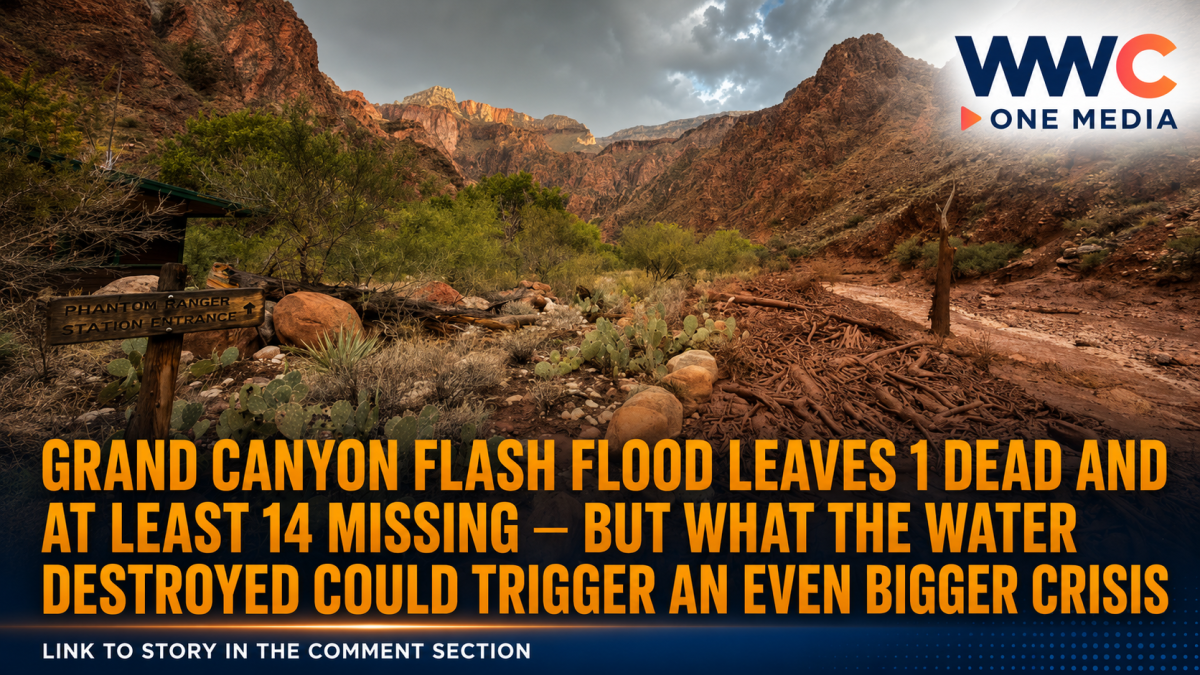
A violent flash flood tore through one of the Grand Canyon’s most heavily traveled inner-canyon corridors over the weekend, leaving one person dead, at least 14 others potentially missing or unaccounted for and a trail of destruction that could disrupt the national park long after the search operation ends.
The flooding struck the Bright Angel Canyon and Phantom Ranch area at about 2:30 p.m. Saturday, August 29, after intense rainfall sent torrents of water, mud, boulders and debris rushing through the narrow canyon toward the Colorado River.
By Sunday evening, the National Park Service said one person had been recovered from the river, according to ABC News. Authorities had reduced the number of people potentially missing or unaccounted for to at least 14 as officials continued trying to determine who had been inside the canyon when the flood struck.
That represents an important update from earlier reports — including the initial CNA/AP account — which said approximately 15 people were unaccounted for and that no injuries had been reported at that stage.
More Than 60 People Airlifted From the Canyon
The scale of the emergency became apparent quickly.
The National Park Service said 62 people had been evacuated by helicopter from Phantom Ranch and the lower North Kaibab Trail by Sunday morning, with additional evacuations planned from Phantom Ranch and Cottonwood Campground.
Evacuees were transported to the Maswik Lodge Cafeteria on the Grand Canyon’s South Rim, where the American Red Cross was assisting those displaced by the disaster.
Witnesses described a scene that changed within minutes.
Hiker Parth Desai told the AP that his group saw the creek flooding as waterfalls appeared suddenly around them and mud, boulders and landslides swept through the canyon. At one point, the hikers scrambled uphill into cactus-covered terrain as a wall of debris approached.
Another camper, Erica Viola, said she and dozens of hikers watched Bright Angel Creek rapidly swell as debris — including what appeared to be part of a building — moved downstream before the group was eventually evacuated by helicopter.
ABC News reported witnesses describing an even more dramatic surge through the campground, with campers running for higher ground as floodwater and debris swept through the area.
Nearly Every Footbridge Across Bright Angel Creek Was Destroyed
The flood did far more than strand hikers.
According to the National Park Service, nearly all footbridges spanning Bright Angel Creek were destroyed, cutting hiking routes across the waterway and causing extensive damage to trails, utilities and other infrastructure.
Phantom Ranch, Bright Angel Campground, the Phantom Ranch Canteen and cabins, and the entire North Kaibab Trail between its trailhead and Phantom Ranch were ordered closed until further notice.
The flood also pushed metal structures and other debris into the Colorado River, initially forcing officials to suspend river traffic while conditions were assessed.
The National Park Service’s latest hiking information continues to list Phantom Ranch, Bright Angel Campground and the entire North Kaibab Trail as closed because of the August 29 flooding.
Rain Fell Fast — and the Canyon Amplified the Danger
The disaster illustrates why relatively short bursts of rain can become extraordinarily dangerous inside the Grand Canyon.
National Weather Service meteorologist Justin Johndrow told the AP that roughly 1 to 2.5 centimeters — up to about one inch — of rain fell in roughly 30 minutes in the steep terrain.
“Most of it ran off instantly,” he said.
The Bright Angel drainage drops roughly 1,828 meters, or about 6,000 feet, from the North Rim toward the Colorado River, allowing runoff to accelerate through narrow terrain.
The San Francisco Chronicle, citing weather and stream-gauge data, reported that Bright Angel Creek rose more than five feet in about 10 minutes before the monitoring equipment was damaged.
Last Year’s Wildfire Left Another Risk Behind
There is another important piece of context.
The Dragon Bravo Fire affected several North Rim watersheds, including the Bright Angel Creek drainage.
The National Park Service had already warned that burned areas face a heightened threat from flash floods and debris flows during monsoon storms because runoff can race through steep watersheds within minutes. Such debris flows can carry mud, ash, rocks and trees far downstream.
That does not by itself establish that the wildfire caused Saturday’s disaster, but the burned landscape had been identified by park officials as particularly vulnerable to intense rainfall.
The San Francisco Chronicle reported that heavy thunderstorms dropped more than an inch of rain over recently burned terrain before the destructive flood developed.
A Second Crisis: The Grand Canyon’s Water Supply
The flooding has also created a major logistical problem above the canyon.
Officials said the flood extensively damaged the Transcanyon Waterline, the crucial system that moves water for use at the park.
With the pipeline out of operation and reserves limited, the National Park Service announced Stage 4 water restrictions on the South Rim beginning August 31.
The consequences are significant.
Overnight hotel accommodations inside Grand Canyon National Park are being halted for the foreseeable future, including rooms at El Tovar, Bright Angel Lodge, Maswik Lodge, Yavapai Lodge and other park properties.
Dry camping remains available, but campground water access is being sharply restricted. Day visitors can still enter the South Rim, while food services, the Grand Canyon Clinic and the post office remain operating, although some services could have reduced hours.
The pipeline was already a persistent infrastructure problem before this weekend. Earlier in August, the park imposed conservation measures following another Transcanyon Waterline break near Cottonwood Campground.
That means the flood has turned what began as a search-and-rescue emergency into a broader operational crisis for one of America’s most famous national parks.
Search Teams Still Face a Difficult Question
The greatest uncertainty now surrounds the people who have not yet been accounted for.
Officials have asked anyone who knows of hikers or backpackers who were inside the Bright Angel Creek corridor on August 29 to contact investigators.
That includes people who may have been hiking the North Kaibab Trail, staying at Bright Angel Campground or traveling through an area north of Phantom Ranch known as “the Box.”
Accounting for everyone inside the Grand Canyon can be unusually difficult. Cell reception is unreliable in much of the inner canyon, hikers may be traveling without continuous contact, and Saturday’s flood destroyed bridges and dramatically reshaped parts of the landscape.
Search teams therefore face two challenges at once: locating anyone who may actually be stranded or swept away, while determining whether some of those listed as unaccounted for had already left the affected area safely.
For families waiting for answers, that distinction is critical.
For the Grand Canyon, the consequences could stretch much further.
The flood has destroyed infrastructure, closed iconic hiking areas, disrupted the Colorado River corridor and crippled a water system serving visitors and residents.
And with the canyon’s steep terrain and wildfire-affected watersheds remaining vulnerable during storm season, the disaster raises a larger question: was Saturday’s flood an extraordinary event — or a warning of the risks the Grand Canyon may increasingly have to manage?

Leave a Reply