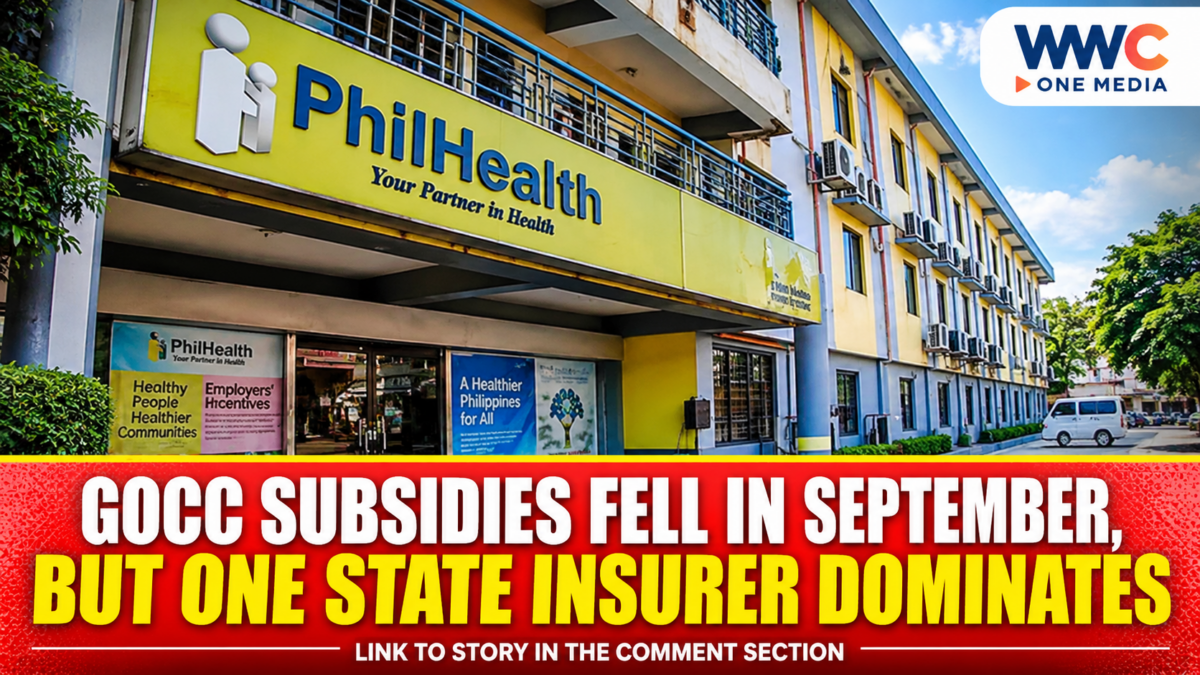
Government subsidies to government-owned and controlled corporations (GOCCs) declined in September 2026, but the bigger fiscal story is unfolding across the first nine months of the year: public financial support has already reached ₱197.919 billion, with the Philippine Health Insurance Corp. (PhilHealth) accounting for the largest share.
The Bureau of the Treasury’s September 2026 national government subsidy table shows that monthly assistance amounted to ₱6.132 billion, compared with ₱9.203 billion in September 2025. That represents a 33.36% year-on-year decline, even as cumulative releases continued to climb.
The figures reveal an important distinction in government spending. While the September decline suggests lower monthly releases to state corporations, the year-to-date numbers show that extraordinary funding movements and support for major public programmes have significantly increased the government’s overall financial commitments.
September Subsidies Declined as Major Government Corporations Received Less
The September figures show that the national government distributed substantially less financial assistance to state corporations than it did during the same month last year.
Of the ₱6.132 billion released, ₱540 million went to government financial institutions, ₱3.090 billion to major non-financial government corporations and ₱2.502 billion to other government corporations.
The largest reduction occurred in the major non-financial government corporation category.
This group received ₱3.090 billion in September 2026, compared with ₱6.812 billion during the same month in 2025.
Meanwhile, assistance to other government corporations increased slightly from ₱2.391 billion to ₱2.502 billion.
Government financial institutions also received ₱540 million, compared with zero recorded in September last year.
These figures indicate that the overall decline was concentrated in the major non-financial government corporation category rather than across every classification of state-owned institutions.
Irrigation Administration Received the Biggest September Allocation
The National Irrigation Administration (NIA) emerged as the largest individual recipient of government subsidies in September.
The agency received ₱2.319 billion during the month, representing approximately 37.8% of total government assistance released to GOCCs.
Other major recipients included:
- Philippine Crop Insurance Corp. (PCIC): ₱707 million
- National Dairy Authority (NDA): ₱681 million
- Social Housing Finance Corp. (SHFC): ₱540 million
- National Food Authority (NFA): ₱317 million
The remaining allocations were distributed among other government institutions included in the Treasury’s subsidy breakdown.
NIA’s position reflects the continuing importance of public funding for irrigation infrastructure and agricultural support.
Its subsidy receipts are particularly relevant because irrigation systems influence agricultural productivity, water availability and the ability of farmers to maintain crop production during changing weather conditions.
However, the subsidy figures alone do not establish how much additional irrigation capacity was completed or how effectively the money was spent.
Those questions require examination of project implementation reports, agency financial statements and government audit findings.
The distinction matters because receiving government assistance and delivering measurable public services are two different stages of public spending.
PhilHealth Accounts for the Biggest Share of 2026 Subsidies
Despite receiving no new subsidy in September, PhilHealth remained the dominant recipient of government financial support during the first nine months of 2026.
The Treasury recorded cumulative assistance of ₱118.555 billion for the state health insurer.
That amount represents approximately 59.9% of the ₱197.919 billion in total GOCC subsidies recorded from January to September.
The breakdown shows two particularly significant releases.
PhilHealth received ₱60 billion in April, identified in the Treasury’s official table as the returned fund balance from unutilised subsidy remitted to the Bureau of the Treasury in 2024 following the Supreme Court ruling.
Another ₱58.555 billion was recorded in August.
Together, these two releases account for virtually the entire cumulative amount attributed to PhilHealth.
The figures also provide important context to the continuing public discussion about the management and utilisation of government healthcare funds.
As previously examined in WWC ONE MEDIA’s report on the ₱89.9-billion PhilHealth fund controversy, questions about unused government subsidies, the National Treasury and the financing of healthcare have remained significant issues in public policy.
The latest figures should not be interpreted as ₱118.555 billion in newly generated premium income or ordinary operating revenue.
The Treasury classifies these amounts as government subsidies, and the April footnote specifically identifies the ₱60-billion entry as a returned fund balance.
That distinction is essential when evaluating the health insurer’s financial position.
Nine-Month Subsidies Climbed 149% Despite September’s Decline
The September slowdown becomes more interesting when viewed alongside the cumulative figures.
From January to September 2026, government subsidies to GOCCs reached ₱197.919 billion, compared with ₱79.454 billion during the corresponding period in 2025.
The increase amounted to ₱118.465 billion, equivalent to approximately 149.09%.
The distribution across recipient categories provides a clearer picture of where the money went.
Other government corporations received ₱163.931 billion during the nine-month period.
Major non-financial government corporations received ₱32.313 billion, while government financial institutions obtained ₱1.675 billion.
PhilHealth’s ₱118.555-billion allocation explains much of the increase in the other government corporations category.
Other notable cumulative recipients included:
- NIA: ₱15.788 billion
- NFA: ₱10.285 billion
- Food Terminal Inc. (FTI): ₱10 billion
- Power Sector Assets and Liabilities Management Corp. (PSALM): ₱8 billion
The figures show that government support was concentrated in a relatively small number of institutions, particularly PhilHealth.
They also demonstrate why a single month’s decline should not automatically be interpreted as a broader reduction in government financial commitments.
A large one-time or exceptional release can substantially change the annual picture even when subsequent monthly disbursements become smaller.
What the Numbers Reveal About Government Spending
Government subsidies to GOCCs serve different purposes depending on the institution receiving the assistance.
Some support agencies responsible for essential public services, while others finance programmes involving agriculture, infrastructure, healthcare and government operations.
The Treasury’s classification provides information about the amounts released, but it does not independently measure whether each recipient achieved its intended objectives.
For taxpayers, the more important question is how these releases translate into actual services.
For example, larger support for PhilHealth should be examined alongside benefit coverage, claims payments and the insurer’s ability to meet its obligations.
Likewise, allocations to NIA and NFA should be assessed against their respective responsibilities involving irrigation, agricultural production and food security.
This is also where government transparency becomes important.
The administration has already institutionalised the COMPASS platform through Executive Order No. 126, providing a framework for public monitoring of budget allocations, obligations and disbursements.
As discussed in WWC ONE MEDIA’s coverage of the government’s COMPASS spending-monitoring portal, improved access to government expenditure information could help citizens examine how public money moves through government institutions.
The importance of transparency also connects with the business community’s calls for stronger accountability in the 2027 national budget.
For government corporations, the challenge is not simply obtaining funding. It is demonstrating that public assistance produces measurable results.
What Happens Next?
The next important development will be the publication and examination of subsequent Treasury subsidy figures.
These will help determine whether September’s lower releases represent a continuing slowdown or simply a temporary adjustment following substantial earlier disbursements.
The government will also need to account for the distinction between recurring operational assistance and exceptional financial transactions when assessing its support for state corporations.
PhilHealth will remain particularly important to this discussion because its cumulative allocation represents the largest portion of the 2026 subsidy total.
Meanwhile, agencies involved in agriculture, food security and infrastructure will face continuing pressure to demonstrate how government funding supports their respective mandates.
For policymakers and taxpayers, the figures provide a starting point for evaluating the government’s financial relationship with state-owned institutions.
The real measure of success, however, will be whether these billions of pesos translate into better public services, stronger institutional performance and more accountable use of taxpayer money.
Frequently Asked Questions
1. How much did government subsidies to GOCCs receive in September 2026?
The national government released ₱6.132 billion in subsidies to government-owned and controlled corporations in September 2026.
2. Why did GOCC subsidies decline in September?
The decline was largely reflected in lower allocations to major non-financial government corporations, which received ₱3.090 billion compared with ₱6.812 billion in September 2025.
3. Which government corporation received the largest subsidy in 2026?
PhilHealth was the largest recipient during January to September 2026, with cumulative government subsidies reaching ₱118.555 billion.
4. How much did the government spend on GOCC subsidies from January to September 2026?
Total subsidies reached ₱197.919 billion, representing a 149.09% increase from ₱79.454 billion during the same period in 2025.
5. Does a government subsidy mean the corporation is losing money?
Not necessarily. Government subsidies can support operational requirements, specific programmes and public-service obligations. Receiving a subsidy does not automatically establish that a corporation is financially unprofitable or poorly managed. Its financial condition must be evaluated using its financial statements and other relevant records.