
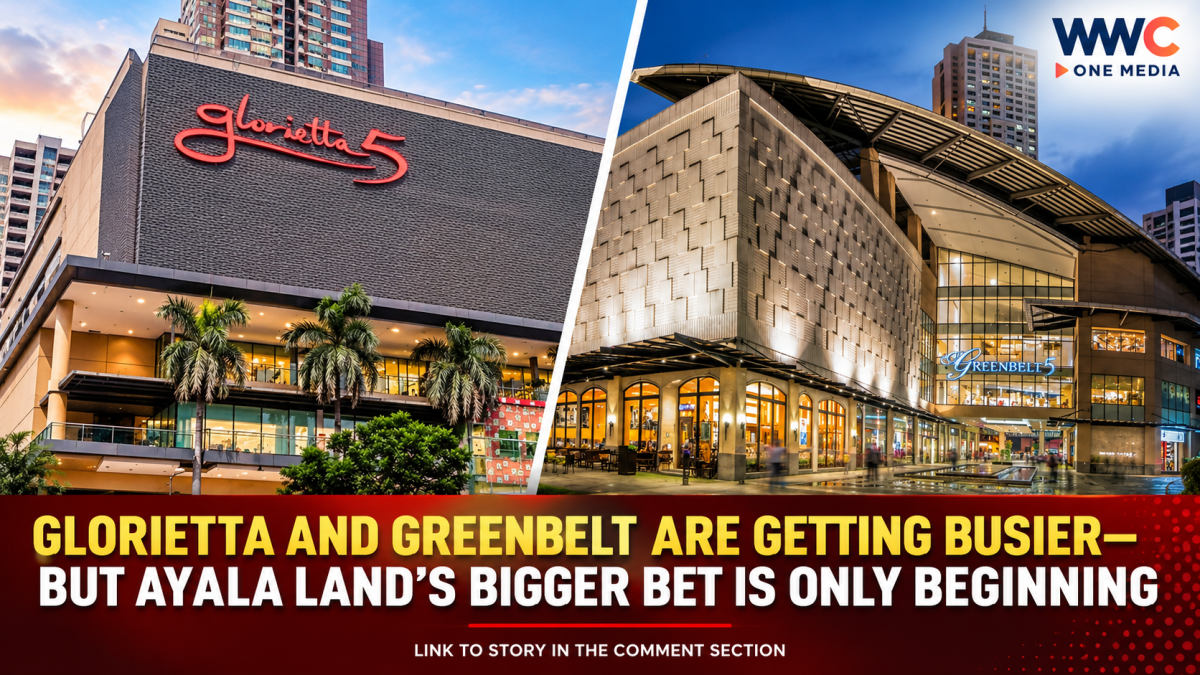
MANILA, Philippines — Ayala Land Inc. (ALI) is beginning to see the payoff from its multibillion-peso makeover of some of the country’s most established malls, with higher shopper traffic, stronger same-mall revenues and improved occupancy giving fresh momentum to its leasing business.
The company’s shopping-center portfolio reached a 90% lease-out rate in the first half of 2026, up from 87% a year earlier. At the same time, same-mall revenues increased 7% while visitor footfall climbed 5%, signaling stronger activity across its retail properties. Mall EBITDA margin remained at a robust 61%.
The improvement comes as ALI moves into the next stage of its mall strategy: maximizing the upgraded properties rather than simply spending on construction and refurbishment.
Glorietta, Greenbelt emerge from major transformation
Glorietta and Greenbelt are among four flagship Ayala malls included in the company’s major reinvention program, alongside TriNoma and Ayala Center Cebu.
The first phase of the program began in 2024 and was designed to modernize older properties, improve customer experience, refresh facilities and rethink the mix of merchants occupying the malls.
Ayala Land originally earmarked roughly ₱13 billion for the reinvention of its flagship malls, part of a broader strategy to unlock more value from existing properties in prime locations. The company has emphasized that the program is not simply about making the malls look newer—it also involves improving circulation, open spaces, amenities and the tenant mix.
The strategy appears to be gaining traction.
According to recent reports, ALI is now focusing increasingly on attracting new merchants and improving tenant productivity as the physical transformation of its flagship properties reaches substantial completion.
Greenbelt gets a fresh identity
Greenbelt has been one of the most visible beneficiaries of the transformation.
The redevelopment includes the replacement of the decades-old Greenbelt 1 structure, which dates back to 1982, while other sections of the complex have undergone major upgrades.
Greenbelt 2 has also unveiled a significantly refreshed look, featuring more contemporary interiors, expansive glass areas and stronger connections between indoor and outdoor spaces while retaining the greenery that has long defined the Makati destination.
The changes are also being accompanied by a new mix of retail and lifestyle concepts, including international luxury brands and new dining and entertainment offerings.
The redevelopment is intended to make Greenbelt more than a conventional shopping center by strengthening its role as a lifestyle and social destination in the Makati central business district.
Glorietta is also being repositioned
Glorietta, another long-established Makati retail landmark, is undergoing its own transformation.
The upgrades include improvements to interiors and cinemas, changes to circulation and the introduction of additional spaces designed to improve the overall customer experience.
The broader objective is to make the mall easier to navigate while creating more reasons for shoppers to stay longer and return more frequently.
That matters because Ayala Land is increasingly treating its malls as “social infrastructure”—places where retail, dining, entertainment, work and community activities converge rather than simply destinations for shopping.
The numbers suggest the strategy is working
The latest performance figures provide an early indication that the reinvention program is translating into stronger mall economics.
ALI reported that its shopping-center portfolio achieved a 90% lease-out rate in the first half of 2026. Same-mall revenues rose 7%, while visitor traffic increased 5%.
The improvement is particularly significant because some of the malls were still undergoing renovations during the period.
Earlier in 2026, Ayala Land said its shopping-center business had already delivered revenue growth despite the disruption caused by reinvention projects. For full-year 2025, shopping-center revenues reached ₱24.2 billion, up 5% year-on-year, according to the company’s earnings discussion.
The company therefore appears to be moving from a period of heavy reinvestment toward one focused on higher occupancy, stronger tenant sales and better returns from existing assets.
But Ayala Land isn’t stopping at renovations
The mall makeover is only one part of Ayala Land’s broader shift toward recurring income.
The company is also expanding its retail footprint, with roughly 200,000 square meters of new retail gross leasable area expected to be delivered in 2026.
Ayala Malls Arca South has already opened, while Ayala Malls Gatewalk in Mandaue City, Cebu is targeted to open in December. Additional redevelopment is also planned for properties including Ayala Malls Abreeza, MarQuee Mall and Cloverleaf.
Ayala Land’s strategy is increasingly centered on building a larger and more productive leasing portfolio, which provides recurring income that can help balance the more cyclical nature of property development.
A major bet on existing locations
The logic behind the strategy is straightforward: instead of relying exclusively on new developments, Ayala Land is reinvesting in properties that already occupy prime locations and have established customer bases.
Its own redevelopment framework describes the projects as a way to revitalize existing assets while making better use of scarce land in major urban centers. The company is also incorporating energy-efficient systems, expanded open areas and other sustainability measures into the redevelopment.
Greenbelt 1’s redevelopment is also backed by a ₱12.87-billion sustainability-linked financing package from the International Finance Corp., which supports both the Greenbelt project and Ayala Malls Evo City.
The bigger picture
The stronger mall numbers are encouraging, but they should not be mistaken for a complete turnaround in Ayala Land’s overall business.
ALI reported ₱11.5 billion in net income for the first half of 2026, down 19% from ₱14.2 billion a year earlier, while revenues declined to ₱75 billion from ₱83.1 billion. However, leasing and hospitality remained a bright spot, with combined first-half revenues rising 9% to ₱25.2 billion.
That contrast explains why the performance of Glorietta, Greenbelt and other upgraded malls is attracting attention.
The question is no longer whether Ayala Land can spend billions to reinvent its malls. The bigger test is whether the newly upgraded destinations can sustain higher traffic, stronger tenant sales and higher rental income for years to come.
For shoppers, the transformation means newer spaces, fresh brands and more lifestyle experiences.
For Ayala Land, however, the stakes are much bigger: turning some of the Philippines’ most recognizable malls into higher-performing engines of recurring income.
WWC ONE MEDIA J.M.S

Leave a Reply