
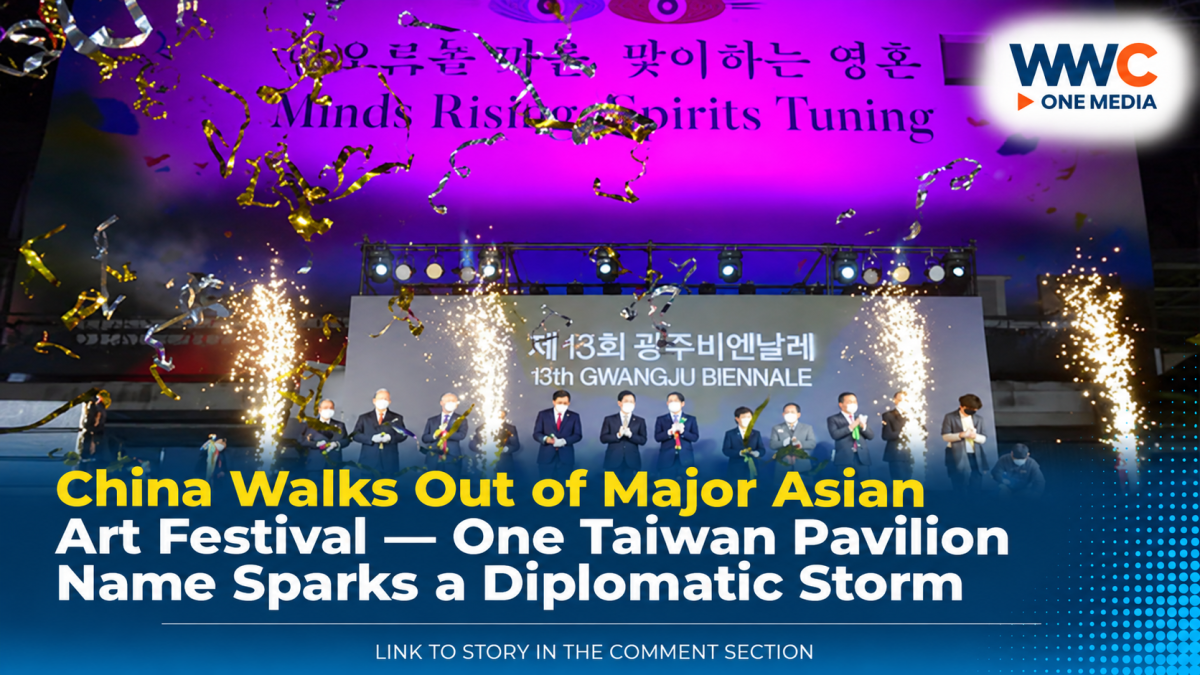
A major Asian art festival has been pulled into a growing China-Taiwan diplomatic dispute after Chinese artists withdrew from South Korea’s Gwangju Biennale, objecting to organizers’ decision to allow a Taiwanese exhibition to use the name “Taiwan Pavilion.”
The withdrawal came just as the 16th Gwangju Biennale was preparing to open in Gwangju, South Korea. The biennale is regarded as one of Asia’s leading contemporary art events and this year’s programme includes a separate Pavilion Project featuring national and institutional exhibitions.
Why did China pull out?
The dispute centres on how the Taiwanese exhibition is identified.
The exhibition is associated with Taiwan’s National Taiwan Museum of Fine Arts (NTMoFA). Organizers had initially used the designation “NTMoFA Pavilion,” but the name was later changed back to “Taiwan Pavilion” following objections from the Taiwanese side and participating artists.
China strongly objected to the change.
Chinese Foreign Ministry spokesperson Guo Jiakun said Beijing considers the designation incompatible with its position that Taiwan is part of China and described the move as a violation of the One China principle. China said it had lodged representations with the South Korean side and called for the decision to be corrected.
The Chinese exhibition team subsequently announced that it would withdraw from the biennale in protest.
The Chinese pavilion had been preparing an exhibition involving artists and cultural institutions, but installation work was halted after the naming dispute intensified.
Taiwan had its own objections
The controversy did not begin with China.
Taiwanese participants had previously objected when the Gwangju Biennale changed the exhibition’s name from “Taiwan Pavilion” to a designation based on the National Taiwan Museum of Fine Arts.
The participating curator and artists argued that the change was made without their consent and amounted to political censorship. The Gwangju Biennale Foundation disputed aspects of that account, saying its naming decision was connected to its agreement with the museum.
After further discussions, the foundation approved the use of “Taiwan Pavilion.”
That decision then triggered Beijing’s protest.
South Korea tries to contain the fallout
The controversy has placed South Korea in an awkward position.
Seoul maintains diplomatic relations with Beijing and officially adheres to the One China position. However, South Korea’s Foreign Ministry has emphasized that the pavilion naming decision was made by a nongovernmental cultural organization and does not represent a change in the government’s Taiwan policy.
The ministry expressed hope that the dispute would not damage South Korea-China relations or broader exchanges between the two countries.
The Gwangju Biennale Foundation has also expressed regret over the controversy.
At a press conference marking the opening of the event, foundation chief executive Youn Bum-mo said he had hoped the Chinese artists would remain involved until the last moment and described their withdrawal as deeply disappointing.
The dispute goes beyond the art world
What began as a dispute over an exhibition label has increasingly become entangled with broader tensions surrounding Taiwan’s international status.
Beijing regards Taiwan as part of its territory and strongly opposes international events using terminology that could suggest Taiwan is a separate sovereign state.
Taiwan, meanwhile, operates its own government and participates in many international cultural, sporting and other events under different names depending on the organization and circumstances.
The Gwangju episode highlights how even cultural events can become caught between those competing political positions.
And the fallout may not end with the biennale.
South Korean media have reported that Chinese participation in other events in the country has also been affected by the dispute, including a planned Guangzhou delegation visit. There have also been reports of uncertainty surrounding Chinese participation in a promotional pavilion at the upcoming Yeosu World Island Expo.
The bigger question
The Gwangju Biennale itself is continuing despite the Chinese withdrawal.
The 16th edition features the main exhibition alongside its Pavilion Project, with dozens of national and institutional participants. The festival is scheduled to run from September 5 to November 15, 2026.
But the controversy has placed an uncomfortable spotlight on the intersection of art, diplomacy and Taiwan’s disputed international status.
A name intended to identify an exhibition has now become the centre of a diplomatic confrontation — raising a larger question about how much political pressure international cultural events can withstand before the politics begins to overshadow the art itself.
Editorial accuracy note: This story should be described as a withdrawal or boycott by Chinese artists/the Chinese exhibition team, not as China “banning” the Gwangju Biennale. There is also no evidence that South Korea has changed its official Taiwan policy. The “Taiwan Pavilion” designation refers to the exhibition’s presentation and does not by itself establish South Korean diplomatic recognition of Taiwan as an independent state.
WWC ONE MEDIA J.M.D




Leave a Reply