
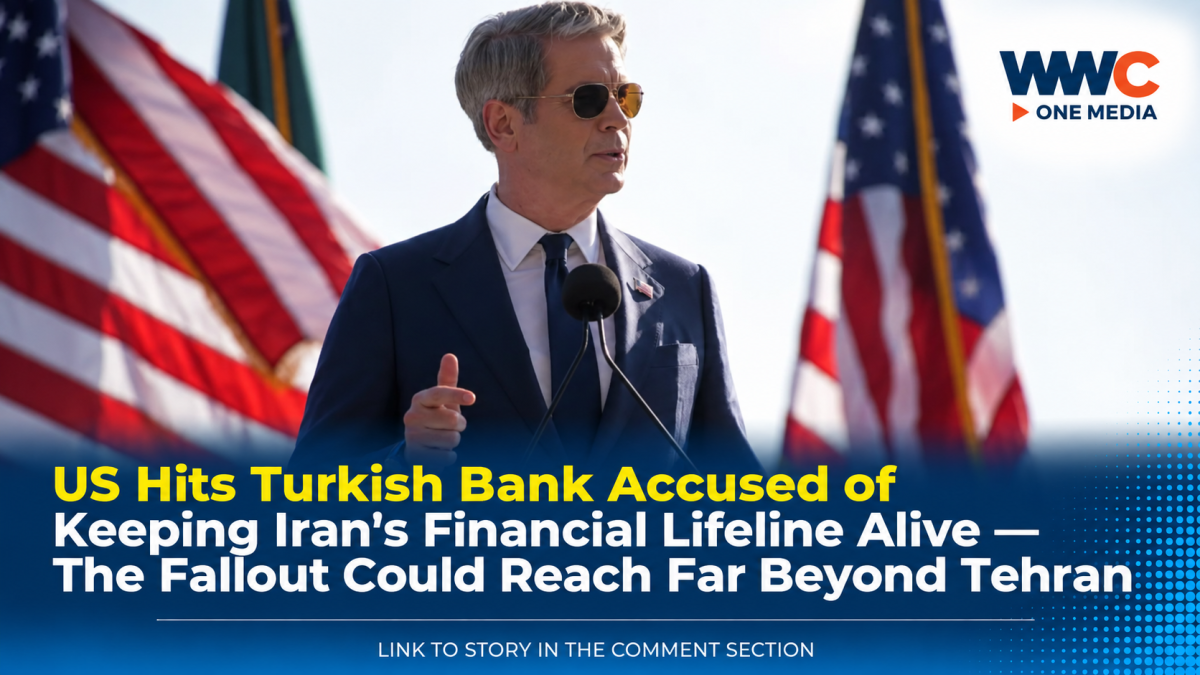
WASHINGTON — The United States has imposed sanctions on a Turkish financial institution and two of its subsidiaries, accusing them of helping maintain an important financial channel for Iran as Washington intensifies its campaign to squeeze Tehran economically.
The US Treasury Department announced on Sept. 4 that it had designated Istanbul-based Golden Global Yatirim Bankasi Anonim Sirketi, along with Golden Global Varlik Kiralama Anonim Sirketi and Golden Global Portfoy Yonetimi Anonim Sirketi.
Washington described Golden Global Bank as a key correspondent-banking link for Iranian financial networks, saying it had facilitated tens of millions of dollars in transactions involving Iran’s Islamic Revolutionary Guard Corps-Qods Force (IRGC-QF).
The action is part of the Trump administration’s broader “Operation Economic Outcast,” an intensified campaign designed to cut off financial channels that Washington says enable the Iranian government to generate, move and access money internationally.
Washington’s allegations
According to the Treasury, Golden Global Bank played a role in a network used to transfer Iranian oil revenues from China to Turkey.
The department alleges that the proceeds could then be converted into cash and gold through money exchangers linked to Iran’s so-called “rahbar” network.
Treasury also accused the bank of knowingly providing correspondent-banking services to Iranian financial institutions and accounts controlled by the IRGC-QF and its proxies.
One of the networks identified by Washington has links to Turkish businessman Sitki Ayan, whose network was sanctioned by the US in 2022 over alleged involvement in hundreds of millions of dollars in oil sales connected to the IRGC-QF.
These are US government allegations underlying the sanctions, not independent findings of criminal guilt.
Golden Global rejects the accusations
Golden Global Bank has rejected the US allegations and said it has complied with Turkish and international banking and compliance requirements.
The dispute therefore puts the bank at the centre of a much broader confrontation between Washington and Tehran over Iran’s ability to earn and move foreign currency.
What the sanctions mean
The three entities were added to the US Treasury’s sanctions framework, effectively restricting their access to the US financial system.
Under the sanctions, property and interests in property belonging to designated entities that are in the United States or controlled by US persons are generally blocked.
US persons are also generally prohibited from conducting transactions involving blocked property unless an authorization or exemption applies.
Treasury also issued a general license allowing transactions to wind down, giving affected parties a period to terminate certain existing dealings rather than requiring every transaction to stop instantly.
Foreign financial institutions can also face significant risks if they knowingly facilitate certain transactions involving sanctioned parties, including potential exposure to US secondary sanctions.
That is where the wider impact could emerge.
Why target a Turkish bank?
Golden Global may not be the largest financial institution involved in Iran’s international trade, but Washington’s strategy is increasingly focused on the intermediaries that allow money to move between jurisdictions.
Turkey is particularly significant because it is a major regional financial and commercial hub while maintaining substantial economic ties with Iran.
By targeting a bank in Turkey, Washington is sending a warning not only to Iranian institutions but also to financial institutions in third countries that continue handling Iranian-related transactions.
Sanctions experts cited by RFE/RL described the move as potentially important for its deterrent effect, encouraging other banks to reconsider the risks of maintaining Iranian business relationships.
Part of a much larger pressure campaign
The Golden Global action comes only days after Washington targeted operations of Egypt’s Banque Misr in the United Arab Emirates over alleged dealings connected to Iran.
Treasury Secretary Scott Bessent has indicated that the administration intends to continue rolling out measures against financial institutions involved in Iran-related transactions.
Reuters reported that Bessent had said the Treasury was likely to introduce new secondary sanctions on a regular basis, initially concentrating heavily on banks.
The campaign reflects a broader attempt by Washington to make international financial institutions calculate whether doing business with Iran is worth the possibility of losing access to the US financial system.
But will it actually cripple Iran?
That remains a much bigger question.
Iran has spent years developing alternative financial channels designed to operate around US sanctions. These include networks involving banks, money exchangers, front companies and other intermediaries across multiple countries.
Targeting one institution can therefore disrupt a particular route without necessarily eliminating the broader network.
RFE/RL cited sanctions specialists who said the Golden Global designation could serve as a warning to other financial institutions, but cautioned that greater financial “de-risking” would not automatically be enough to break Iran’s economy.
The pressure could nevertheless become more significant if additional banks and financial intermediaries decide that handling Iranian transactions carries too much regulatory and commercial risk.
The next financial pressure point
For Iran, the stakes extend beyond one Turkish bank.
The country’s ability to convert oil income into usable foreign currency and move those funds across borders is a crucial part of its economic survival under sanctions.
For Washington, the objective is increasingly clear: identify the institutions that keep those channels open and make them choose between Iranian business and access to the US-led international financial system.
The latest sanctions therefore may be less about the size of Golden Global itself and more about the message being sent to every bank still willing to handle Iranian money.
And if Washington follows through on its promise of more sanctions, Golden Global may be only the beginning.
Accuracy & editorial note
The sanctions were announced by the US Treasury on Sept. 4, 2026. The allegations concerning Golden Global Bank’s role in Iranian financial networks come from the US government. Golden Global has rejected the allegations and said it complies with applicable banking and compliance requirements. The sanctions should therefore not be described as proof that the bank committed a crime.
It is also more accurate to say the US sanctioned a Turkish bank and two subsidiaries, rather than saying Washington sanctioned Turkey itself. The measure targets specific entities, not the Turkish government or the entire Turkish banking sector.
WWC ONE MEDIA J.M.D




Leave a Reply