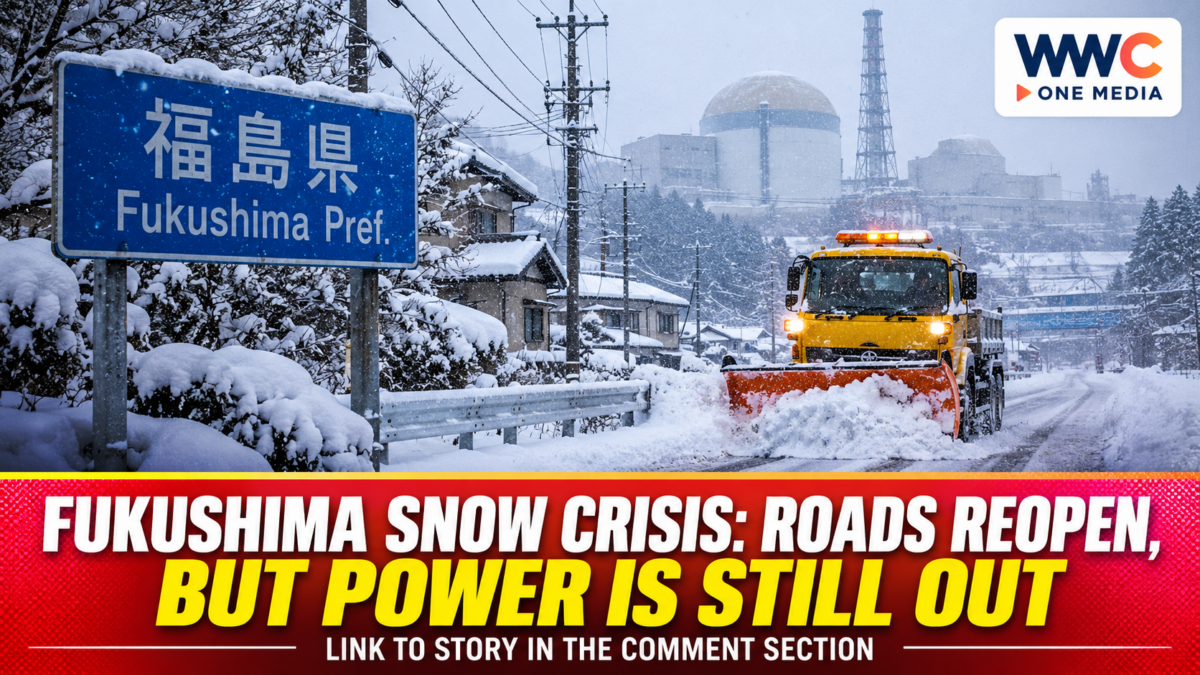
Road access to much of Kitashiobara Village in Japan’s Fukushima Prefecture was restored on 22 November after heavy snowfall and fallen trees blocked key routes, leaving hundreds of households and accommodation facilities cut off. But the reopening did not end the emergency: the village still reported widespread electricity interruptions, communication problems and one remaining road closure in its latest update that evening.
The recovery marks an important shift for the mountainous Urabandai area, where residents and visitors had faced restricted access since the snowfall began on 20 November. The immediate challenge has moved from restoring the main road connections to bringing essential services back to normal.
The episode also shows why reopening a route does not necessarily mean a community has fully recovered. Electricity, telecommunications, local transport and safe access to individual districts can remain disrupted even after major roads become passable.
Fukushima snow emergency affected residents and visitors
The scale of the isolation was documented in Fukushima Prefecture’s disaster report dated 21 November, which recorded 514 households and 948 residents in ten Kitashiobara districts as isolated. The report also listed 450 accommodation guests in the affected area.
The districts included Hinohara, Kanayama, Wasezawa, Nagamine, Kotakamori, Sohara, Kengamine, Hebidaira, Akimoto and Onogawa. The figures show that the incident affected more than a single settlement or a small number of stranded travellers.
The same prefectural report recorded no deaths, missing people or injuries in Kitashiobara at the time of its assessment. Those figures were a snapshot from 5 p.m. on 21 November, not a final assessment of every possible impact.
The village’s location in the Urabandai area is important to understanding the disruption. Its accommodation facilities and tourism activity mean that road closures can affect both local households and people staying in the area.
For residents, the problem was access to everyday necessities. For visitors, it meant being unable to leave as planned while roads remained blocked.
Which roads reopened, and which remained closed?
Kitashiobara Village’s 22 November update provided a detailed picture of the road situation at 7 p.m.
National Route 459 reopened between the Urabandai Roadside Station, the Kengamine intersection and Nagasaka in Inawashiro Town. The village noted that some sections were operating under alternating one-way traffic.
The Aizuwakamatsu-Urabandai Prefectural Route also reopened between the Urabandai roadside station and Wasezawa, again with partial one-way traffic. A section of the Yonezawa-Inawashiro route between the Kengamine intersection and Kotakamori was also cleared.
However, the entire road network was not yet back to normal. The village said the Yonezawa-Inawashiro route between Wasezawa and Kotakamori remained closed.
The municipality also reported that fallen-tree removal and snow-clearing work on Lakewood Street, a village road, had been completed.
This distinction is important for motorists. The reopening of the main access routes did not mean every road was unrestricted. Drivers still needed to follow traffic controls and check the latest local notices before travelling.
The village’s update also stated that large vehicles could use the reopened routes, but warned that some sections remained subject to alternating traffic.
Electricity and communications remained the bigger problem
The most significant unresolved issue in the village’s 7 p.m. update was electricity. About 900 households remained without power, with Tohoku Electric Power Network carrying out restoration work.
That figure was higher than the approximately 700 affected households recorded in the prefecture’s earlier 21 November disaster report. The two numbers refer to different reporting times, so they should not be treated as contradictory final totals.
Communications were also affected. The village said NTT Docomo service had recovered in the northern Hinohara area, including Hinohara, Kanayama and Wasezawa. SoftBank connections, however, remained unavailable in affected areas as the company worked on the problem.
The earlier prefectural report had listed 200 telephone lines and 570 optical-fibre lines unavailable in parts of Kitashiobara. Those figures provide an indication of how the disruption extended beyond electricity.
Water service had improved in some locations. The village said an interruption affecting certain municipal housing units had been resolved, although water service at Lakewood remained disrupted.
The local community bus serving the Hinohara and Urabandai districts was also scheduled to remain suspended for the entire day on 23 November. Other listed local bus routes were operating normally.
Emergency supplies and local safety measures
The village arranged the distribution of emergency food and drinking water at the Urabandai Joint Government Building. Its notice listed distribution until 7 p.m. on 22 November, with service scheduled to resume at 8:30 a.m. on 23 November.
The municipality also issued practical warnings while power restoration continued. Residents were advised to use warm clothing and blankets, rely on flashlights for lighting where possible, and take care when using candles or other open flames.
It specifically warned people to stay away from fallen trees and hanging electrical wires. These hazards can remain dangerous after snow-clearing crews have reopened roads.
The prefecture’s earlier disaster report also recorded the suspension of sections of the JR Banetsu West Line after a fallen tree collided with a train between Kitakata and Yamato stations on 20 November. The report stated that no injuries occurred in that incident, but rail operations remained suspended at the time of its publication.
The road reopening therefore represented only one part of a wider recovery effort involving electricity, communications and transport.
Why reopening a road is not the same as full recovery
The Fukushima incident highlights a practical weakness in measuring disaster recovery solely by whether a major road has reopened.
A road connection can restore access for emergency services, supply vehicles and residents. But households still face difficulties if electricity, telephone networks or water systems remain unavailable.
The same distinction matters in other countries. WWC has previously examined how motorists were stranded for hours on the NLEX during severe flooding, showing how transport disruptions can affect people even when the wider road network remains operational.
In another report, a road closure in Benguet following a landslide illustrated the safety assessments and clearing work required before motorists can use a damaged route again.
WWC has also reported on the collapse of a bridge in Tarlac during prolonged rainfall, another example of how weather-related incidents can interrupt access to communities and businesses.
These events are different in cause and scale, but they share a common lesson: restoring movement is only one measure of recovery. Essential services and the safety of the remaining routes matter just as much.
What happens next
The next priority in Kitashiobara is the restoration of electricity and communications, alongside continued checks on roads that remain closed or operate under traffic restrictions.
The village’s latest published update in the records reviewed for this report was dated 22 November at 7 p.m. It listed the remaining road closure, the power interruptions and the communication problems. It also provided the next schedule for emergency food and drinking-water distribution.
Residents and travellers should consult the municipality and Fukushima Prefecture for updated road conditions before setting out. The situation can change as clearing and utility restoration work progresses.
The main access crisis has eased, but the recovery is not complete. For the affected households, normal life will depend on more than the return of passing traffic: electricity, communications and safe local access must also be restored.
Frequently asked questions
Where in Japan were residents isolated by the heavy snow?
The affected area was Kitashiobara Village in Fukushima Prefecture, particularly districts around the Urabandai area.
How many residents were isolated?
Fukushima Prefecture’s 21 November report listed 948 residents from 514 households, along with 450 accommodation guests, in the affected area.
When did the main roads reopen?
Kitashiobara Village reported that National Route 459 and several prefectural roads reopened at 6 p.m. on 22 November, with some sections operating under alternating one-way traffic.
Were all roads in the village open?
No. As of the village’s 7 p.m. update on 22 November, the Yonezawa-Inawashiro route between Wasezawa and Kotakamori remained closed.
Was electricity fully restored?
No. The village reported that about 900 households remained without electricity at 7 p.m. on 22 November, with Tohoku Electric Power Network working on restoration.