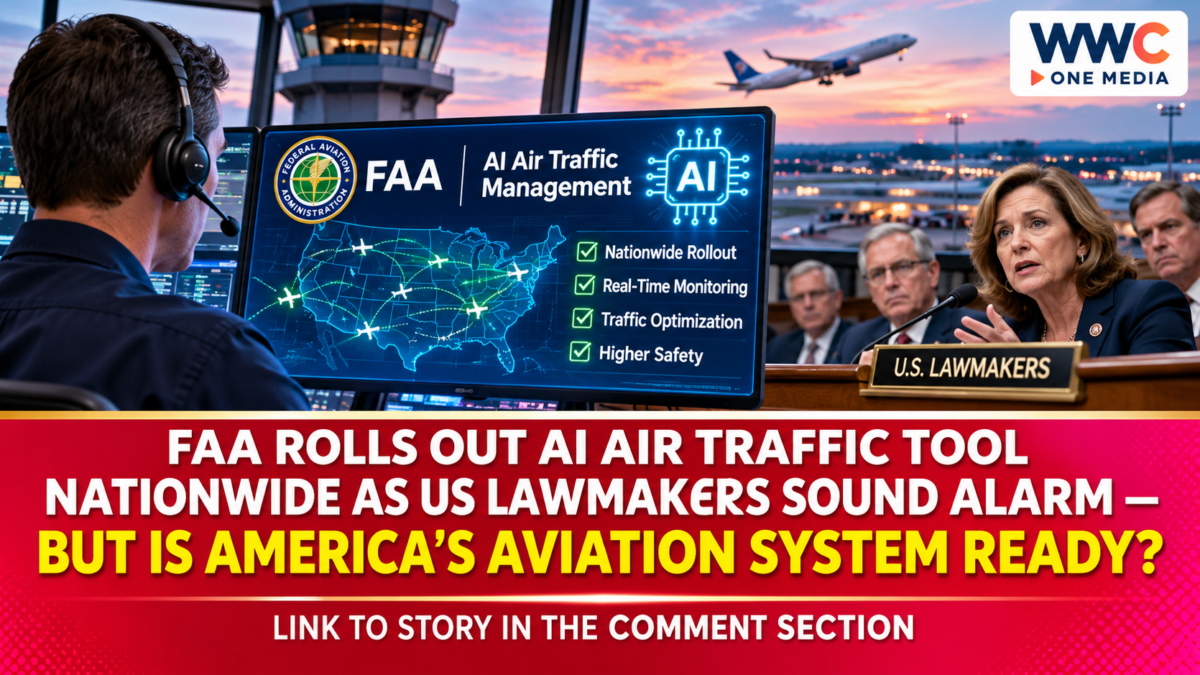
WASHINGTON, UNITED STATES — America’s ambitious effort to modernise its aviation infrastructure has entered a controversial new phase after congressional Democrats challenged the Federal Aviation Administration (FAA) over the nationwide expansion of its artificial intelligence-powered air traffic management system.
On Nov. 24, 2026, lawmakers demanded detailed explanations from FAA Administrator Bryan Bedford regarding the safety validation, operational reliability and implementation of the Strategic Management of Airspace, Routes, and Trajectories (SMART) platform.
The FAA AI air traffic system expanded to all 22 US air route traffic control centres on Nov. 10, just 50 days after its initial introduction in the Washington metropolitan region.
The expansion has intensified a broader debate over how quickly governments should integrate artificial intelligence into critical infrastructure, particularly when operational reliability and public safety are at stake.
While the FAA expects SMART to improve flight efficiency, reduce congestion and lower fuel consumption, lawmakers want greater assurance that its nationwide deployment was supported by sufficient testing.
FAA AI air traffic system faces congressional scrutiny
House Transportation and Infrastructure Committee Ranking Member Rick Larsen, Aviation Subcommittee Ranking Member André Carson, Representatives Alexandria Ocasio-Cortez and April McClain Delaney, alongside other congressional Democrats, are pressing the aviation regulator for greater transparency.
The lawmakers have requested responses to 13 principal questions by Nov. 30, 2026.
Their concerns include whether the FAA completed adequate safety assessments, how aviation personnel were prepared for the technology and whether the system has demonstrated sufficient reliability for nationwide operations.
The congressional challenge also focuses on the difference between the originally communicated 90-day validation period and the decision to expand SMART nationally after 50 days.
The dispute does not establish that SMART is unsafe. Instead, it highlights disagreements over the evidence necessary to justify deploying emerging technologies across a safety-critical transportation network.
What is the FAA’s SMART aviation system?
SMART is a cloud-based decision-support platform designed to improve the planning and coordination of air traffic.
The technology combines approximately 200 streams of information, including meteorological conditions, aircraft routes, traffic demand and controller staffing information.
Its objective is to identify potential operational problems before they develop into significant flight disruptions.
Rather than replacing air traffic controllers, SMART provides recommendations that aviation professionals can evaluate.
The FAA retains human oversight of the process, with local air traffic control leadership able to accept or decline the platform’s scheduling suggestions.
This distinction is important for passengers concerned about artificial intelligence entering aviation.
SMART is not an autonomous aircraft control system. Its purpose is to assist operational planning rather than directly fly aircraft or independently issue instructions to pilots.
The potential benefit is a more predictable aviation network in which congestion and weather-related restrictions can be addressed earlier.
However, the quality of those recommendations depends on reliable information, appropriate system validation and effective human supervision.
Early results suggest potential airline savings
The FAA’s Nov. 10 operational update identified several preliminary benefits from SMART’s initial deployment.
Since its introduction on Sept. 21, the system had helped reroute 180 flights, with the agency reporting average savings of 10 minutes and almost 80 gallons of fuel per flight.
For airlines, even modest improvements in routing efficiency could become financially meaningful if they can be consistently reproduced across large flight networks.
Reduced fuel consumption could help manage operating expenses, while improved scheduling could potentially minimise disruption to aircraft rotations, airport operations and connecting journeys.
Nevertheless, preliminary operational efficiency figures are not equivalent to comprehensive safety validation.
The system’s long-term commercial value will depend on whether its benefits remain consistent across different airports, traffic conditions and weather patterns without introducing unacceptable operational risks.
Nationwide ground stop intensifies infrastructure concerns
The congressional scrutiny comes after the United States experienced a nationwide aviation disruption on Nov. 13, 2026.
The FAA temporarily restricted departures following communications problems affecting multiple air traffic control centres.
The incident exposed the importance of reliable telecommunications infrastructure, as explored in WWC ONE MEDIA’s earlier coverage of the FAA nationwide ground stop and suspension of US flight departures.
The disruption also demonstrated how aviation infrastructure failures can affect industries beyond air transportation.
WWC’s coverage of college sporting events disrupted by the nationwide FAA ground stop illustrates the broader consequences of interruptions to domestic travel.
Importantly, the Nov. 13 incident has not been established as a failure of the SMART platform.
The fact that the nationwide AI expansion occurred three days before the ground stop does not prove a causal relationship.
The two developments nevertheless underscore the importance of ensuring that new software and existing telecommunications infrastructure can operate together reliably.
Air Space Intelligence and the business of aviation modernisation
On June 22, 2026, the FAA announced a contract award to Air Space Intelligence (ASI) covering two complementary aviation technologies.
The initiative includes Flow Management Data and Services (FMDS), which provides information and planning capabilities for managing air traffic demand, alongside the SMART enhancement.
The combined technologies are intended to improve the use of available airspace and reduce avoidable congestion.
For aviation technology developers, this represents an important application of artificial intelligence beyond conventional consumer software.
Unlike applications where an inaccurate recommendation might cause minor inconvenience, aviation decision-support platforms must operate within demanding reliability and accountability requirements.
Commercial success in this sector requires more than sophisticated predictive capabilities. It also requires dependable integration with existing systems, effective cybersecurity protections and the confidence of aviation professionals.
The infrastructure challenges surrounding this transition are further explored in WWC’s examination of the FAA telecommunications failure and unresolved technical questions.
What happens next?
The immediate milestone is the Nov. 30 deadline for the FAA to respond to congressional questions.
Beyond the initial performance figures, lawmakers are seeking evidence about system reliability, workforce preparation, security protections and contingency arrangements if SMART becomes unavailable.
These questions will help determine whether the programme’s expansion is supported by an appropriately robust operational framework.
For airlines and international passengers, the potential advantages of more efficient US airspace management are substantial. Improved predictability could benefit connecting journeys, aircraft scheduling and international aviation operations.
But those advantages remain dependent on reliable implementation.
Artificial intelligence may become an increasingly valuable component of modern aviation infrastructure. The challenge is ensuring that the pursuit of efficiency never comes at the expense of safety, accountability or public confidence.
America’s aviation modernisation programme now faces a defining question: can it demonstrate that technological progress and operational safety are advancing together?
Frequently Asked Questions
What is the FAA SMART system?
SMART stands for Strategic Management of Airspace, Routes, and Trajectories. It is an AI-enabled decision-support platform designed to improve air traffic planning and scheduling.
When did the FAA expand SMART nationwide?
The FAA announced its expansion to all 22 air route traffic control centres on Nov. 10, 2026.
Does SMART replace air traffic controllers?
No. SMART provides planning recommendations for aviation professionals. Human personnel retain decision-making authority.
Did SMART cause the November 2026 FAA ground stop?
No causal relationship has been established. The FAA identified communications problems as the reason for imposing the Nov. 13 nationwide ground stop.
Why are US lawmakers questioning the FAA’s AI deployment?
Lawmakers want additional evidence concerning safety assessments, system validation, controller training, cybersecurity, operational reliability and backup arrangements before and during nationwide implementation.