
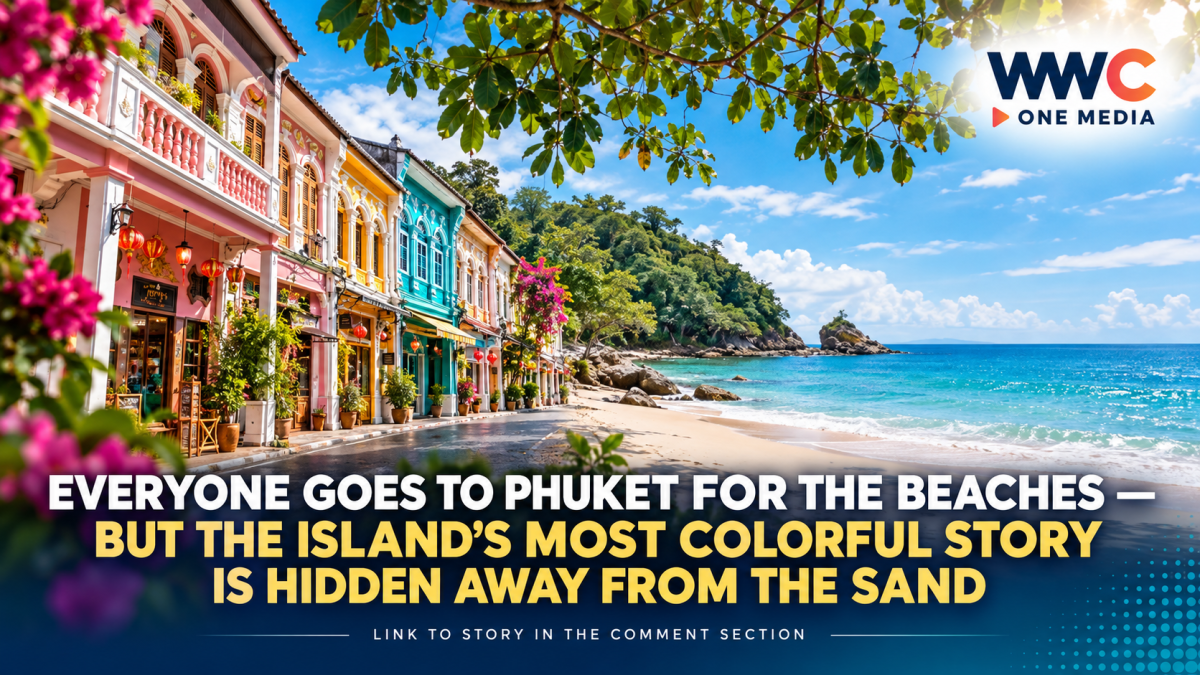
PHUKET, Thailand — Mention Phuket and the images almost write themselves: white-sand beaches, turquoise Andaman waters, sunset cocktails and resort-lined coastlines.
But travel away from the shore and another Phuket emerges — one built not around beach clubs but around tin, trade, immigration, food and a multicultural history that still survives in its streets.
That place is Phuket Old Town, the compact historic quarter that has become one of the island’s most rewarding cultural stops.
AsiaOne highlighted the neighborhood as an alternative to Phuket’s better-known beach experience, pointing visitors toward its museums, markets, restaurants and vividly restored shophouses. The bigger story, however, goes much deeper.
A town built on tin — and shaped by the world
Phuket Old Town owes much of its distinctive character to the island’s 19th-century tin boom.
The Tourism Authority of Thailand says mining helped turn Phuket into an important Andaman trading center, attracting Chinese workers and merchants as well as Indian, European and Muslim communities. Chinese migrants — many arriving through Penang — became especially influential in the island’s commercial and cultural life.
The legacy is still visible along streets such as Thalang Road, Dibuk Road, Krabi Road, Phang Nga Road and Yaowarat Road, where rows of narrow shophouses combine Chinese traditions with European architectural features.
The style is often described as Sino-Portuguese, although Thai tourism authorities also use the broader term Sino-European. Think arched windows, decorative stucco, wooden shutters, internal courtyards and façades painted in pink, yellow, turquoise and other pastel shades.
The buildings are only half the story
The most photogenic façades may draw visitors in, but Phuket Old Town’s deeper appeal lies in the people and communities that created them.
One of the best places to understand that history is Phuket Thai Hua Museum, housed in a historic building on Krabi Road. Its exhibitions explore the story of Phuket’s Chinese community and its role in the island’s development.
There is also a strong Baba-Peranakan heritage — the culture created through generations of interaction among Chinese migrants and communities across maritime Southeast Asia.
That identity isn’t simply being preserved behind museum glass.
In April 2026, Phuket Old Town hosted the Phuket Peranakan Festival 2026, with historic streets including Thalang, Yaowarat and Phang Nga roads transformed into cultural performance spaces. Then in August, the Chartered Bank intersection became the centerpiece of a projection-mapping event celebrating Baba-Peranakan history through light, animation, music and performance.
In other words, Old Town’s heritage remains very much alive.
Sunday changes everything
Visitors who want to see Phuket Old Town at its busiest should consider Sunday.
Every Sunday afternoon and evening, Thalang Road becomes the Lard Yai — or Phuket Walking Street — market, with food vendors, handicrafts, clothing, souvenirs and performers filling the historic street.
The Tourism Authority of Thailand lists the market as running from 4 p.m. to 10 p.m., although operating hours can change around public events or local conditions.
It is also one of the easiest places to sample Phuket without committing to a formal restaurant meal.
Visitors can move between grilled meats, seafood, sweets, drinks and southern Thai snacks while watching the streets change from pastel daylight to lantern-lit evening.
Phuket’s secret weapon may be its food
That food culture is not merely a tourist attraction.
Phuket has been a UNESCO Creative City of Gastronomy since 2015, with UNESCO highlighting the island’s combination of seafood, Thai cooking and Baba-Peranakan traditions.
Its cuisine reflects centuries of cultural exchange. Chinese, Malay and Thai influences appear in everything from noodle dishes and curries to sweets and breakfast foods. TAT notes that Phuket’s Baba-Peranakan cooking can move from sweeter Chinese-influenced flavors to the intense heat and aromatics associated with southern Thai and Malay cuisine.
And Phuket’s dining scene now carries serious international recognition.
The current Michelin Guide lists numerous Bib Gourmand restaurants across Phuket, including One Chun, Go Benz, A Pong Mae Sunee, The Charm Dining Gallery and Khao Tom Dibuk.
For something particularly local, O Cha Rot on Yaowarat Road remains Michelin-listed for its beef balls, sliced beef, fragrant broth and noodles — a reminder that some of Phuket’s most memorable meals come without resort-level prices or elaborate presentation.
Look beyond the Instagram façades
Yes, Phuket Old Town is highly photogenic.
Street murals, floral cafés, restored buildings and colorful alleys have helped turn the neighborhood into a social-media favorite. But treating the area simply as a backdrop for photos misses what makes it different from many carefully manufactured tourist districts.
This is a neighborhood in which temples, Chinese shrines, traditional businesses, cafés, museums and modern bars still sit surprisingly close together.
The Saeng Tham Shrine, tucked away near Phang Nga Road, is a particularly good example. Michelin’s Phuket guide traces the shrine to 1891, making it one of the historic religious landmarks hidden among Old Town’s commercial streets.
The trick is to slow down.
Instead of racing between photo spots, walk the side streets, look above the storefront signs, step into museums and shrines, and leave time for food.
There is also a modern tourism dilemma
Phuket’s spectacular tourism success has created challenges.
Reuters reported in 2025 that Phuket was generating more than 1,000 tonnes of waste per day, with booming tourism and construction putting increasing pressure on the island’s waste-management infrastructure.
That makes the way visitors experience places such as Old Town increasingly important.
Spending at small restaurants, community markets and locally run shops, walking where practical, limiting disposable plastics and respecting religious and residential spaces are small choices, but multiplied across millions of visitors they matter.
Why Phuket Old Town deserves more than a quick detour
Phuket’s beaches remain world-class. Nothing about Old Town changes that.
What it changes is the idea that Phuket is only a beach destination.
Behind the resort image is an island shaped by migration, mining wealth, trade routes and generations of Thai-Chinese and Peranakan families. Those stories survive in ornate windows and tiled floors, but also in noodle bowls, Sunday markets, Chinese shrines and family recipes.
For travelers willing to trade the sun lounger for walking shoes for a few hours, Phuket Old Town offers something the beach cannot:
a chance to understand how the island became Phuket in the first place.
And that may be the side of Phuket visitors remember longest.



Leave a Reply