
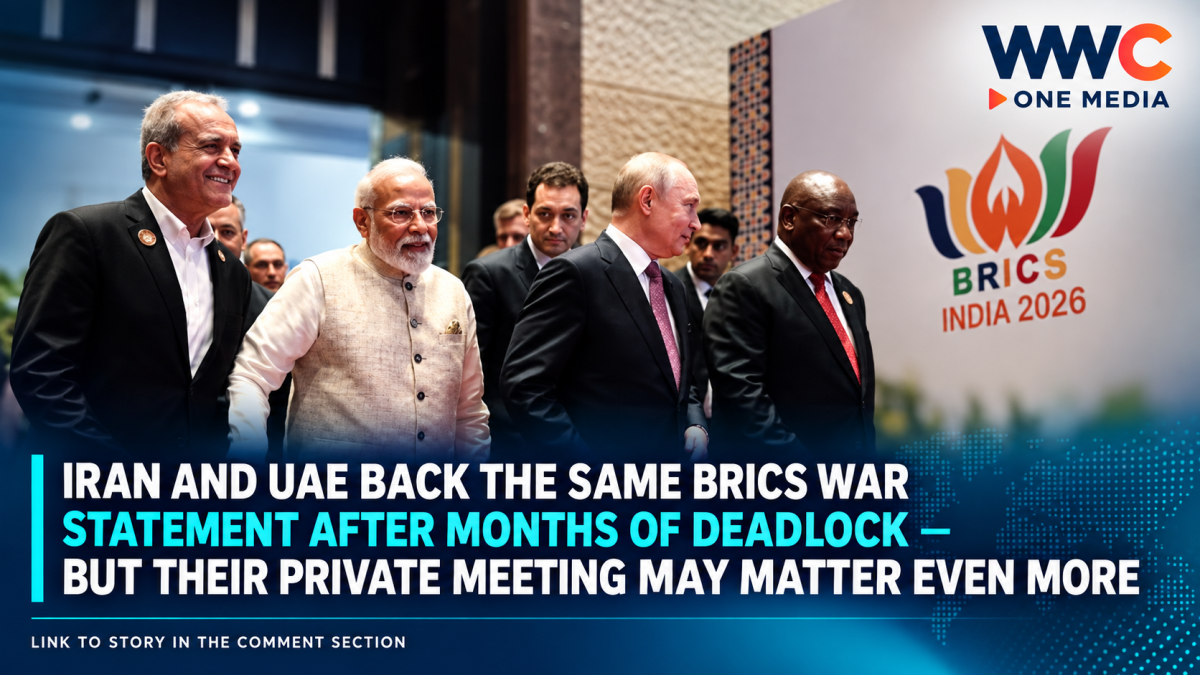
NEW DELHI — Iran and the United Arab Emirates have done something that proved elusive for months: they agreed to the same BRICS language on the Middle East conflict.
At the 18th BRICS Leaders’ Summit in New Delhi on Saturday, September 12, Iran and the UAE joined other members in adopting the New Delhi Declaration, which expressed deep concern over escalating tensions in the Middle East and called on the parties to exercise “maximum restraint” and avoid steps that could make the situation worse.
The wording may sound cautious. Diplomatically, however, getting Tehran and Abu Dhabi onto the same document was significant.
Earlier BRICS meetings had repeatedly exposed sharp divisions between Iran and the UAE over the war, leaving the bloc unable to agree on a common position. In April and again during a May foreign ministers’ meeting in New Delhi, disagreements over how to describe the conflict prevented members from producing a unified statement.
This time, they found language both sides could accept.
Pezeshkian and Abu Dhabi crown prince meet face to face
The political signal went beyond the declaration.
Iranian President Masoud Pezeshkian met Sheikh Khaled bin Mohamed bin Zayed Al Nahyan, Crown Prince of Abu Dhabi, on the sidelines of the summit — the highest-level direct engagement between the two countries since the current conflict began, according to Reuters.
UAE reporting said the two sides discussed regional and international developments and emphasized efforts to ease tensions, encourage de-escalation and strengthen regional stability.
No ceasefire agreement or broader diplomatic settlement was announced. But the meeting offered a rare direct channel between governments whose relationship has been severely strained by the fighting.
That distinction is important: New Delhi produced diplomatic movement, not a peace deal.
Why the agreement matters after months of division
The Iran-UAE dispute had become one of the clearest tests of whether an expanded BRICS could still reach consensus on major security crises.
During the May foreign ministers’ meeting, Iran wanted stronger language condemning what Tehran described as U.S. and Israeli aggression. The UAE, meanwhile, sought recognition of Iranian attacks affecting Gulf states.
The disagreement was so sharp that BRICS issued a chair’s statement rather than a unified declaration.
The September summit therefore presented host India with a delicate diplomatic problem: find wording acceptable to both sides without forcing either government to abandon its national position.
The final declaration did exactly that.
It acknowledged members’ “respective national positions” while calling for maximum restraint, respect for international law and peaceful resolution of disputes through dialogue, consultation and diplomacy.
The compromise avoided assigning direct blame for the wider conflict.
That ambiguity may limit the statement’s ability to change events on the battlefield, but it is also what made consensus possible.
India emerges as an important diplomatic bridge
India has relationships with several governments on opposing sides of the current geopolitical divide, including the United States, Israel, Iran, Russia and Gulf Arab states.
That made New Delhi unusually positioned to host the discussions.
Former Indian ambassador to the UAE Sunjay Sudhir told Reuters that the value of India’s role was in keeping difficult conversations alive and showing that regional rivals could still sit at the same table and identify areas where their interests overlap.
Indian Prime Minister Narendra Modi, opening the summit, pushed BRICS members to convert the group’s growing size and influence into more concrete international results.
The summit is also being closely watched as BRICS attempts to position itself as a stronger voice for emerging economies and the broader Global South in institutions historically dominated by Western powers.
China pushes political settlement
Chinese President Xi Jinping also used the summit to argue for a political solution to the Middle East conflict.
According to the Reuters-carried AsiaOne report, Xi said the parties should pursue a permanent and comprehensive ceasefire and indicated that China was prepared to play a role in efforts toward regional peace and stability.
The declaration itself reinforces BRICS’ broader preference for diplomacy and multilateral negotiation rather than prolonged military escalation.
That position comes at a time when instability in the Gulf has raised concerns far beyond the immediate combatants, particularly because of the region’s importance to energy exports, shipping routes and global supply chains.
BRICS unity still faces a much bigger test
The New Delhi agreement should not be mistaken for a reconciliation between Iran and the UAE.
Only days before the summit, senior UAE figures were publicly warning that rebuilding trust with Tehran would be extremely difficult following months of conflict. UAE presidential adviser Anwar Gargash described restoring that trust as a “mountain to climb,” while also acknowledging that geography ultimately makes engagement with Iran unavoidable.
That makes the New Delhi encounter potentially more important as a starting point than as an endpoint.
BRICS has also struggled more broadly with the competing foreign-policy priorities of its rapidly expanding membership. Those tensions have repeatedly raised questions over whether the grouping can translate its economic weight into coordinated diplomatic influence.
The summit’s agreement shows that consensus remains possible — but often only through carefully negotiated wording that leaves major disputes unresolved.
A bigger BRICS than the original report suggests
BRICS began with Brazil, Russia, India and China before South Africa joined and transformed BRIC into BRICS.
The bloc has since expanded dramatically.
Official BRICS material currently identifies 11 full members: Brazil, Russia, India, China, South Africa, Egypt, Ethiopia, Iran, the United Arab Emirates, Saudi Arabia and Indonesia. Indonesia became a full member in 2025.
That expansion has given BRICS greater demographic and economic weight, but it has also brought countries with sharply different alliances, security concerns and regional rivalries into the same organization.
The Iran-UAE dispute illustrates both sides of that transformation.
BRICS is now large enough to bring adversaries into the same diplomatic room.
The harder question is whether it can persuade them to do more than sign the same statement.
For now, New Delhi has delivered something that previous meetings could not: Iran and the UAE have publicly accepted a common call for restraint while reopening high-level dialogue.
Whether that moment becomes the beginning of meaningful de-escalation — or simply another carefully worded summit compromise — will depend on what happens after the leaders leave New Delhi.




Leave a Reply