
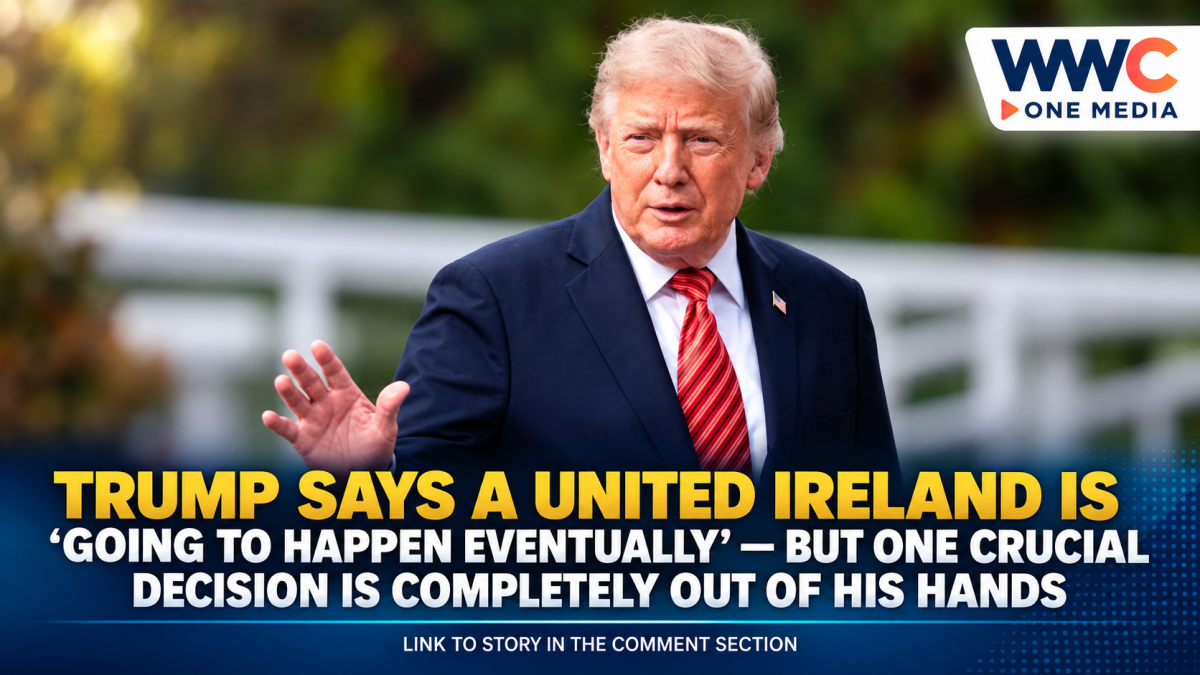
DUBLIN — U.S. President Donald Trump has plunged into one of Ireland’s most politically sensitive debates, declaring that he would like to see Northern Ireland reunified with the Republic of Ireland and predicting that it will eventually happen.
Trump made the remarks on Saturday, September 12, during a visit to Dublin, where he met Irish Taoiseach Micheál Martin before travelling to County Clare for the Irish Open at his family-owned golf resort in Doonbeg.
Asked about the prospect of a united Ireland, Trump said he would “love to see it unified” and described reunification as a “fantastic thing.” He also suggested that, in his view, it would happen eventually, while acknowledging that Britain would have a say in the process.
The comments immediately elevated what had already been a closely watched presidential visit into a much larger political story stretching from Dublin to Belfast and London.
Why Trump’s Remarks Hit a Political Nerve
The future of Northern Ireland remains one of the most sensitive constitutional issues in British and Irish politics.
Northern Ireland has been part of the United Kingdom since the partition of Ireland more than a century ago. Nationalists generally favour eventual reunification with the Republic of Ireland, while unionists want Northern Ireland to remain within the United Kingdom.
That divide helped fuel decades of sectarian and political violence known as the Troubles, which were substantially brought to an end by the 1998 Good Friday Agreement.
Under that agreement, Northern Ireland’s constitutional future is ultimately determined through democratic consent. Its status can change only if a majority of people in Northern Ireland support such a move. British law also requires the Northern Ireland secretary to order a referendum if it appears likely that a majority would vote for a united Ireland.
In other words, Trump may publicly support reunification, but the decision does not belong to Washington.
It belongs principally to the people of Northern Ireland through the process established by the peace agreement.
London Says Nothing Has Changed
The British government quickly distanced itself from Trump’s position.
Prime Minister Andy Burnham’s office reiterated that the government’s stance remained unchanged, pointing to Burnham’s position that there is currently insufficient evidence of majority support for a referendum on Irish unity.
That response underscored the gulf between Trump’s prediction and Britain’s current policy.
The Good Friday Agreement does provide a democratic route toward reunification, but it does not establish a timetable for one.
The UK government’s position remains that the conditions for triggering such a referendum have not yet been met.
Unionists Push Back at Trump
Trump’s remarks also drew sharp reactions from unionist politicians in Northern Ireland.
Democratic Unionist Party leader Gavin Robinson stressed that Northern Ireland’s constitutional future should be decided by its people rather than political figures in Washington, Dublin or London.
Other unionist politicians issued similar responses, reinforcing the long-standing position that Northern Ireland should remain part of the UK unless voters themselves choose otherwise.
The comments were received very differently within nationalist politics.
Sinn Féin representatives noted the significance of an American president openly discussing Irish unity, although some stopped short of treating Trump’s remarks as a decisive shift in the political landscape.
Martin, whose Fianna Fáil party supports Irish unity as a long-term objective, later said Trump’s position should not be surprising and stressed the importance of building stronger relationships and shared experiences across the island before constitutional change is pursued.
Trump Goes Further Than Many U.S. Presidents
Trump’s intervention was particularly striking because American presidents have traditionally approached Northern Ireland’s constitutional future cautiously.
The United States played a major diplomatic role in the Northern Ireland peace process, particularly during negotiations surrounding the Good Friday Agreement, but Washington has generally emphasised peace, consent and cooperation rather than openly prescribing whether Northern Ireland should remain British or become part of a united Ireland.
The Good Friday Agreement itself recognises both constitutional aspirations: Northern Ireland may remain within the United Kingdom for as long as that reflects majority consent, while supporters of Irish reunification have a legitimate democratic route to pursue their goal.
That careful balance is precisely why Trump’s declaration attracted so much attention.
Ireland Visit Brings Diplomacy, Golf — and Protests
Irish reunification was not the only controversy surrounding Trump’s visit.
He also met Irish President Catherine Connolly, who had been sharply critical of Trump before becoming Ireland’s largely ceremonial head of state.
Following their meeting, Connolly said she had conveyed concerns about war and international conflict. She also presented Trump with works by the late Irish poet Michael Longley, including a collection containing the poem Ceasefire.
Meanwhile, thousands of demonstrators took to the streets of Dublin during Trump’s visit, with protesters criticising several aspects of his policies and presidency.
Trump had already left Dublin for Doonbeg by the time the main demonstration was under way.
His trip combines official presidential engagements with attendance at the Irish Open, being staged at Trump International Golf Links & Hotel Ireland in County Clare — once again putting attention on the overlap between Trump’s presidency and his family’s international business interests.
What Happens Next?
Despite the uproar surrounding Trump’s declaration, Irish reunification is not suddenly imminent because of what the American president said.
The constitutional mechanism remains unchanged.
Under the peace settlement that has governed Northern Ireland since 1998, its status rests on the principle of consent. A united Ireland can emerge only through the democratic processes agreed by Britain, Ireland and the political parties involved in the Good Friday Agreement.
But Trump’s intervention could still have political consequences.
By openly predicting that Irish reunification will eventually happen, one of the world’s most prominent political figures has injected fresh international attention into a debate already unfolding across Ireland and Northern Ireland.
For supporters of unity, the comments provide another high-profile talking point.
For unionists, they reinforce concerns about outsiders attempting to influence a constitutional question they insist belongs to Northern Ireland’s voters.
And for London, Trump’s remarks create an awkward diplomatic situation: a U.S. president has publicly endorsed an outcome that the British government says currently lacks the democratic support necessary even to trigger a referendum.
Trump may have described a united Ireland as “fantastic.”
Whether it ever becomes reality, however, will ultimately be decided not in Washington — but by voters on the island itself.
Leave a Reply