
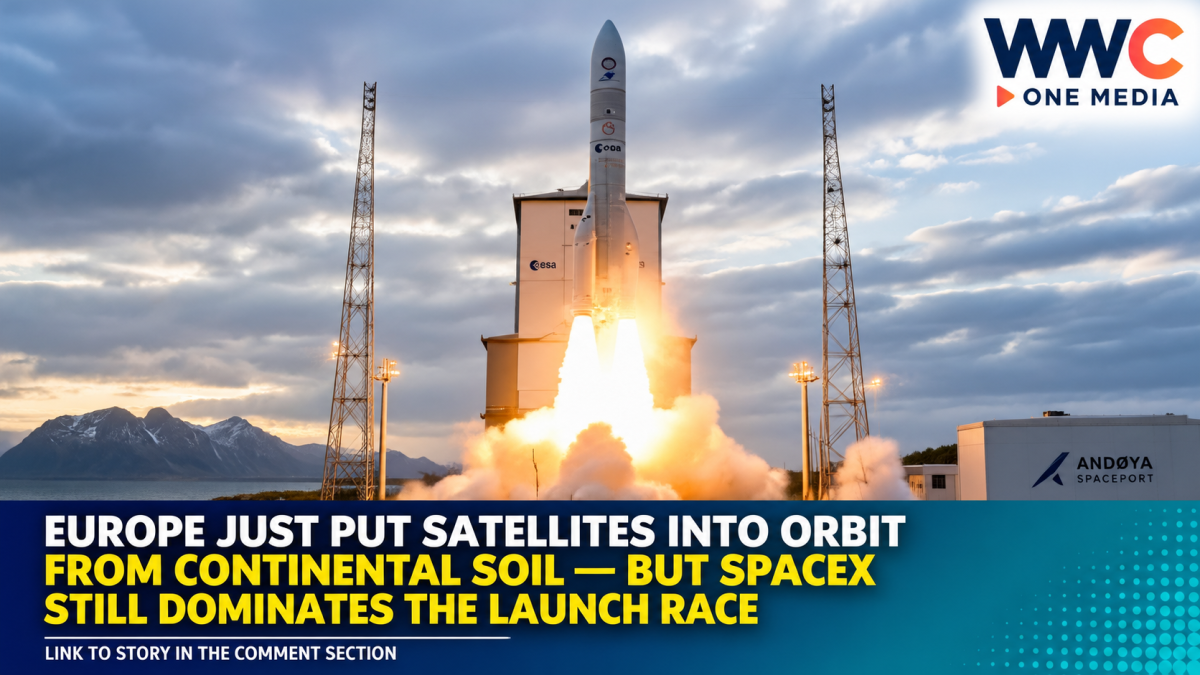
ANDØYA, Norway — Eighteen months ago, Germany’s Isar Aerospace watched its first Spectrum rocket lose control shortly after takeoff and plunge back toward the Norwegian coast.
On Saturday night, the company’s second rocket did something dramatically different.
It reached orbit.
Spectrum lifted off from the Arctic Andøya Spaceport at 10:12 p.m. Central European Summer Time on Sept. 5, successfully reaching orbit and deploying payloads on a mission Isar Aerospace called “Onward and Upward.”
The achievement makes the Munich-area startup the first commercial European company to successfully deliver satellites into orbit with a rocket launched from continental European soil, according to Isar Aerospace, Reuters and Andøya Space.
It is a major technological milestone.
But Europe’s much bigger challenge starts now.
Because launching one rocket successfully is one thing.
Building a reliable, affordable launch industry capable of competing with SpaceX is something else entirely.
From a fiery failure to orbit in 18 months
The turnaround is particularly striking because Spectrum’s maiden flight ended rapidly.
On March 30, 2025, the first Spectrum rocket successfully cleared the launch pad but lost control shortly afterward and crashed into the sea. No one was injured. ESA says the flight lasted approximately 30 seconds, while Reuters reported the vehicle came down about 40 seconds after liftoff.
Isar did not treat that first mission as a conventional commercial launch.
It was a test intended primarily to gather flight data.
The company later said its investigation identified an unintended opening of a vent valve followed by loss of attitude control during the beginning of the roll maneuver as the events that initiated the failure.
Spectrum’s second flight was therefore much more demanding.
This time there were real payloads aboard.
And this time the rocket reached orbit.
Five satellites actually went along for the ride
The mission carried five CubeSats and one non-deployable technology experiment, selected with support from the European Space Agency’s Boost! program and Germany’s DLR microlauncher competition.
They included:
- CyBEEsat from TU Berlin
- TriSat-S from the University of Maribor
- Platform 6 from EnduroSat
- FramSat-1 from the Norwegian University of Science and Technology
- SpaceTeamSat1 from TU Wien Space Team
- the “Let It Go” technology experiment from Dcubed.
Isar said spacecraft separation was completed after the rocket reached orbit, while the company continued working with customers to confirm the individual status of the satellites.
That distinction matters.
The central mission objective — achieving orbit and deploying the payloads — succeeded.
But deployment from a rocket does not automatically guarantee that every individual spacecraft subsequently becomes fully operational.
Spectrum is relatively small — by design
Spectrum is not trying to compete with giant heavy-lift rockets on sheer size.
The two-stage vehicle measures approximately 28 meters tall and 2 meters wide.
Its first stage uses nine Aquila engines, while a single vacuum-optimized Aquila powers the second stage. The engines burn liquid oxygen and propane.
Isar lists the rocket’s maximum target payload capacity at:
1,000 kilograms to low Earth orbit, and
700 kilograms to sun-synchronous orbit.
That places Spectrum in a part of the market aimed heavily at small and medium satellites, Earth-observation spacecraft and constellations.
The company’s economic argument is that customers with smaller spacecraft may prefer a dedicated rocket rather than waiting for space aboard a much larger launcher.
Why Europe cares so much about one German rocket
The importance of the launch goes well beyond Isar Aerospace.
Europe has become increasingly worried about its ability to independently place strategically important satellites into orbit.
For more than four decades, Europe has maintained autonomous access to space primarily through the Ariane and Vega rocket families.
But those rockets launch from Europe’s spaceport at Kourou in French Guiana, on the northeast coast of South America.
Europe also went through an uncomfortable period in which delays to Ariane 6, problems with Vega C and the end of access to Russian Soyuz launches sharply reduced its available launch options.
That forced some important European satellites onto foreign rockets, including SpaceX’s Falcon 9.
The successful Spectrum mission now creates something Europe has sought for years:
a commercially developed orbital-launch capability physically based on the European continent.
Norwegian Industry Minister Cecilie Myrseth described the achievement as strengthening both Norwegian and European security.
Andøya has become part of the story
The location is almost as important as the rocket.
Andøya Spaceport, located on the Norwegian island of Andøya above the Arctic Circle, was formally opened in November 2023.
Its operator described it at the time as the first operational orbital spaceport in continental Europe.
Its northern position makes it particularly useful for launches into polar and sun-synchronous orbits — trajectories heavily used by Earth-observation, climate-monitoring, reconnaissance and other satellite systems.
Following Saturday’s mission, Andøya Space called it the first successful satellite launch from mainland Europe.
The launch also gave Norway a domestic milestone: Andøya said FramSat-1 became the first Norwegian-built satellite launched from Norwegian soil.
Germany and Europe are pouring serious money into the company
Isar Aerospace is no longer being treated simply as an experimental startup.
Only days before the historic launch, the company secured a €200 million — roughly $233 million — European Space Agency contract under the European Launcher Challenge.
The wider European Launcher Challenge has more than €900 million in commitments from ESA member states and is intended to create more competition and resilience in Europe’s launch sector.
ESA’s shortlisted commercial providers originally included:
Isar Aerospace, MaiaSpace, Orbital Express Launch, PLD Space and Rocket Factory Augsburg.
Orbital Express Launch subsequently entered administration and withdrew.
The program represents a significant change in European space policy.
Instead of relying almost exclusively on large government-backed launcher programs, ESA increasingly wants to act as a customer for competing private launch companies.
The theory is familiar.
It is broadly the same competitive commercial model that helped transform America’s launch market.
Isar also raised another €270 million privately
Government support is only part of the funding story.
Isar announced a separate €270 million financing round in 2026, backed by investors including Island Green Capital, Molten Ventures, HV Capital, Lakestar, UVC Partners and KfW Capital.
That money is helping finance a much bigger production strategy.
Near Munich, the company is ramping up a new 40,000-square-meter integrated rocket production facility.
Isar says the plant is eventually designed to manufacture as many as 40 Spectrum rockets per year.
And the next vehicles are not theoretical.
According to Isar, Spectrum rockets three through seven are already in production.
That may prove more important commercially than Saturday’s historic flight.
A rocket company does not become a serious competitor by reaching orbit once.
It becomes one by doing it repeatedly.
Europe is entering a launch-capacity race
Demand for orbital launches is expected to continue climbing as governments and businesses deploy much larger numbers of satellites.
ESA Director General Josef Aschbacher said this month that Europe may need to increase the planned flight rate of both Ariane 6 and Vega C as satellite deployment demand rises toward the end of the decade.
Arianespace expects Ariane 6 to reach as many as 10 flights annually from 2027, but ESA is already examining whether even that will provide enough capacity.
That is where companies such as Isar hope to fit.
Instead of replacing Ariane 6, smaller commercial rockets could supplement Europe’s larger launchers by handling lighter payloads and missions that need their own schedule or orbit.
In other words, Europe’s future launch industry may look less like a single national champion and more like an ecosystem.
But SpaceX remains the giant in the room
This is where the celebratory headlines need perspective.
Spectrum reaching orbit is a landmark for Europe’s private space sector.
It does not mean Europe has suddenly caught SpaceX.
SpaceX’s Falcon 9 operates at a flight frequency none of Europe’s current launchers approach, and its vertically integrated Starlink business gives the company a massive source of internal demand.
Reuters reported in August that about 79% of Falcon 9 missions in 2026 were being used for SpaceX’s own Starlink satellites, up from 54% in 2020.
That level of launch cadence matters enormously.
Frequent flights spread infrastructure costs across more missions, generate enormous quantities of operational data and help turn a rocket from an experimental vehicle into routine transportation.
Some commercial satellite companies have even been told that Falcon 9 availability is tight until 2028 or 2029, Reuters reported.
That shortage also creates an opening.
A reliable European alternative suddenly becomes commercially interesting even if it cannot match SpaceX’s scale.
Europe’s satellite ambitions make that alternative strategically valuable
The geopolitical argument has become even stronger.
Europe is developing IRIS², its secure satellite communications constellation, while governments are investing more heavily in military reconnaissance, communications and resilient space infrastructure.
Reuters reported last month that Germany’s OHB secured a contract worth close to €1 billion to build 18 satellites for IRIS², with the first spacecraft expected to launch beginning in 2029 and operations planned from 2030.
The war in Ukraine has also demonstrated how important commercial satellite networks can become during military conflict.
That means launch independence is increasingly viewed not just as an industrial-policy goal, but as a security capability.
Germany’s Defence Minister Boris Pistorius made that point explicit during a July visit to Isar Aerospace, describing sovereign access to space as strategically important for defence and deterrence.
Isar isn’t stopping in Norway
The company is also preparing a second launch complex in Nova Scotia, Canada.
That facility is intended to give Isar access to additional mid- and high-inclination trajectories suitable for Earth observation and communications satellites.
The approach gives Isar two potential advantages.
Norway provides a European launch base.
Canada gives it another geographic option for international customers and mission planning.
Combined with increased manufacturing capacity near Munich, the strategy is clearly aimed at becoming a launch provider operating at industrial rather than experimental scale.
One successful launch does not prove reliability
This is the most important caveat.
Spectrum now has a record of:
two launches, one failure and one orbital success.
That is an enormous improvement, but it is still a tiny statistical sample.
Commercial and government satellite operators care not only about whether a rocket can reach orbit but whether it can do so reliably, on schedule and at a competitive price.
And Spectrum’s second mission itself experienced months of delays.
The flight was initially targeted for January but was postponed after an issue with a pressurization valve. Later launch attempts were delayed by weather, maritime-range interference and technical concerns. A June attempt was stopped after engineers detected abnormal behavior in the rocket’s fluid systems.
Those issues are hardly unusual during development of a new launch vehicle.
But solving them consistently is exactly what separates an experimental rocket from a commercial transportation system.
The next launch may matter more than the historic one
Saturday’s flight gave Isar Aerospace something no press release or funding round could provide:
proof that Spectrum can reach orbit.
The first test proved it could lift off.
The second proved it could get there.
Now comes the harder part.
Can Spectrum launch again?
Can it do so without months of postponements?
Can Isar manufacture rockets rapidly enough to build a meaningful flight cadence?
Can it reach the company’s ambitious target of dozens of launch vehicles per year?
And can it offer European governments and satellite companies enough reliability and price competition to reduce their dependence on American launch providers?
Those are the questions that will determine whether Sept. 5, 2026 becomes remembered merely as an impressive European first — or as the moment a genuine new competitor entered the global launch business.
Europe has finally put a privately developed rocket into orbit from its own continental soil.
Now it has to prove it can do it again — and again.
WWC ONE MEDIA M.J.E




Leave a Reply