
KATHMANDU — For nine days, there was almost no reason to believe anyone buried deep inside the wreckage of Nepal’s devastated hydropower network could still be alive.
Then rescuers heard something.
Voices.
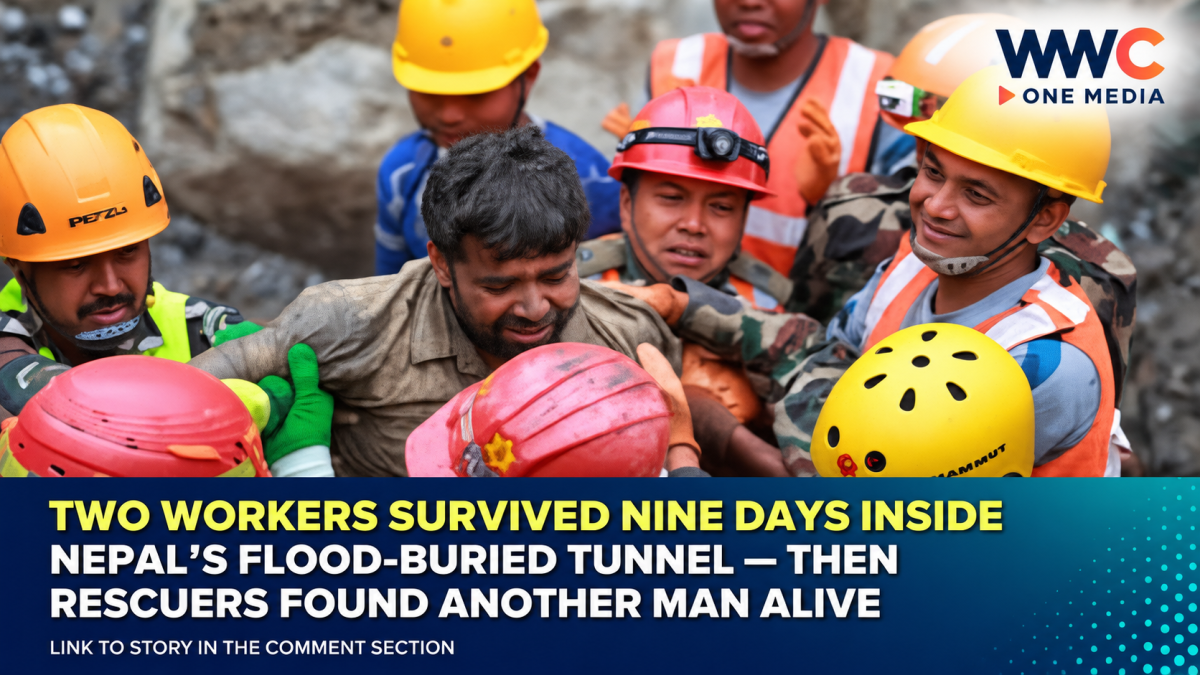
On Friday, September 4, emergency crews pulled Sanjay Sah and Kabir Maharjan alive from the Upper Trishuli 3A Hydropower Station after they had spent nine days trapped following the catastrophic August 26 flash flood that ripped through the Himalayan valley.
The men became the first workers rescued alive from Nepal’s flood-hit hydropower tunnels, turning what had increasingly become a recovery operation into a renewed search for survivors.
But the story did not end there.
A day later, rescuers found Chinese worker Lu Haitao alive inside a 225-meter tunnel at the Upper Trishuli-1 Hydropower Project. He was suffering from mild hypothermia but had no visible injuries and was flown by helicopter to an army hospital.
Hours later, Nepalese rescuers also pulled Chandika Kumari Shrestha alive from a mud-filled home in Betrawati.
Ten days after one of Nepal’s worst disasters in years, people were still being found alive.
Sanjay Sah Had a Chance to Run — He Stayed Behind
Perhaps the most extraordinary story belongs to mechanical foreman Sanjay Sah.
When warnings reached workers that disaster was moving downstream, Sah told colleagues to flee.
But he remained in the control room.
The 30-year-old later told Nepalese officials that he felt responsible for helping others escape and that by the time he tried to leave, the flood had already cut off his route. Reuters reported that Sah believed as many as 40 to 45 people could have been in the control-room area that day.
For more than a week he remained underground.
He told rescuers he prayed while trapped and had been in contact with several other workers during the ordeal.
When crews finally reached him, images released by authorities showed Sah coated in mud, being carried from the destroyed site before doctors fitted him with oxygen and checked his vital signs.
Mechanical supervisor Kabir Maharjan was rescued alongside him.
Both were flown to Kathmandu for treatment. Reuters reported Friday that their vital signs were stable, although Maharjan initially could not move his hands or legs and was being treated in intensive care.
A Third Tunnel Survivor Changed the Story Again
The following day brought another extraordinary development.
Lu Haitao was discovered inside the Upper Trishuli-1 tunnel.
Nepal’s army said a joint team involving Nepalese personnel and South Korean disaster specialists helped rescue him from approximately 225 meters inside the tunnel. Images showed the exhausted worker receiving medical attention aboard a helicopter.
Lu later described repeatedly shouting when he could see rescuers’ lights but being unable to make himself heard.
His survival became especially significant because search teams had already been operating for 10 days in an environment packed with collapsed concrete, mud, rock and flood debris.
International specialists from South Korea, India, China and the United States have joined or supported searches across the disaster zone.
Hundreds of Hydropower Workers Are Still Missing
The three tunnel rescues are extraordinary.
They are also tiny compared with the scale of the emergency.
Associated Press reported that about 900 workers remain missing across 12 damaged hydropower projects, with roughly 500 believed to have been inside various tunnels when the disaster struck.
Those underground structures may have saved some workers by shielding them from the initial wall of water.
They may also have become traps.
Tunnel entrances have been buried beneath enormous quantities of mud and boulders, internal sections have collapsed and access roads have vanished.
Reuters reported that the flood deposited an estimated 2.2 million tonnes of mud and debris across the valley.
At some locations, rescuers are relying on old engineering drawings simply to work out where tunnel entrances and underground chambers once were.
More than 500 engineers and officials have been exchanging plans and technical information through a WhatsApp group, giving search crews real-time guidance on tunnel layouts as excavators attempt to reopen access points.
One Important Correction About Trishuli 3A
The early reporting understandably contained conflicting numbers as officials struggled to determine who had been working where.
The Korea Herald article, carrying an Associated Press report, stated that 557 workers were missing from Trishuli 3A, with about 115 thought to be in its main tunnel.
More detailed local reporting subsequently painted a different picture.
The Kathmandu Post reported that 42 people had been working at the Upper Trishuli 3A project, while Upper Trishuli-1 had 557 workers, Upper Trishuli 3B had 191 and Rasuwagadhi had 93.
After Sah and Maharjan were rescued, a seven-member Armed Police Force team said it had reached all accessible sections of the Trishuli 3A tunnel and found one body but no additional survivors there. Search operations at other hydropower facilities, however, continued.
That distinction is important because the broader estimate of hundreds of missing hydropower workers remains credible—but they are spread across multiple projects and tunnels, rather than all being concentrated at Trishuli 3A.
The Disaster Was More Complicated Than a Simple ‘Glacier Collapse’
Early reports widely described the August 26 disaster as being caused by a glacier collapse.
That is broadly consistent with the evidence—but scientists now describe a more complicated chain of events.
Satellite analysis indicates that a huge mass of ice and rock collapsed high in the Himalayas, possibly after underlying bedrock failed. The avalanche plunged into the Lhende River valley and appears to have temporarily blocked the river.
Water then accumulated behind that natural dam.
When the blockage failed, the accumulated water, ice, rock and sediment surged downstream through the Bhotekoshi and Trishuli river systems.
ICIMOD reported that water levels on sections of the Trishuli River rose by as much as nine meters in roughly 30 minutes, illustrating how little time some downstream communities had to escape.
Scientists have warned against describing the disaster simply as a glacial-lake outburst flood. Current evidence instead points toward an ice-rock avalanche followed by temporary river blockage and catastrophic release.
Researchers also caution that although warming is increasing glacier and slope instability across the Himalayas, a direct attribution of this individual collapse to climate change has not yet been established.
More Than 1,300 Dead, Nearly 4,900 Missing
The numbers have continued to change as bodies are recovered and some missing people make contact.
Reuters reported on September 5 that at least 1,344 people had been confirmed dead in Nepal and approximately 4,887 remained missing, including 583 foreign nationals.
On the Tibetan side of the border, Chinese authorities had reported 31 deaths and 531 people missing, according to figures cited by Reuters.
Because search operations remain active and records in isolated mountain communities are incomplete, those numbers should be treated as evolving rather than final.
The devastation extends far beyond the death toll.
Entire settlements were swept away.
Roads and bridges disappeared.
Schools were destroyed.
Hydropower plants were overwhelmed.
And thousands of families are facing the prospect of rebuilding lives in areas where infrastructure has effectively vanished.
Nepal’s Energy System Took a Massive Hit
The disaster also exposed a vulnerability at the heart of Nepal’s economic strategy.
Hydropower has become central to the country’s electricity supply and growing energy exports.
Reuters reported that the flood knocked out roughly 10% of Nepal’s electricity-generating capacity. Eleven hydropower projects in the affected region sustained damage, with access roads, plants and other infrastructure destroyed or buried.
The economic consequences could be enormous.
Nepalese authorities initially estimated direct losses to property, housing and infrastructure at about 387.5 billion Nepalese rupees, or $2.56 billion.
Finance Minister Swarnim Wagle told Reuters that overall reconstruction could eventually cost $4 billion to $5 billion—nearly one-tenth of Nepal’s economy.
Authorities estimate around 20,000 homes may need rebuilding, including at least 7,500 that were destroyed.
The Most Important Question Is Now Underground
For rescue teams, however, the economic calculations can wait.
Every newly opened tunnel creates the same question.
Is anyone still alive inside?
The odds become worse with every passing day.
But Sanjay Sah and Kabir Maharjan survived nine days.
Lu Haitao survived 10.
And a woman buried inside her home was still alive when rescuers reached her.
Those rescues have fundamentally changed the psychology of the operation.
What looked increasingly like a search for bodies has again become a race to find pockets where water, air or stored supplies may have allowed people to survive.
Families of missing workers continue to wait near the disaster zone, posting photographs and names of loved ones and searching for any report that a tunnel has been reopened.
The scale of Nepal’s tragedy remains overwhelming.
But after three workers emerged alive from darkness more than a week after the flood, rescuers now have one powerful reason not to stop digging.
WWC ONE MEDIA M.J.E




Leave a Reply