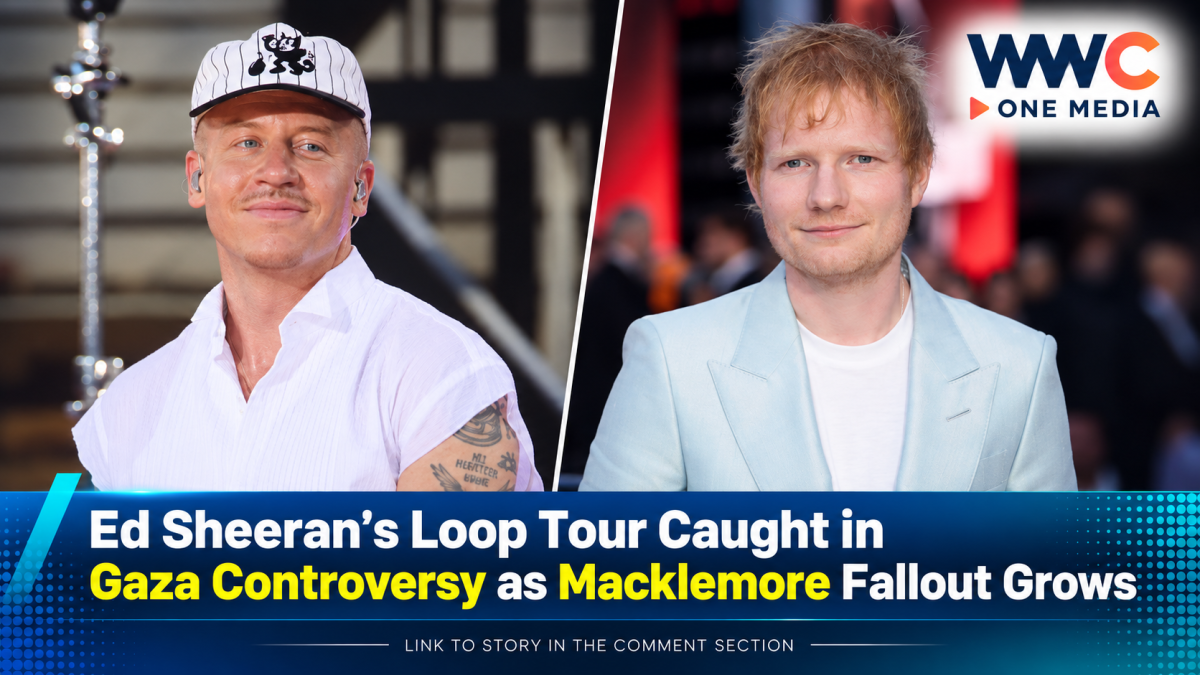
Ed Sheeran’s Loop Tour has become an unexpected flashpoint over the Gaza war, free expression and the role of artists in political debates after rapper Macklemore was removed from the tour and several other supporting acts subsequently pulled out.
What began with Macklemore’s pro-Palestinian remarks during Sheeran’s September shows at New Jersey’s MetLife Stadium has rapidly developed into a wider dispute involving musicians, concert promoters, stadium owners and advocacy groups.
Despite the turmoil, Sheeran’s tour is continuing. His scheduled Philadelphia performance was confirmed to proceed, although supporting acts for upcoming dates have been affected by the fallout.
How the Controversy Started
Macklemore, who had been supporting Sheeran on the North American leg of the Loop Tour, spoke about Gaza during his September performances at MetLife Stadium.
He expressed support for Palestinians and called for a “Free Palestine,” prompting criticism from some Jewish advocacy organizations and pressure surrounding his continued participation in the tour.
The Israeli American Council also launched a petition calling for Macklemore to be removed from the tour, while other organizations criticized elements of his performance and political messaging.
Macklemore defended his comments, saying his criticism of Israel’s government and his support for Palestinians should not be interpreted as criticism of Jewish people.
Macklemore Removed From Remaining Tour Dates
Messina Touring, the promoter associated with Sheeran’s tour, subsequently announced that Macklemore would no longer perform on the remaining dates following discussions with stakeholders.
The decision quickly became the central point of the controversy.
Macklemore said Sheeran had told him that venue owners, including Robert Kraft, owner of the Kraft Group and Gillette Stadium, had objected to his participation.
Kraft later confirmed that Macklemore would not perform at Gillette Stadium, saying the venue believed his recent remarks and what Kraft described as a broader history of antisemitic rhetoric and imagery crossed a line for the venue.
Kraft’s statement did not publicly confirm Macklemore’s allegation that multiple stadium owners had collectively given Sheeran an ultimatum.
Sheeran Says the Decision Was Not His
Sheeran subsequently addressed the controversy himself.
The British singer said that removing Macklemore was the promoter’s decision, not his, explaining that Macklemore’s contract was with the promoter.
Sheeran also said he had spoken with promoters and people on different sides of the dispute in an effort to find a solution, but that the venue and promoter decisions were ultimately final.
Sheeran also pushed back against suggestions that his relatively restrained public position meant he did not care about the conflict.
He said he has personal views about the war but has generally preferred to use his concerts to bring people from different backgrounds together rather than turn them into political forums.
Supporting Acts Begin Leaving the Tour
The controversy intensified when other musicians associated with the Loop Tour announced their departures.
Finneas, Lukas Graham and Irish singer-songwriter Aaron Rowe were among those who withdrew from upcoming performances.
Sheeran’s Irish backing band, Beoga, also departed.
Several of the artists cited solidarity with Macklemore or expressed support for Palestinians and concerns about artists being restricted from speaking publicly about political issues.
The departures left Sheeran facing a highly unusual situation: the headline artist remains on the road, while much of the supporting lineup has changed amid a political controversy.
The Tour Is Still Going Ahead
Despite the disruption, the Loop Tour itself has not been cancelled.
The Los Angeles Times reported that Sheeran’s next scheduled performance in Philadelphia was still expected to take place, although the supporting lineup remained uncertain.
That means the immediate challenge is not whether the tour will continue, but how its remaining shows will operate following the departures and continuing public debate.
The Associated Press also noted that the episode illustrates the complicated balance of power between major performers, promoters and venue operators. Major artists can have substantial influence over tour decisions, while venues retain significant authority over what happens on their properties.
A Bigger Debate Over Music and Politics
The dispute has expanded beyond Sheeran and Macklemore.
It has raised questions about whether major concerts should remain politically neutral spaces, whether performers should be able to use their platforms to address wars and humanitarian crises, and how venue owners should respond when an artist’s political statements become controversial.
Those questions have produced sharply different responses from musicians, advocacy groups and venue operators.
For Sheeran, however, the immediate focus remains the tour itself.
The singer has maintained that his approach is to bring audiences together rather than use his concerts as political forums, while Macklemore has continued to publicly advocate for Palestinians.
Macklemore has also said he plans to donate earnings from his Sheeran tour appearances to organizations supporting Palestinians.
Why the Fallout Matters
The controversy demonstrates how quickly a single performance can affect a major international concert operation.
What began as political remarks from an opening act has now involved a promoter, stadium ownership, advocacy organizations and multiple performers.
And with the Loop Tour continuing, the story is unlikely to end simply with Macklemore’s removal.
For the remaining dates, attention will now turn to whether Sheeran performs without a traditional supporting lineup, whether replacements are announced, and whether the dispute continues to affect venues and artists associated with the tour.