
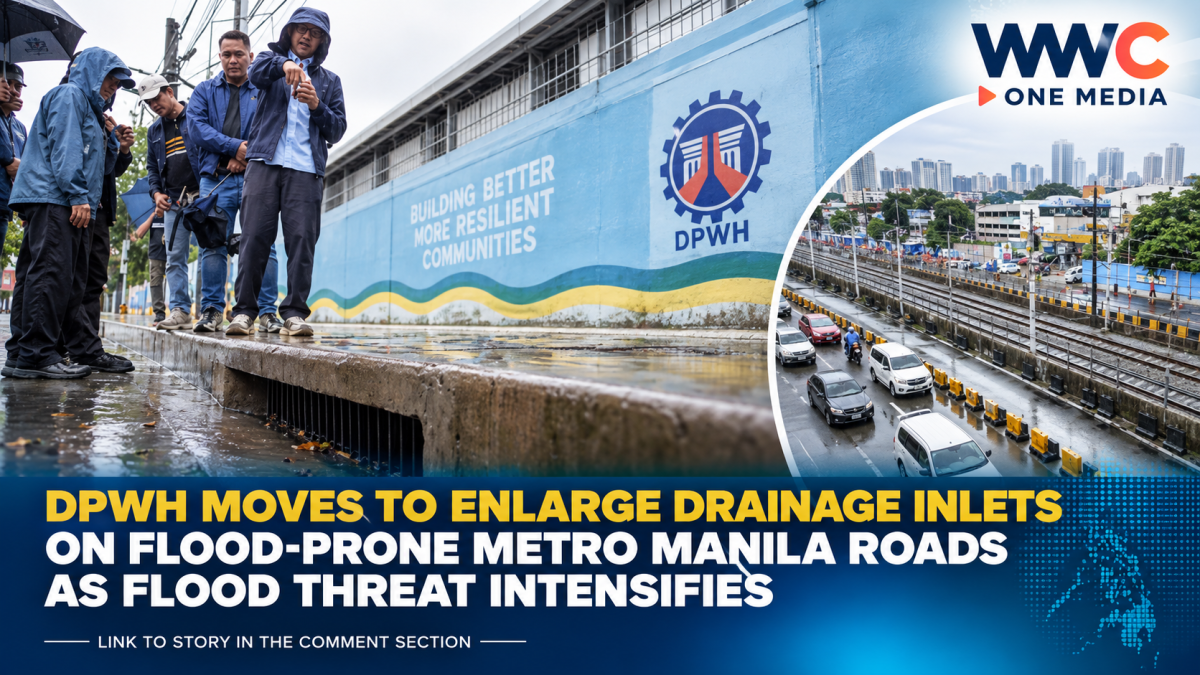
MANILA, Philippines — The Department of Public Works and Highways (DPWH) is moving to redesign and enlarge drainage inlets along major Metro Manila roads in an effort to make floodwaters drain faster and reduce prolonged flooding in some of the capital’s most vulnerable areas.
DPWH Secretary Vince Dizon ordered the redesign after inspecting flood-control facilities in Manila, saying existing inlets in several flood-prone locations are too small to efficiently handle large volumes of water.
The initial focus will be on major national roads, including Roxas Boulevard, EDSA, C-5, Taft Avenue, España Boulevard, Quezon Avenue and Commonwealth Avenue, with priority given to areas where small drainage inlets are slowing the movement of floodwater.
Bigger inlets, faster drainage
According to Dizon, the plan is to make drainage openings larger and, in some locations, extend them to improve the speed at which floodwater enters the drainage system.
One area specifically cited by the DPWH chief is the Estrella portion of EDSA, where improved inlet capacity is intended to help reduce severe flooding.
Dizon said the agency plans to use maintenance funds for the work because there are no dedicated flood-control funds available for the projects in the 2026 budget. He also said work was already underway along portions of EDSA and C-5 in Pasig City.
The announcement comes as Metro Manila continues to confront recurring flooding caused by intense rainfall, clogged drainage systems, limited drainage capacity and the metropolis’ highly urbanized landscape.
DPWH has already cleared thousands of cubic meters of drainage
The inlet redesign is only one part of the government’s broader flood-mitigation campaign.
Under Oplan Kontra Baha, DPWH-National Capital Region has been carrying out extensive declogging and drainage-clearing operations.
By the third week of June, DPWH-NCR reported removing 7,678.68 cubic meters of drainage waste, exceeding its target of 4,606.80 cubic meters by more than 166 percent. The agency said the operations include cleaning drainage inlets and desilting waterways to improve the flow of stormwater.
Earlier in June, DPWH-NCR reported clearing 7,564.89 cubic meters of material from drainage inlets and desilting more than 70,000 cubic meters of waterways across Metro Manila.
These operations are designed to complement larger infrastructure projects rather than serve as a single solution to the capital’s flooding problem.
New drainage projects are already underway
One example is the G. Araneta Avenue Drainage Improvement Project in Quezon City, where DPWH is installing two 1.5-meter-diameter high-density polyethylene pipes between Kaliraya Street and E. Rodriguez Sr. Avenue.
The project is intended to improve the movement of stormwater toward the San Juan River, while mobile pumping equipment is also being used to help manage floodwater.
The government has also reported improvements in several traditionally flood-prone locations.
The Presidential Communications Office said in July that portions of G. Araneta Avenue, Bonifacio Drive and Taft Avenue experienced little to no flooding following heavy overnight rain, citing drainage improvements, dredging and upgraded pumping stations.
DPWH looking beyond drainage inlets
Officials acknowledge that enlarging road inlets alone cannot solve Metro Manila’s flooding problem.
DPWH is also examining other interventions, including pumping systems and detention basins.
The agency recently disclosed plans to work with Quezon City on possible detention basins that could temporarily store floodwater upstream before it reaches the San Juan River.
Dizon has also ordered the updating of the country’s flood-management master plans, with DPWH working with the University of the Philippines–Project Nationwide Operational Assessment of Hazards (UP NOAH) and local governments to incorporate updated hazard maps and scientific data into future flood-control planning.
Why the plan matters
Metro Manila’s flooding problem is not caused by a single weak point in the drainage network. Heavy rainfall can overwhelm drainage capacity, while garbage, sediment, inadequate infrastructure and limited pumping capacity can slow the removal of water.
That is why DPWH is pursuing multiple measures simultaneously—from clearing existing drainage systems to enlarging inlets, upgrading pumps, improving underground drainage and exploring detention facilities.
The immediate objective is simple: get rainwater off roads faster and prevent floodwater from remaining in communities and major transport corridors for extended periods.
But the bigger test will be whether these interventions can keep pace with increasingly intense rainfall and the enormous amount of water that Metro Manila’s drainage network must handle.
For motorists and residents who have grown accustomed to seeing major roads disappear under floodwater after heavy rain, the promise is significant.


Leave a Reply