
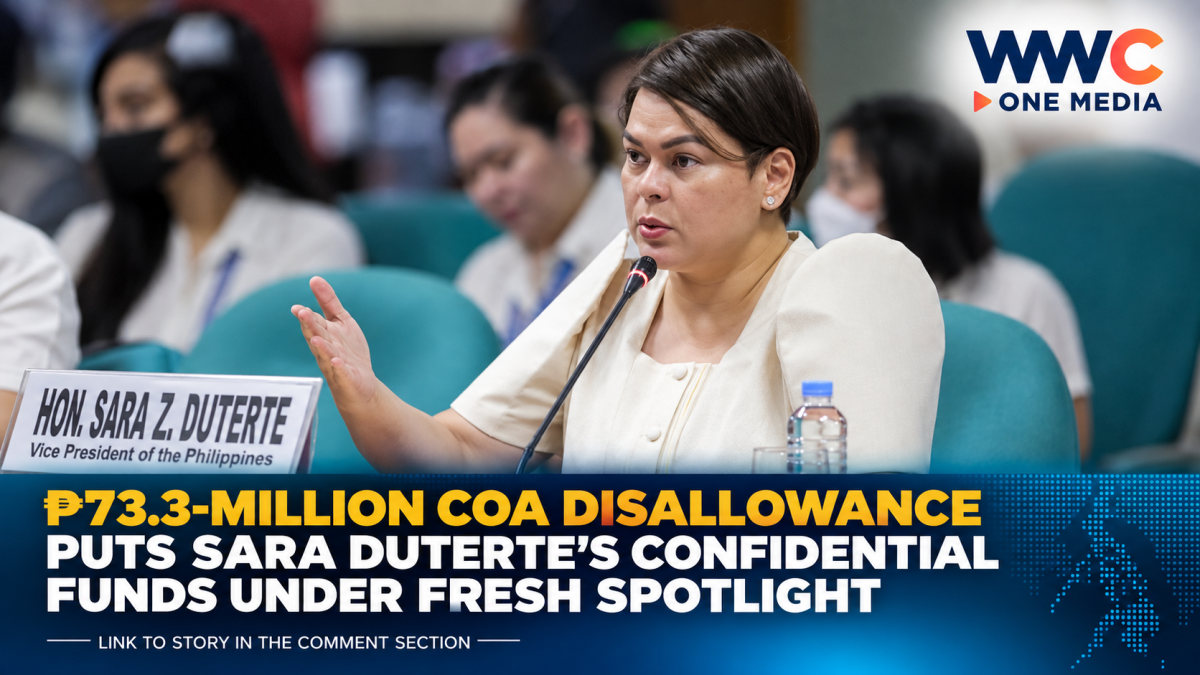
MANILA, Philippines — Vice President Sara Duterte is facing renewed scrutiny over ₱73.287 million in disallowed confidential-fund expenditures, after the Commission on Audit (COA) affirmed its finding that the spending did not meet the required documentation and accounting rules.
The issue has become a major flashpoint in Duterte’s ongoing impeachment proceedings, where questions surrounding the use of confidential funds have taken center stage.
COA supervising auditor Xylene Mae del Campo testified before the Senate impeachment court that Duterte, together with former Office of the Vice President (OVP) special disbursing officer Gina Acosta and chief accountant Julieta Villadelrey, was held liable for the disallowed 2022 expenditures.
What happened to the ₱73.287 million?
The disallowance covers confidential-fund expenditures made from December 21 to 31, 2022—a period of only 11 days.
According to COA testimony reported by The Philippine Star, approximately ₱69.787 million involved reward payments for which auditors said there was insufficient documentation demonstrating successful information-gathering or surveillance activities.
Another ₱3.5 million involved items including tables, chairs, desktop computers and printers, with auditors saying the OVP did not provide sufficient documentation showing that the purchases were for confidential operations.
COA had issued the original Notice of Disallowance in 2024. The Commission Proper subsequently affirmed the disallowance on April 10, 2026, after Duterte and other OVP officials appealed the finding.
Does Duterte have to immediately return the money?
This point requires careful wording.
COA’s finding means the disallowed amount is subject to recovery under the government’s audit rules, but the legal process does not mean that a simple news headline should automatically characterize the money as already proven to have been personally misappropriated by Duterte.
COA has identified officials as liable for the questioned transactions, while Duterte’s camp has disputed responsibility and sought to distinguish the Vice President’s role from that of the officials who directly handled the funds.
PNA reported in April that COA officials told lawmakers that once the ruling becomes final, the disallowed amount must be returned to the government.
That distinction is crucial: a COA disallowance is an audit finding, not by itself a criminal conviction.
The ₱73 million is only part of the controversy
The financial issue has grown considerably beyond the original ₱73.287 million.
In April 2026, COA also flagged another ₱375 million in confidential-fund spending by the OVP during the first three quarters of 2023.
That brought the total amount covered by COA disallowances to roughly ₱448.3 million. Philstar.com reported that the later notice involved three ₱125-million cash advances released between February and September 2023.
COA questioned, among other things, the transfer of funds to an unauthorized officer, reward payments without sufficient supporting evidence and purchases that lacked the required documentation.
The broader issue has therefore become one of accountability, documentation and compliance with rules governing confidential funds.
Why the issue matters politically
The controversy comes as Duterte faces an impeachment trial in the Senate.
The confidential-fund allegations are among the issues being examined in the proceedings, alongside other accusations. Duterte has denied wrongdoing and her defense has challenged the allegations against her.
The political stakes have increased sharply in recent months. Duterte was also recently ordered arrested over separate grave-threat charges connected to comments she made in 2024. She posted bail after the court found probable cause to proceed with the case.
Meanwhile, public opinion surrounding the impeachment remains divided.
A July 2026 nationwide Pulso Intelligence survey found 41% of respondents saying Duterte was not guilty, 32% saying she was guilty, and 27% undecided. The survey involved 2,067 adults and was conducted from July 19 to 22.
That result illustrates why claims about public support for requiring Duterte to return the ₱73 million should be attributed carefully to a specific poll rather than presented as an uncontested national consensus.
What happens next?
The immediate question is whether the COA disallowance ultimately becomes final and enforceable after the available legal remedies are exhausted.
Beyond the money itself, the controversy has raised a larger question about how confidential funds should be documented and monitored—and who should ultimately be accountable when auditors determine that government spending did not comply with established rules.
For taxpayers, the issue is straightforward: public funds must be properly accounted for.
For Duterte and her defense team, however, the fight is about more than reimbursement. It is also about determining who bears legal responsibility for the questioned transactions and whether the audit findings are sufficient to establish personal liability.
As the impeachment proceedings continue, the ₱73.287-million disallowance is unlikely to disappear from the political spotlight.
And with another ₱375 million in disputed 2023 spending also under scrutiny, the biggest question may no longer be how much money is being questioned—but where the accountability trail ultimately leads.


Leave a Reply