
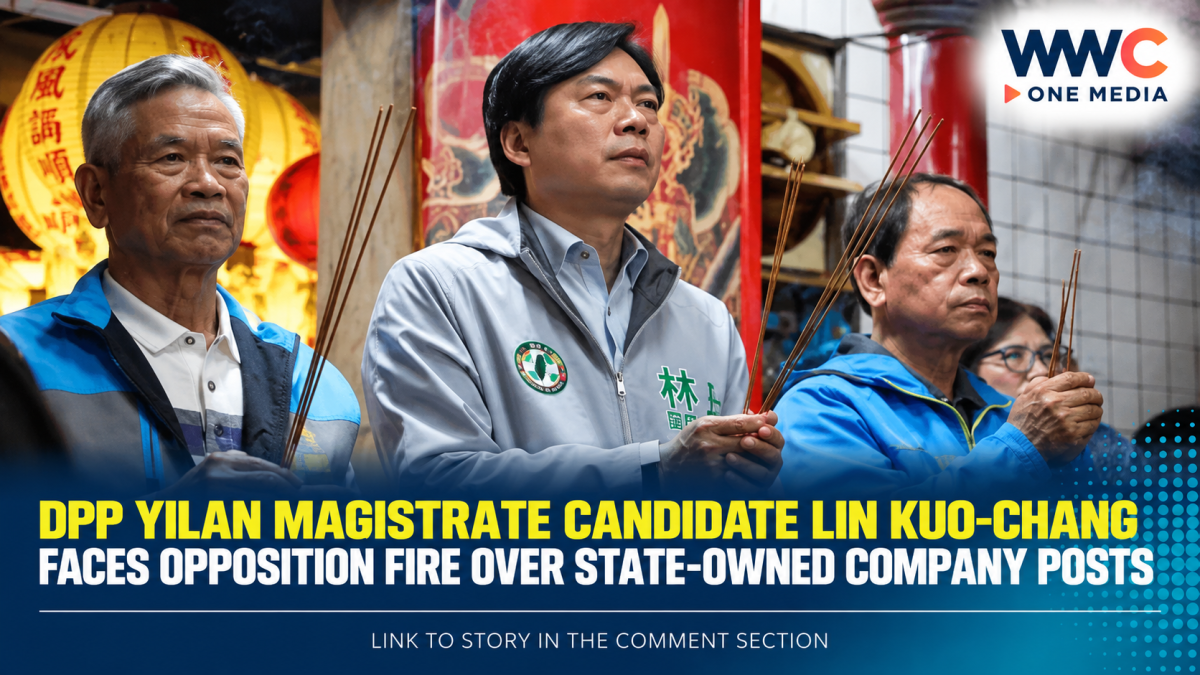
YILAN, Taiwan — Taiwan’s 2026 local election battle in Yilan is heating up, with Democratic Progressive Party (DPP) magistrate candidate Lin Kuo-chang facing mounting attacks from opposition politicians over his roles at several state-owned or government-linked companies.
The controversy erupted after opposition figures accused Lin of holding multiple positions at government-linked enterprises while receiving substantial compensation, describing the appointments as evidence of political patronage.
Lin, however, has rejected the allegations and argued that his professional record and the compensation he receives have been misrepresented.
According to recent Taiwanese media reports, Lin currently serves as a supervisor at Huaneng Shipping and Kuokuang Power, while also serving as an independent director of China Airlines. His campaign office said the positions generate considerably less income than the more than NT$2 million annual figure cited by opposition politicians.
The dispute has become a fresh flashpoint in the Yilan magistrate race, where Lin is seeking to return the county leadership to the DPP.
Opposition raises ‘political patronage’ questions
Taiwan People’s Party Yilan chairwoman Chen Wan-hui, one of Lin’s political critics, questioned why a single lawyer was selected for multiple positions at government-linked enterprises.
Opposition lawmakers and politicians have argued that Lin’s appointments raise questions about whether government-controlled companies are being used to reward political allies.
The criticism has focused particularly on the number of positions Lin has held and the compensation attached to them. United Daily News reported that opposition figures accused Lin of simultaneously serving at three state-owned or government-linked enterprises and receiving more than NT$2 million in annual compensation.
The allegations have given the opposition an opportunity to frame the issue as a question of government accountability ahead of November’s local elections.
But the figures themselves have become part of the political dispute.
Lin’s camp pushes back on compensation claims
Lin’s campaign office says the opposition’s description of his earnings is inaccurate.
According to the campaign, Lin receives about NT$10,000 per month in transportation-related compensation from each of his supervisor positions at Huaneng Shipping and Kuokuang Power. As China Airlines’ independent director, he receives approximately NT$60,000 per month in compensation.
His campaign therefore estimates his combined annual compensation from the three positions at roughly NT$1 million, rather than the more than NT$2 million figure cited by his opponents.
Lin’s camp has also emphasized his background as a lawyer and his experience in public affairs, arguing that his appointments should be assessed according to his professional qualifications rather than political labels.
The dispute illustrates how the definition of “political patronage” itself has become part of the election fight: the opposition sees the appointments as a question of political connections, while Lin’s side portrays them as positions earned through professional expertise.
A bigger battle for Yilan
The controversy comes as Yilan’s 2026 magistrate election becomes one of Taiwan’s closely watched local contests.
Lin was selected by the DPP as its candidate, while the opposition’s eventual joint candidate is Kuomintang (KMT) legislator Wu Tsung-hsien, after the KMT and Taiwan People’s Party conducted an integration process. Focus Taiwan previously reported that Wu emerged as the joint KMT-TPP choice following their polling process.
Earlier polling suggested a competitive race. A March TVBS survey cited in election coverage put Lin ahead of Wu in a potential two-way contest, while other polling has shown the candidates within a relatively close range.
That makes every controversy potentially significant.
For Lin, the challenge is to keep the campaign focused on his policy agenda and qualifications rather than allowing the state-owned-enterprise controversy to dominate the election conversation.
For the opposition, meanwhile, the issue offers a way to question the DPP candidate’s relationship with government-linked institutions and challenge the party’s claims of transparency and accountability.
Why the controversy matters
The fight is bigger than the amount of money involved.
At its core is a question that often becomes politically explosive during Taiwan’s elections: when does professional public service cross the line into political patronage?
Lin’s opponents argue that holding several government-linked positions while preparing to run for county magistrate deserves heightened scrutiny.
Lin’s campaign counters that the compensation figures have been inflated and that his professional qualifications have been ignored in the criticism.
With the 2026 local elections approaching, the dispute is unlikely to disappear quickly.
Instead, it could become another defining test of Lin’s campaign — and a measure of how effectively the DPP candidate can turn questions about his past appointments into a broader argument about experience, qualifications and Yilan’s future.
The battle for Yilan is now entering a phase where every appointment, every salary figure and every political connection can become campaign ammunition.




Leave a Reply