
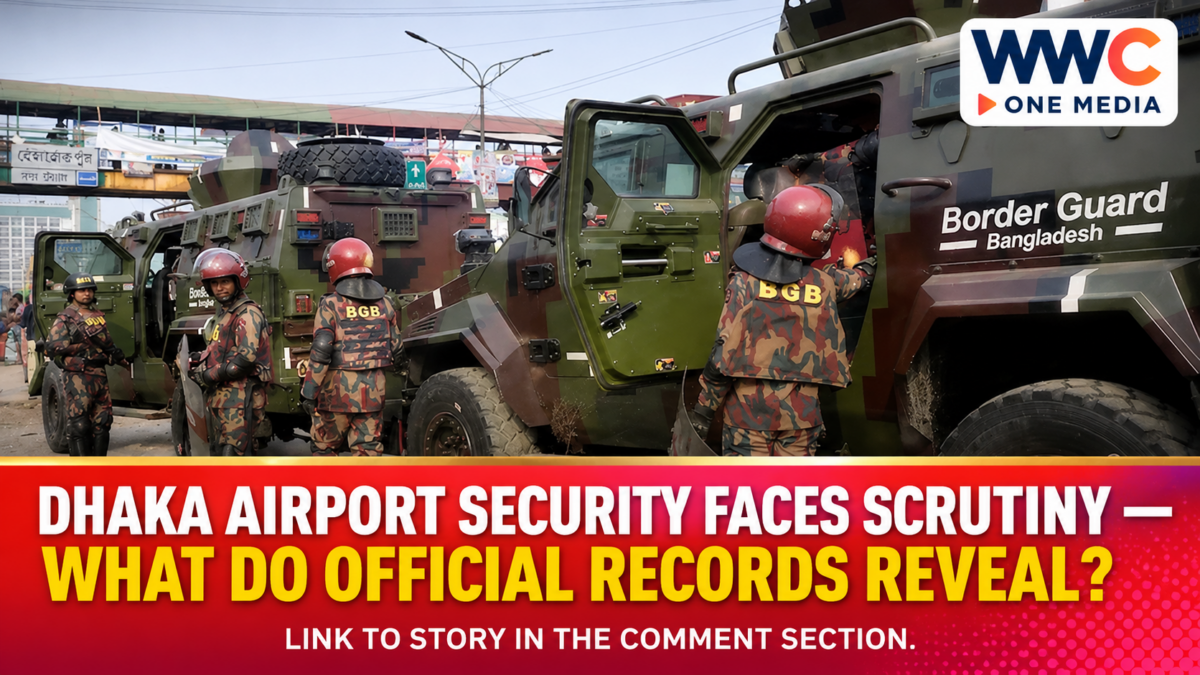
DHAKA, Bangladesh — Reports of explosions near Hazrat Shahjalal International Airport in November 2026 have renewed questions about Dhaka airport security and the protection of public areas surrounding one of Bangladesh’s major aviation facilities. As of Nov. 22, the publicly accessible official records examined for this report did not establish the reported number of injuries, identify suspects or provide a completed investigation into the specific incident.
The distinction is important for travellers, airport employees and businesses. Bangladesh’s aviation authorities publish operational security responsibilities and passenger guidance, but general security arrangements cannot substitute for an incident-specific investigation or establish what happened during a reported explosion.
Dhaka Airport Security: What Official Records Establish
Hazrat Shahjalal International Airport maintains a dedicated Aviation Security division, known as AVSEC, with responsibilities extending across passenger screening, aircraft security, cargo checks, access control and emergency response.
The airport’s official description of the division also identifies patrols, identity-card management, security training and cooperation with other law-enforcement agencies as part of its work.
These functions show that airport protection is not limited to inspecting passengers immediately before boarding. It also involves controlling movement through restricted facilities and ensuring that security personnel can respond when potential threats arise.
The public record, however, does not establish that any specific protection failed during the reported November explosions.
An effective assessment would require authorities to identify the precise location of each incident, determine which agency had jurisdiction and establish whether security procedures were followed.
Until those findings become available, conclusions about a breakdown inside the airport would be premature.
Why Security Beyond the Terminal Matters
International aviation standards recognise that airport security extends beyond aircraft and departure gates.
The International Civil Aviation Organization maintains Annex 17, which addresses the protection of civil aviation against unlawful interference.
Its airport landside-security training programme specifically covers identifying threats, developing preventive measures, protecting facilities and preparing crisis-management procedures.
Landside security is particularly significant because publicly accessible airport approaches may involve passengers, transport providers, employees and visitors who have not passed through aviation screening.
Analysis: A reported incident near an airport does not automatically establish that attackers entered a restricted aviation facility. The distinction between a public road, an airport entrance and a controlled departure area is essential when evaluating both the seriousness of an incident and the response required.
A useful comparison appears in WWC ONE MEDIA’s previous reporting on security arrangements extending beyond ASEAN Summit venues.
Although the Philippine and Bangladeshi situations are different, both illustrate why transport routes, access points and coordination between agencies deserve attention alongside physical security inside a venue.
Who Is Responsible for Protecting Travellers?
The airport’s published security arrangements describe several functions requiring coordination rather than a single organisation handling every potential emergency.
AVSEC is responsible for measures such as passenger and baggage screening, secure-area access management, security patrols and responses to incidents.
The airport also publishes emergency contact details for Aviation Security and Airport Police, explaining that assistance is available around the clock.
These provisions create several important questions for any investigation into an incident near airport property.
Investigators would need to establish whether the reported location was inside an aviation-controlled area, on an airport approach road or elsewhere under ordinary police jurisdiction.
They would also need to determine which responders received the initial alert, whether passengers faced an immediate threat and whether any disruption to airport operations resulted.
A reported explosion outside a terminal does not, by itself, prove a breach of aviation screening procedures.
What Can Passengers Actually Verify?
The airport’s published departure guidance provides an operational baseline for international travellers.
Passengers are instructed to reach the departure driveway at least four hours before their scheduled flight and follow the designated terminal-entry arrangements.
The airport also requires relevant travel documents to be presented to security personnel before entry and provides instructions for subsequent screening.
These are published airport procedures, not a special advisory established for the November reports.
Travellers should therefore distinguish routine instructions from emergency measures announced in response to particular incidents.
For passengers who encounter a security concern, the airport publishes an assistance hotline, 13600, alongside contacts for its security and police services.
Philippine readers may recognise a similar distinction from WWC ONE MEDIA’s coverage of airport security preparations at NAIA during a major travel period.
Security checks may be intensified for operational reasons, but travellers should not interpret a change in screening procedures as confirmation that a particular threat has been established.
Why Transparent Incident Reporting Matters
Public confidence depends partly on how accurately officials explain an incident and the measures introduced afterward.
For the reported Dhaka explosions, an authoritative public account would ideally establish the location, date, number of people affected, condition of the injured, evidence collected and status of any investigation.
It would also distinguish confirmed findings from preliminary assessments.
This matters because reports of explosions can generate immediate concern among passengers even when their effect on airport operations remains unclear.
Analysis: Airports need two forms of accountability: the ability to protect people and the ability to explain significant security events without overstating their implications.
WWC ONE MEDIA examined a related question in its review of Philippine police security operations and unresolved accountability issues.
That coverage concerns a different country and different circumstances. Its relevance is the broader public-interest principle that operational claims should be assessed against documented actions and independently verifiable findings.
For Dhaka, an accessible incident report would help establish which security concerns are supported by evidence and which remain allegations or unanswered questions.
What Happens Next?
The immediate outstanding issue is whether Bangladesh’s relevant authorities will make an incident-specific account publicly accessible.
Such a record could clarify the reported explosions, determine whether anyone was injured, establish the location relative to airport-controlled property and explain any resulting security measures.
Travellers should monitor current airport and airline guidance before departure, particularly if future operational notices announce revised access arrangements.
As of Nov. 22, the records reviewed here do not justify attributing responsibility for the reported incident to any named individual, political organisation or movement.
Bangladesh’s airport security framework is publicly described. What remains necessary is independently verifiable documentation connecting that framework to the particular events under examination.










