
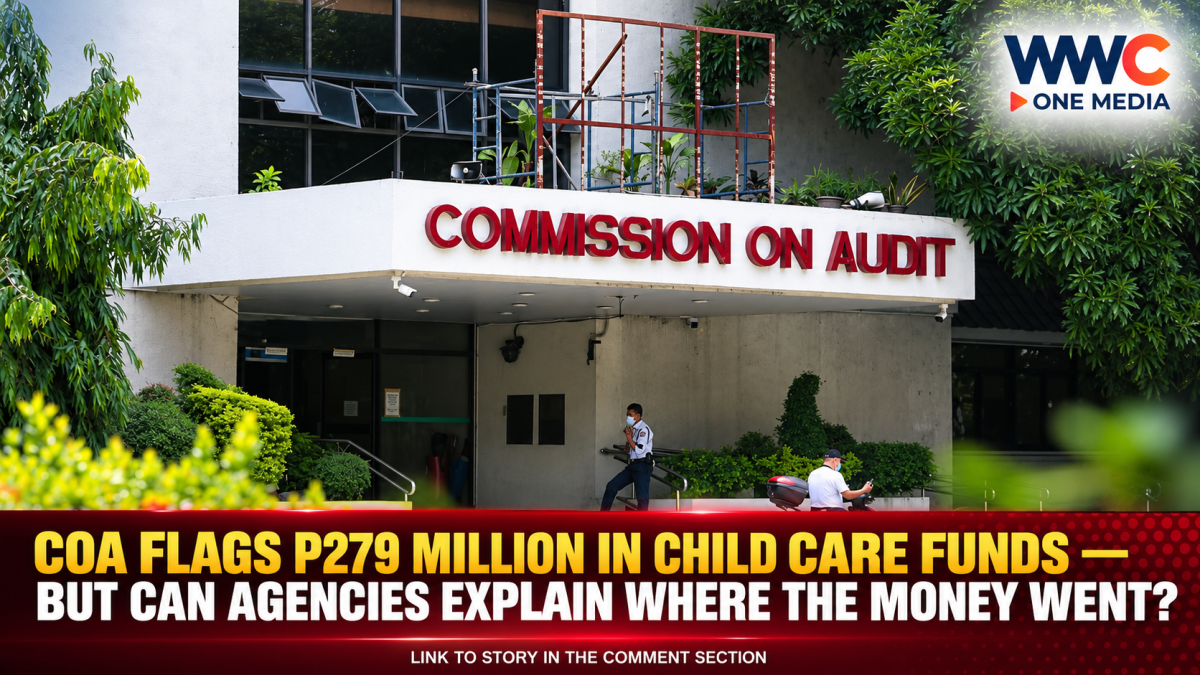
MANILA, Philippines — State auditors have flagged approximately P279 million in child care-related funds, raising fresh concerns over the monitoring, liquidation and accountability of government money intended to support early childhood care and development.
The Commission on Audit’s findings, reported by BusinessWorld on September 3, put renewed attention on how funds transferred to implementing agencies and local government units are tracked and eventually accounted for. The audit observations underscore a recurring challenge in government financial management: money may be released for a public program, but incomplete liquidation records and weak documentation can make it difficult for auditors to determine the final status of the funds.
The issue is particularly significant because the funds involve programs connected to the country’s early childhood care and development system, which serves children during some of the most critical years of their development.
Audit Findings Put Fund Monitoring Under the Spotlight
The latest report comes amid heightened scrutiny of government agencies responsible for children’s welfare and early childhood programs.
A separate 2024 audit report involving the Council for the Welfare of Children (CWC), reported by the Philippine Daily Inquirer in December 2025, also found P53.658 million in accounting deficiencies. Of that amount, P53.349 million involved dormant fund transfers from national government agencies and local government units, while other findings involved property items that could not be located because of inadequate records and documentation.
According to the COA findings cited by the Inquirer, some recipient local governments said the funds had been received during previous administrations, while others had failed to respond to demands for liquidation.
The auditors also noted the absence of records showing that immediate action had been taken to demand the liquidation, settlement or refund of fund transfers after they became due.
The COA recommended continued coordination with recipient agencies and local governments to reconcile and settle unliquidated transfers, as well as updated documentation and proper procedures for accounts that may eventually be deemed uncollectible.
Why the P279-Million Finding Matters
The latest P279-million audit issue comes as the Philippine government is increasing its investment in early childhood care and development.
The sector received a major policy boost following the enactment of the strengthened Early Childhood Care and Development system. Government initiatives have included funding for child development centers and additional support for child development workers.
In March 2025, President Ferdinand Marcos Jr. approved P700 million in funding for the establishment of child development centers in fourth- and fifth-class municipalities, highlighting the government’s push to expand access to early childhood services.
The 2026 national budget has also included significant support for early childhood development, including P226.9 million for the upskilling of child development workers, according to the Second Congressional Commission on Education.
That makes the proper monitoring of every peso even more critical.
Audit Flag Does Not Automatically Mean Theft or Corruption
It is important to distinguish an audit finding from a criminal finding.
A COA observation or audit flag does not automatically establish that public funds were stolen, misappropriated or lost. Audit findings can involve deficiencies in documentation, delayed liquidation, dormant accounts, weak monitoring or failures to comply with accounting and reporting procedures.
However, unresolved audit observations can raise serious questions about accountability and whether government agencies have sufficient controls to track public money from the time it is released until it is fully liquidated or returned.
The latest findings are therefore expected to intensify calls for stronger financial controls, faster reconciliation of fund transfers and more aggressive action against long-unsettled accounts.
Government’s Bigger Challenge: Accountability From Release to Liquidation
The P279-million issue highlights a broader problem confronting government agencies: releasing funds is only the first step.
The more difficult task is ensuring that every transfer is:
- properly documented;
- used for its intended purpose;
- supported by complete liquidation records;
- regularly monitored by the source agency; and
- promptly reconciled when discrepancies emerge.
For programs involving children, the stakes are particularly high.
Early childhood care and development covers essential services involving young children’s health, nutrition, education and overall development. The government’s continuing investment in child development centers and workers makes strong financial oversight crucial to ensuring that public funds actually translate into services for Filipino children.
As auditors press for better documentation and the settlement of outstanding accounts, the key question now is whether agencies involved can quickly reconcile the flagged funds and demonstrate exactly how the money was used.
Because when millions are intended for the country’s youngest citizens, unanswered questions about where the money went — and whether it was properly accounted for — are not likely to disappear anytime soon.
WWC ONE MEDIA J.M.S
Leave a Reply