
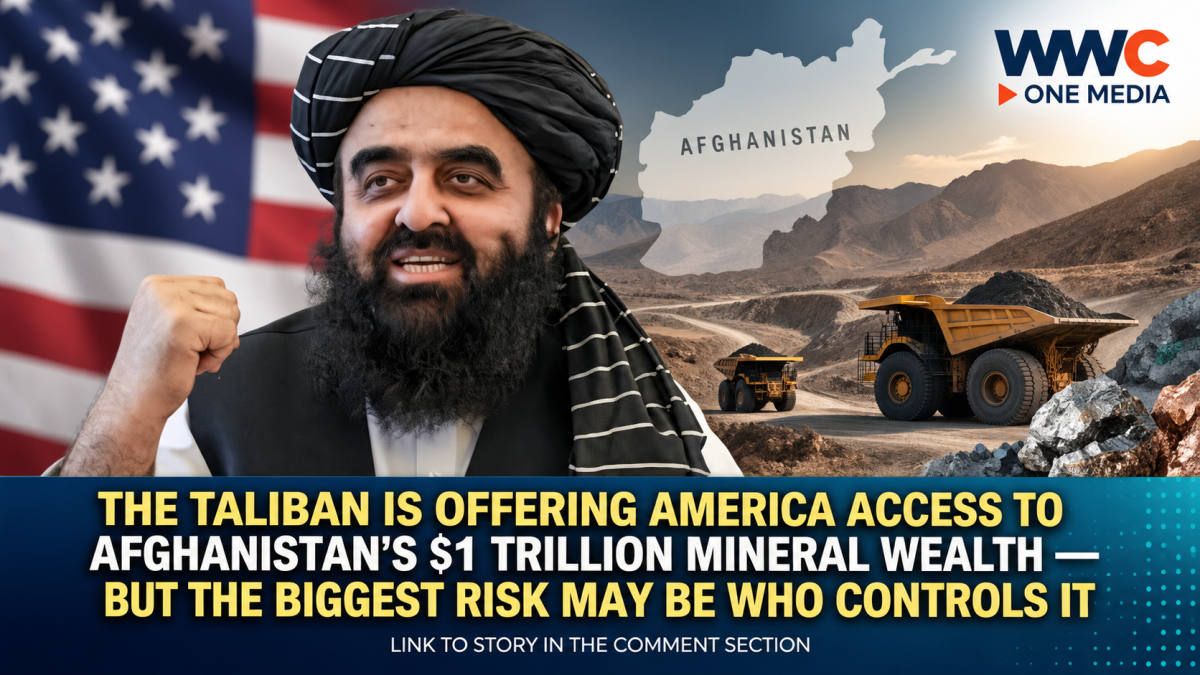
KABUL — Five years after retaking Afghanistan as the United States ended its longest war, the Taliban is making Washington an extraordinary new proposition:
Come back — not with soldiers, but with mining companies.
Taliban Foreign Minister Amir Khan Muttaqi has publicly welcomed American investment in Afghanistan’s mining, infrastructure, agriculture and trade sectors, arguing that relations between Kabul and Washington should no longer be judged exclusively through the 20 years they spent fighting each other.
Instead, he wants the United States to look underground.
Afghanistan is believed to contain enormous deposits of copper, iron ore, gold, lithium, cobalt, rare-earth-related minerals and precious stones, resources that could become increasingly attractive as Washington races to reduce its dependence on China for critical mineral supply chains.
But beneath the trillion-dollar sales pitch lies a problem potentially more dangerous than geology.
Who actually controls Afghanistan’s mines — and who would ultimately receive the money?
That question sits at the heart of a new Asia Times analysis warning that competition inside the Taliban over mineral revenues could turn what appears to be an attractive resource opportunity into an unusually complicated political and security gamble.
The Taliban Wants to Turn Minerals Into Diplomacy
Muttaqi’s overture represents a striking change in tone.
The Taliban spent two decades fighting U.S. and NATO forces before returning to Kabul in August 2021. Now its government is seeking American capital as part of a broader attempt to reduce Afghanistan’s economic isolation.
In an interview reported by the Financial Times, Muttaqi said Afghanistan’s economic policy was open to U.S. investment and argued that the future of relations should be built around cooperation rather than the previous war. The Taliban also continues to seek relief from sanctions and greater access to Afghan assets held abroad.
Mining is central to that strategy.
Since returning to power, the Taliban has announced or signed mining agreements valued collectively at more than $7 billion, involving partners including companies connected to China and Iran. But an important distinction is often lost in headlines: the value of announced contracts is not the same as money already invested, minerals already extracted or government revenue already collected.
Washington, so far, appears unconvinced.
A U.S. State Department spokesperson told Afghanistan International that the United States had no plans to work with the Taliban on developing Afghanistan’s critical mineral resources.
So the Taliban has made its offer.
America has not accepted it.
But the timing explains why the proposal cannot simply be dismissed.
America Is Hunting for Minerals Almost Everywhere
Critical minerals have become an economic and national-security priority for Washington.
The Trump administration announced roughly $3 billion in government investment and financing for critical-mineral and battery projects in August, including projects involving materials important to defense and advanced manufacturing.
The objective is straightforward: reduce American vulnerability to mineral supply chains dominated or heavily influenced by China.
The U.S. is also backing overseas projects.
A government-supported investment consortium has been building a multibillion-dollar pipeline of potential critical-mineral investments across Asia and other regions, including opportunities in countries such as Indonesia, Vietnam, the Philippines, Kazakhstan and Uzbekistan.
And the urgency is increasing.
Reuters reported this week that some Chinese rare-earth suppliers had halted certain shipments to the United States amid renewed geopolitical tensions and concerns surrounding Beijing’s export-control regime. Materials including tungsten, yttrium and other specialty minerals have become increasingly strategic for aerospace, defense, electronics and semiconductor production.
On paper, Afghanistan therefore looks tempting.
Huge deposits.
Strategic location.
An impoverished government eager for foreign capital.
And an America desperate to diversify mineral supplies.
But Afghanistan’s minerals have looked tempting on paper before.
The Famous ‘$1 Trillion’ Number Needs Context
The idea that Afghanistan sits on $1 trillion or more in mineral wealth exploded into public consciousness in 2010.
U.S. geological work identified potentially significant deposits of iron, copper, gold, rare earths and other materials. A Pentagon task force subsequently attached enormous dollar values to those geological estimates.
A U.S. State Department presentation at the time cited estimates of as much as $800 billion in sedimentary iron, hundreds of billions in copper and large potential values in hydrocarbons and other resources.
But even U.S. Geological Survey specialists cautioned against interpreting the trillion-dollar number too literally.
One USGS official later explained that the figure had essentially been produced by multiplying estimated quantities of resources by commodity prices and adding the totals together. USGS itself had tried to distance its geological assessment from the simplistic headline valuation.
That distinction is enormous.
A mineral existing underground does not automatically make it an economically viable reserve.
Commercial mining requires roads, electricity, water, processing facilities, skilled labor, financing, security, regulatory certainty and often billions of dollars in upfront investment.
The mineral may be worth $100 in the ground but considerably less once the cost of extracting and transporting it is calculated.
And in Afghanistan, almost every one of those complications is magnified.
Then Comes the Question Asia Times Raises: Who Controls the Money?
The Taliban presents itself internationally as Afghanistan’s government.
But control of economic resources inside Afghanistan can be considerably more complicated.
Asia Times argues that mining increasingly intersects with competing centers of Taliban power: the leadership surrounding Supreme Leader Hibatullah Akhundzada in Kandahar, powerful figures associated with the Haqqani network, provincial commanders and local economic interests.
The clearest recent warning comes from Badakhshan.
The mountainous northeastern province contains valuable gold and precious-stone deposits.
Afghanistan International reported in June that the Taliban leadership had deployed a newly formed force of roughly 1,000 personnel to Badakhshan amid an effort to increase central control over mining.
Sources quoted in that investigation alleged that officials and commanders were being removed, transferred or arrested as Kandahar sought to weaken locally powerful figures whose influence had grown partly through control of mineral resources.
Those allegations are significant, but they require careful attribution: they come primarily from Taliban-linked and local sources speaking to Afghanistan International and have not all been independently verified by major international news agencies.
Still, subsequent reporting showed real friction surrounding mining.
Residents protested restrictions on gold extraction, while another report said Taliban authorities later loosened certain mining restrictions following unrest in parts of Badakhshan.
That is exactly the kind of political risk a foreign mining company would have to price into any Afghan project.
A contract signed by a ministry in Kabul may establish legal rights on paper.
It does not necessarily settle who exercises influence around the mine, transportation corridor, labor force or local revenue streams.
Minerals Can Create Wealth — Or Intensify Competition for It
This is where Afghanistan’s trillion-dollar story becomes more complicated.
Natural resources do not automatically create prosperity.
When institutions are weak, mineral wealth can instead produce competition among political elites, armed groups, local power brokers and central governments over who gets the revenue.
Asia Times argues that Afghanistan faces precisely this danger: mineral resources distributed across distant provinces while political authority and revenue collection are increasingly centralized around Kandahar.
Local communities create another layer of risk.
Afghanistan International has reported complaints in Badakhshan that some mining operations damaged land and that ordinary residents received relatively little of the economic benefit. Other reports describe disputes between authorities, local miners and politically connected operators over who is permitted to extract gold.
For a Western company, those questions would quickly become corporate-governance issues:
Who owns the local partner?
Where do royalties go?
Who provides security?
Who controls transportation?
Are communities compensated?
Can environmental rules be enforced?
And could payments indirectly benefit sanctioned individuals or networks?
Those are not theoretical concerns when operating in one of the world’s most politically isolated governments.
Afghanistan Desperately Needs the Investment
The Taliban’s enthusiasm for foreign mining capital also reflects economic reality.
Afghanistan’s economy has recently returned to modest headline growth, but living standards remain under severe pressure.
The World Bank estimated real GDP growth at 4.8%, but the country’s population expanded much faster following the return of millions of Afghans from neighboring countries. As a result, GDP per person was estimated to have fallen 5.6%.
Inflation reached 7.6% by March 2026, while Afghanistan remained burdened by weak investment, unreliable electricity, limited financing and a huge trade imbalance.
The World Bank estimated Afghanistan’s current-account deficit at an extraordinary 36.1% of GDP in 2025, partly reflecting dependence on imports and declining external inflows.
Mining therefore offers something the Taliban badly needs:
A possible source of exports, tax revenues, employment and foreign currency that does not depend entirely on humanitarian assistance.
But converting geological resources into sustainable economic growth is the difficult part.
Human Rights Make Any American Deal Even Harder
Mining economics are only one obstacle.
Political legitimacy is another.
Russia became the first country to formally recognize the Taliban government in July 2025, but most Western governments continue to withhold recognition.
The Taliban’s treatment of women and girls remains one of the biggest barriers to normalization.
Reuters reported in August that the Taliban had issued more than 100 decrees restricting women’s rights since returning to power, including severe limits on education, employment, health access and freedom of movement. The United Nations has described Afghanistan as facing the world’s most severe women’s-rights crisis.
Earlier this year, the UN human rights chief also condemned another Taliban decree that he said could expand executions and corporal punishment while further institutionalizing repression.
That makes a major American mining partnership politically difficult even if the commercial numbers eventually make sense.
Any U.S. administration contemplating such investment would have to explain why American capital should strengthen an internationally isolated government whose domestic policies Washington has repeatedly condemned.
And China Is Already There
The Taliban’s pitch also has a geopolitical dimension.
China has long been interested in Afghanistan’s mineral potential, particularly the enormous Mes Aynak copper deposit in Logar province, while Chinese-linked companies have participated in newer Taliban-era mining arrangements.
The Taliban’s invitation to American companies can therefore be viewed partly as an attempt to diversify investment partners rather than allowing Afghanistan’s resource economy to become overwhelmingly dependent on China.
From Kabul’s perspective, competition is useful.
If American, Chinese, Iranian and regional investors compete for concessions, Afghanistan potentially gains bargaining leverage.
From Washington’s perspective, however, that same environment creates an uncomfortable possibility:
The United States could spend billions building mines and infrastructure inside a country where political control remains opaque while simultaneously competing against China for influence over the same resources.
That is a far more complicated calculation than simply identifying lithium on a geological map.
The Real Treasure May Be Much Harder to Unlock
Afghanistan unquestionably possesses substantial mineral resources.
Copper could be particularly important as electrification, power grids, data centers and defense manufacturing drive global demand. Lithium and other critical minerals would also attract attention if deposits prove commercially viable.
But Afghanistan has been described as a future mining powerhouse for more than 15 years.
The minerals remained underground through the U.S.-backed republic.
They remained underground through years of war.
And large-scale extraction remains extraordinarily difficult under Taliban rule.
The Taliban now hopes Donald Trump’s transactional approach to foreign policy — combined with America’s increasingly urgent search for critical minerals — could finally change that equation.
Yet Washington’s initial answer is no.
And Asia Times’ central warning deserves attention even if some of its conclusions remain analysis rather than established fact:
The biggest risk may not be whether Afghanistan has enough minerals.
It may be whether an investor can determine who really controls them, who gets paid, whether contracts survive internal power struggles and whether extracting that wealth creates stability — or another contest for power.
The Taliban is selling America a trillion-dollar opportunity.
Before Washington reaches for the minerals, it may first have to figure out whose hands are actually on the mine.
WWC ONE MEDIA M.J.E


Leave a Reply