
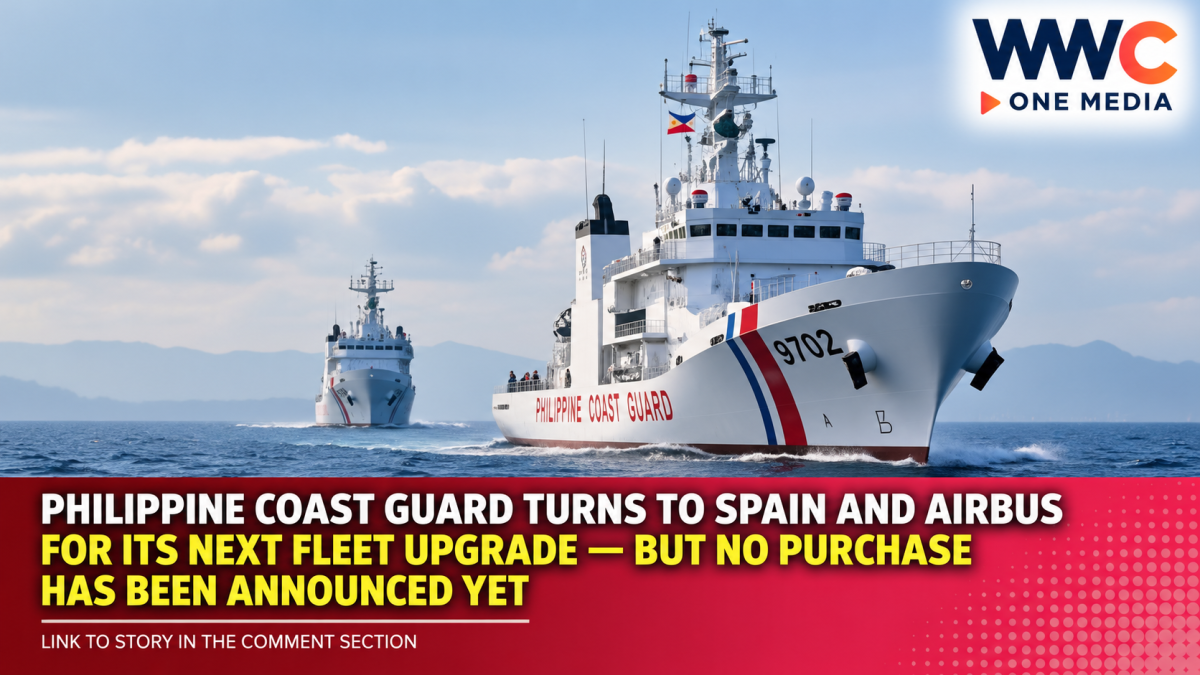
MANILA — The Philippine Coast Guard’s modernization drive is opening another door in Europe.
The PCG has explored possible cooperation with the Spanish government and Airbus Defence and Space as it seeks to strengthen the aircraft, ships and technology available for maritime surveillance, search and rescue and other Coast Guard missions, according to a Sept. 6 report by Manila Bulletin.
The development comes as the Philippines rapidly expands one of the most consequential Coast Guard modernization programs in its history.
Japan is financing five new 97-meter patrol ships.
France is supplying 40 fast patrol boats.
The United States is supporting the acquisition of three King Air aircraft.
And now Spain and Airbus have entered the conversation.
But there is a crucial difference.
Unlike several of those existing programs, no publicly confirmed purchase contract with Airbus has yet emerged from the latest discussions.
That means the story is not yet about what aircraft the Philippines has bought.
It is about what the Coast Guard may decide it needs next.
The PCG needs more than ships
The timing is significant because Philippine officials are increasingly acknowledging that maritime modernization cannot be accomplished with vessels alone.
In August, PCG spokesperson for the West Philippine Sea Rear Admiral Jay Tristan Tarriela said the Coast Guard’s priority had shifted toward acquiring more assets, improving logistics hubs and ports, and modernizing operational capability.
“Right now, what we need is several assets and modernization also of our capability,” Tarriela said.
That gap is particularly visible in aviation.
At a Senate hearing on Sept. 3, Sen. Juan Miguel Zubiri argued that the Coast Guard needs to organize both sea and air assets to provide faster emergency response as the Philippines moves toward fuller implementation of the International Convention on Maritime Search and Rescue.
Inquirer reported that Zubiri specifically pointed to the PCG’s lack of air assets as a weakness in rapid-response capability.
For an archipelago of more than 7,000 islands surrounded by enormous stretches of sea, aircraft can reach distressed vessels, monitor large areas and coordinate rescue missions far faster than ships alone.
That makes the Spain-Airbus discussions strategically interesting even before the exact equipment is known.
But do not call it an Airbus aircraft order yet
This is the biggest editorial caution surrounding the story.
Manila Bulletin says the PCG explored cooperation with Spain and Airbus Defence and Space.
That is not the same thing as announcing a contract.
As of the reporting checked for this rewrite, there is no independently confirmed public announcement identifying:
- a specific Airbus aircraft or system,
- the number of units to be acquired,
- a contract value,
- a financing structure,
- or a delivery schedule.
So headlines claiming that the PCG has “bought Airbus aircraft,” “ordered C295s,” or signed a finished acquisition deal would go beyond what is currently verified.
The distinction is particularly important because Airbus Defence and Space is a different Airbus business line from Airbus Helicopters.
The Coast Guard already has an established relationship with the helicopter side of Airbus, but that does not prove the current discussions concern another helicopter purchase.
The Coast Guard already knows Airbus
The Airbus name itself is not new to the PCG.
In 2018, Airbus announced that the Philippine Coast Guard would become the country’s first parapublic operator of the H145 helicopter.
The aircraft was configured with high-frequency radios, emergency flotation equipment, fast-rope capability, a cargo sling, searchlight and electro-optical systems for missions including search and rescue, medical evacuation, maritime patrol and law enforcement.
That history matters because it means the Coast Guard already has experience operating Airbus equipment in demanding maritime missions.
But it should not be used to assume that the latest Spain-linked discussions are automatically about buying additional H145s.
The company named in the new report is Airbus Defence and Space, whose portfolio extends well beyond helicopters into military transport aircraft, surveillance, satellites and other aerospace systems.
Until the PCG names a platform, anything more specific remains speculation.
Meanwhile, three American King Air aircraft are already on the way
The clearest sign that the Coast Guard intends to expand its aviation capability came earlier this year.
On Feb. 16, PCG Commandant Admiral Ronnie Gil Gavan signed a Letter of Offer and Acceptance with the United States for three Beechcraft King Air turboprop aircraft.
The Coast Guard said the planes are intended to strengthen maritime domain awareness, maritime surveillance and search-and-rescue operations.
That acquisition gives useful context to the Airbus talks.
The PCG is not simply looking for more aircraft for transportation.
It is building an aviation capability around one of its largest operational problems: seeing what is happening across enormous areas of Philippine waters quickly enough to respond.
A fixed-wing aircraft can patrol vast distances much faster than even the Coast Guard’s largest cutters.
That matters in everything from missing-vessel searches to illegal fishing and monitoring activities in the West Philippine Sea.
The West Philippine Sea is driving urgency
PCG modernization has become increasingly intertwined with the Philippines’ maritime disputes with China.
Tarriela said in August that additional assets and capability improvements are necessary to sustain monitoring of Philippine maritime territory, particularly around the Kalayaan Island Group and Bajo de Masinloc, or Scarborough Shoal.
The Coast Guard has become one of Manila’s most visible agencies in the West Philippine Sea because its white-hulled vessels undertake patrols, escort resupply missions, support Filipino fishermen and document encounters with Chinese ships.
The mission is complicated by distance.
Scarborough Shoal lies roughly 120 nautical miles west of Luzon.
Many Philippine-held features in the Spratly Islands are much farther from the mainland.
Ships can remain on station for long periods, but aircraft and advanced surveillance systems can dramatically improve the Coast Guard’s ability to find, identify and track vessels across those enormous areas.
That is why modernization is increasingly about sensors, aviation and maritime-domain awareness, not only hull numbers.
Japan is building the Coast Guard’s next generation of big ships
On the surface-fleet side, Japan remains one of the Philippines’ most important Coast Guard partners.
Tokyo and Manila signed a ¥64.38-billion loan agreement, worth roughly ₱24.57 billion at the time of signing, to finance five additional 97-meter multi-role response vessels.
Those ships will join the 97-meter BRP Teresa Magbanua and BRP Melchora Aquino, the PCG’s current largest Japanese-built vessels.
JICA says the five additional ships are intended to improve the Coast Guard’s response to offshore and coastal incidents, including search and rescue, maritime law enforcement and marine-environment protection.
The Philippine government has also explicitly linked them to the country’s response in the West Philippine Sea.
Japan’s financing therefore represents the heavy end of the modernization program: large ships capable of prolonged operations far from shore.
France is supplying 40 smaller, faster patrol boats
France occupies another part of the fleet plan.
French shipbuilder OCEA signed a contract to supply the PCG with 40 35-meter FPB 110 MKII fast patrol boats, along with logistics and maintenance support.
The Philippine government put the project at approximately ₱25.8 billion, calling it the largest single acquisition in PCG modernization when it was approved.
Twenty of the vessels are planned for construction in the Philippines.
The boats are intended for missions such as maritime law enforcement, anti-smuggling operations, countering illegal fishing and rapidly responding across Coast Guard districts.
PCG officials have also said some could operate in the West Philippine Sea as part of a broader mix of capabilities.
Naval News reported in February that OCEA expected the first batch to begin arriving in the latter part of 2026, if the program proceeds according to schedule.
Put together, the pattern is becoming clear
The Coast Guard is not betting its modernization on one country or one type of asset.
Instead, Manila is assembling different capabilities from multiple partners:
Japan: five additional 97-meter multi-role response vessels.
France: 40 fast patrol boats from OCEA.
United States: three King Air aircraft for surveillance and search and rescue.
Spain and Airbus: newly reported exploratory cooperation whose exact equipment and financing have not yet been publicly specified.
That diversification has a practical advantage.
A modern Coast Guard needs long-endurance ships, fast coastal patrol craft, aircraft, communications networks, sensors, logistics support and crews capable of operating them.
No single platform solves all of those problems.
And there is more money behind modernization than before
The PCG’s resources have also expanded.
The final 2026 General Appropriations Act provides ₱42.514 billion in new appropriations for the Philippine Coast Guard. The Department of Budget and Management describes it as the agency’s largest budget to date.
That figure is higher than the approximately ₱35.4 billion originally proposed in the 2026 National Expenditure Program, underscoring how the final budget changed during the legislative process.
The money covers far more than acquisitions — personnel expenses and routine operations account for substantial portions — so it should not be treated as a ₱42.5-billion fleet-buying fund.
But it gives the Coast Guard greater capacity to operate, maintain and support a rapidly expanding organization.
And that last part is crucial.
Buying ships and aircraft is relatively easy compared with keeping them mission-ready for decades.
The real modernization challenge is sustainment
Every additional aircraft creates requirements for pilots, aircrew, mechanics, spare parts, hangars, training and recurrent maintenance.
Every new patrol vessel needs crews, fuel, port infrastructure and technical support.
That is why several current Coast Guard acquisitions include long-term logistics packages.
Japan’s five 97-meter ships come with an integrated logistics-support component under the JICA project.
OCEA’s French patrol-boat program includes maintenance and integrated logistics support, while the company already operates a Philippine subsidiary supporting previous PCG vessels.
Airbus likewise included technical support and continuing-airworthiness services when the PCG originally acquired its H145.
That should be a major consideration in any future Spain-Airbus arrangement.
A sophisticated aircraft that spends too much time grounded because of maintenance or supply-chain constraints does not improve maritime awareness.
A smaller but consistently available fleet often provides more operational value.
Spain’s involvement also makes strategic sense
Spain and the Philippines share historical ties, but modern security cooperation is increasingly focused on practical capability development.
The Spanish ambassador had already discussed future PCG capability and capacity development during a courtesy visit to Coast Guard headquarters in May 2025, according to PCG posts about the meeting.
Spain is also deeply integrated into Airbus’ defence-industrial base.
That creates the possibility of combining government-to-government support with a major European aerospace supplier — a model broadly similar in structure, though not necessarily in financing, to the PCG’s growing relationships with Japan and France.
But again, the present talks should not be confused with an approved procurement.
What could the Coast Guard actually need?
The operational requirements are easier to identify than the eventual product.
The PCG needs assets capable of:
- monitoring broad areas of the Philippine exclusive economic zone;
- locating ships and small boats at long range;
- coordinating search-and-rescue missions;
- moving personnel and emergency equipment quickly;
- supporting disaster relief and medical evacuation;
- and maintaining situational awareness in the West Philippine Sea.
The King Air acquisition already addresses part of that requirement.
Any additional aircraft or systems from Airbus would therefore need to complement, rather than simply duplicate, capabilities already entering service.
Whether the PCG ultimately seeks another fixed-wing surveillance aircraft, mission systems, communications equipment, unmanned systems or some other capability has not yet been publicly established in the reporting reviewed.
That unanswered question is precisely what makes the Spain-Airbus discussions worth watching.
The Coast Guard is getting bigger — and expectations are rising with it
The Philippine Coast Guard today performs far more than traditional coastal safety work.
Its responsibilities include maritime law enforcement, search and rescue, environmental response, maritime-domain awareness, disaster operations and protection of Philippine sovereign rights at sea.
As the fleet grows, the government is expecting the agency to maintain a larger presence across the country’s maritime zones.
The challenge is especially difficult in the West Philippine Sea, where Philippine Coast Guard vessels frequently operate around much larger Chinese Coast Guard ships.
PCG officials argue that adding more platforms will allow the service to sustain patrols without concentrating too much of its fleet in a handful of hotspots.
That makes the modernization race partly a numbers problem.
But it is also a technology problem.
A country cannot physically place a Coast Guard vessel beside every ship inside an exclusive economic zone stretching across hundreds of thousands of square kilometers.
It needs aircraft and surveillance technology to know where those vessels should go.
That is why the Airbus story could become much bigger
At the moment, the Spain-Airbus development is still an opening move.
There is no confirmed fleet size.
No confirmed platform.
No publicly announced price.
And no publicly announced delivery date.
But it is happening while the Philippine Coast Guard is simultaneously adding American aircraft, Japanese capital ships and French patrol boats — a scale of international modernization cooperation that would have been difficult to imagine for the service only a decade ago.
If the Airbus discussions advance into a funded acquisition, they could fill another major gap in the Coast Guard’s rapidly evolving fleet.
If they remain only exploratory, the PCG will still have significant new aviation and maritime assets arriving through its existing partnerships.
Either way, Manila’s direction is becoming unmistakable:
The Philippines wants a Coast Guard that can see farther, travel faster and remain at sea longer.
The unanswered question is not whether the modernization drive is accelerating.
It is what Spain and Airbus will ultimately add to it.
WWC ONE MEDIA M.J.E




Leave a Reply