
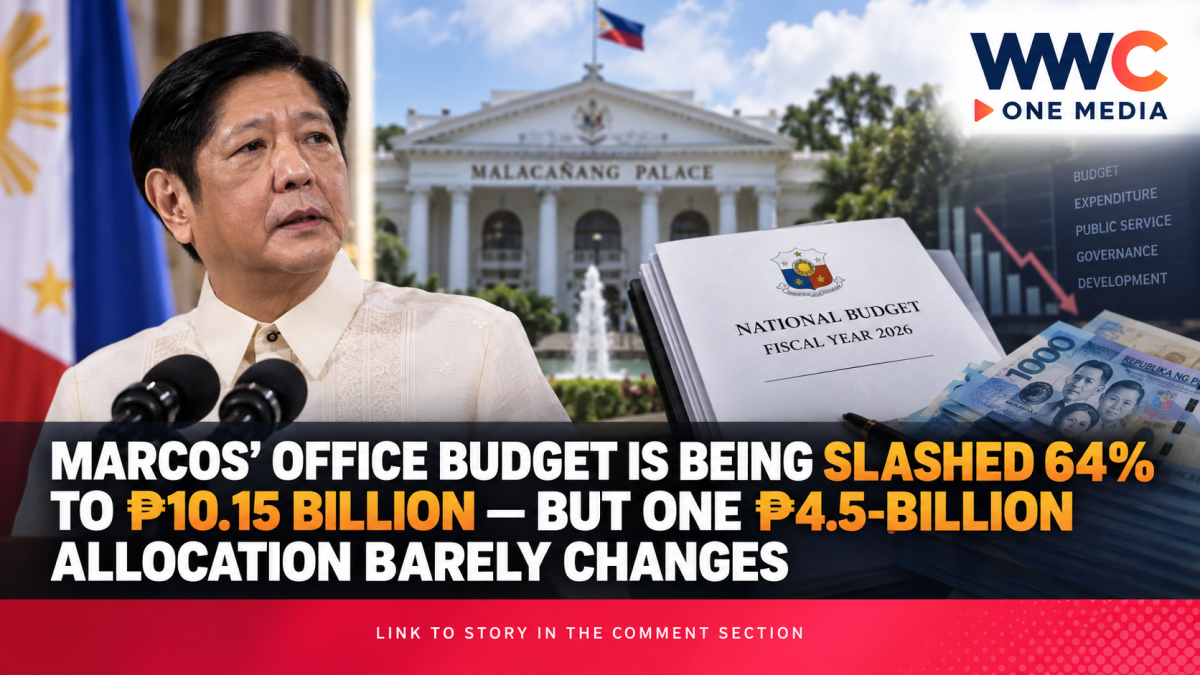
MANILA, Philippines — President Ferdinand Marcos Jr.’s office is preparing to operate next year with nearly two-thirds less money than it received in 2026.
But there is a striking detail buried inside the dramatically smaller budget:
the President’s confidential and intelligence funds are barely changing.
The Office of the President is proposing a ₱10.156-billion budget for 2027, compared with approximately ₱28.029 billion under the 2026 General Appropriations Act. That translates to a reduction of about ₱17.87 billion, or almost 64%.
Executive Secretary Ralph Recto says the enormous cut will not weaken the Palace’s ability to run the executive branch.
“We’re asking for less, while remaining fully prepared to do more,” Recto told lawmakers as he presented the spending proposal.
His argument is straightforward:
2026 was an unusually expensive year because the Philippines was hosting the Association of Southeast Asian Nations summits and related meetings.
Those exceptional expenses largely disappear in 2027.
But while the headline number drops sharply, a much more politically sensitive part of the presidential budget remains almost untouched.
Almost 45% of the entire OP budget is for secret funds
Under the 2027 spending proposal, the Office of the President is seeking roughly:
₱2.25 billion in confidential expenses, and
₱2.3 billion to ₱2.31 billion in intelligence expenses.
Combined, that is approximately ₱4.55 billion to ₱4.56 billion.
That represents roughly 45% of the Office of the President’s entire proposed 2027 budget.
Put another way:
For every ₱100 proposed for President Marcos’ office next year, about ₱45 would fall under confidential or intelligence spending categories.
That percentage appears unusually large because the overall OP budget is shrinking while its confidential and intelligence allocation remains essentially unchanged from 2026.
Official House records say the OP’s proposed ₱4.55-billion confidential and intelligence allocation is unchanged from the current year.
And that is where the political argument begins.
Why is the overall budget falling so sharply?
Recto said there are two main reasons:
lower operational requirements, and the end of spending connected with the Philippines’ 2026 ASEAN chairmanship and summit hosting.
The government budgeted heavily for ASEAN this year.
Official DBM documents show that the 2026 National Expenditure Program set aside approximately ₱17.496 billion across government agencies for ASEAN summits and related meetings.
Of that amount, roughly ₱10.784 billion was assigned through the Office of the President, with the rest distributed among agencies including the Philippine National Police, Department of Information and Communications Technology, Department of Tourism, Presidential Communications Office and others.
The government described the 2026 ASEAN chairmanship as a massive logistical undertaking involving hundreds of meetings throughout the year.
DBM’s President’s Budget Message said the Philippines was preparing to host the 48th ASEAN Summit as well as 231 cluster meetings and 695 sub-cluster meetings.
That helps explain why the Office of the President’s budget surged in 2026 and then appears to collapse in 2027.
But there is a nuance worth preserving.
The approximately ₱17.87-billion year-on-year reduction in the OP budget is larger than the ₱10.78 billion in ASEAN funding directly assigned through the OP in the 2026 NEP.
So it would be misleading to write that the entire 64% cut is simply the disappearance of ASEAN spending.
Recto also specifically cited lower operational requirements.
Recto says Malacañang can still do the job
Despite the sharp reduction, Recto said the proposed ₱10.15 billion is sufficient for the presidency to respond to emergencies, supervise the bureaucracy, protect national interests and manage domestic and international challenges.
Separate reporting by Bombo Radyo said the planned allocation includes roughly ₱7.46 billion for maintenance and other operating expenses, about ₱1.86 billion for personnel services, and around ₱839 million for capital outlays.
The Office of the President itself represents only about 0.14% of the proposed ₱7.2-trillion national budget for 2027, Recto told lawmakers.
The overall national budget is moving in the opposite direction.
DBM says the ₱7.2-trillion 2027 National Expenditure Program is 6% larger than the 2026 national budget, driven partly by mandatory obligations, higher allocations for local governments, government salary adjustments and other fiscal commitments.
So while national spending is increasing, spending assigned directly to the President’s office is plunging.
But lawmakers barely had time to question it
The budget hearing itself became controversial.
After Recto made his presentation on Sept. 1, House leaders invoked “institutional and inter-branch courtesy” and moved to terminate detailed questioning of the President’s budget.
Manila Bulletin timed the substantive deliberation at only about 16 minutes.
The House voted 37-5 to end further committee discussion.
GMA News similarly reported that approval came in less than 20 minutes.
Philstar described the proposal as clearing committee-level deliberations within the opening portion of the hearing.
That speed immediately drew objections from minority lawmakers.
Tinio: If transparency applies to the Vice President, it should apply to the President
ACT Teachers Party-list Rep. Antonio Tinio, a deputy minority leader, opposed ending the discussion.
His central argument was that Congress should apply the same standards of transparency to the Office of the President that lawmakers have demanded from the Office of the Vice President.
“The people want transparency,” Tinio argued, according to GMA News.
His concern focused heavily on the confidential and intelligence funds.
Because the OP’s total proposed budget has fallen dramatically while those funds remain roughly flat, secret spending now takes up a much larger percentage of the whole.
Tinio has put the proportion at approximately 44.9%.
The criticism does not establish that the funds are being misused.
Rather, the debate centers on how much scrutiny Congress should apply to billions of pesos whose operational details cannot ordinarily be made fully public because of their classified nature.
Recto says Marcos needs the money for security
Recto defended both categories.
He said confidential funds are justified because the President is the country’s chief executive and head of state, with responsibility for law and order.
Intelligence funds, he said, are necessary because Marcos is also commander-in-chief of the Armed Forces of the Philippines and bears responsibility for national security.
House Human Rights Committee Chair Bienvenido Abante Jr. has separately defended the President’s access to such funding, arguing that national security responsibilities give the presidency a legitimate need for intelligence capabilities.
Abante nevertheless said the important issue is ensuring the money is used correctly and properly accounted for.
Government-wide, the House says proposed confidential and intelligence spending for 2027 stands at around ₱10.773 billion, down from approximately ₱11.818 billion in 2026.
That means the President’s roughly ₱4.55 billion represents a substantial share of all such funds across government.
Palace points to a clean COA audit opinion
Recto also cited the Office of the President’s “unmodified opinion” from the Commission on Audit as evidence of its financial reporting record.
An unmodified opinion is the highest standard audit opinion and means auditors concluded that the agency’s financial statements were presented fairly, in all material respects, under the applicable accounting framework.
But there is an important distinction journalists should preserve:
an unmodified audit opinion does not mean COA is certifying that every individual government transaction was proper or free of irregularity.
Manila Bulletin itself made that clarification in its coverage of Recto’s defense.
Malacañang has also said documentation exists for the OP’s confidential spending and argued that it follows prescribed accounting procedures.
The 64% cut also comes after underspending concerns
There is another piece of context that makes the 2027 reduction more interesting.
Earlier this year, government figures showed the Office of the President had not fully utilized all of the cash authorities released to it.
Manila Bulletin reported that the OP’s cash utilization rate stood at around 64.1% by the end of the first half of 2026, leaving approximately ₱3.3 billion in unused Notices of Cash Allocation at that point.
That does not automatically mean the OP’s annual appropriation was excessive.
Budget utilization can accelerate later in the year, and ASEAN-related expenses may not occur evenly across the fiscal calendar.
But it adds another layer to the government’s claim that a smaller 2027 allocation can still support presidential operations.
Recto himself has spent much of 2026 pressing government agencies to accelerate budget execution, warning that public funds have little value if approved programs are not implemented on time.
A budget cut that is not really austerity across government
The biggest mistake would be to frame the change as a government-wide austerity drive.
It is not.
The proposed national budget is rising to ₱7.2 trillion.
The Office of the President is shrinking primarily because 2026 contained unusually large spending connected with ASEAN hosting and other temporary requirements.
That makes the 64% number dramatic but potentially misleading without context.
The better comparison is this:
2026 was the exceptional year.
With the ASEAN-related spending winding down, the President’s office is returning toward a more normal operating scale.
For comparison, the proposed OP budget for 2025 was around ₱10.5 billion in the 2025 expenditure program before subsequent annual changes.
So the 2027 proposal is not evidence that Malacañang suddenly intends to run on one-third of what historically has been considered normal.
Rather, it shows how dramatically ASEAN hosting inflated the previous year’s figure.
But the ₱4.5-billion question remains
That leaves the most politically significant number in the proposal untouched.
₱4.5 billion-plus in confidential and intelligence funds.
The Office of the President says those funds are necessary for law enforcement, intelligence and national security.
Critics say a budget in which almost half the money falls into confidential and intelligence classifications deserves sustained congressional scrutiny.
The House Appropriations Committee largely avoided that confrontation by invoking institutional courtesy and moving the proposal forward after only minutes of discussion.
Lawmakers were told additional questions could still be raised when the national budget reaches the plenary stage.
The proposed allocation is therefore not yet final.
Congress can amend the National Expenditure Program before a General Appropriations Bill reaches President Marcos for signature.
Recto himself said he expects lawmakers to make changes to the executive’s proposal.
And that is why the biggest story may not ultimately be the headline-grabbing 64% reduction.
The 2027 budget proves that Malacañang can strip away billions in temporary spending after the ASEAN summit.
What Congress must now decide is whether the ₱4.5-billion confidential and intelligence allocation should remain almost untouched even as nearly everything around it gets smaller.
WWC ONE MEDIA M.J.E
Leave a Reply