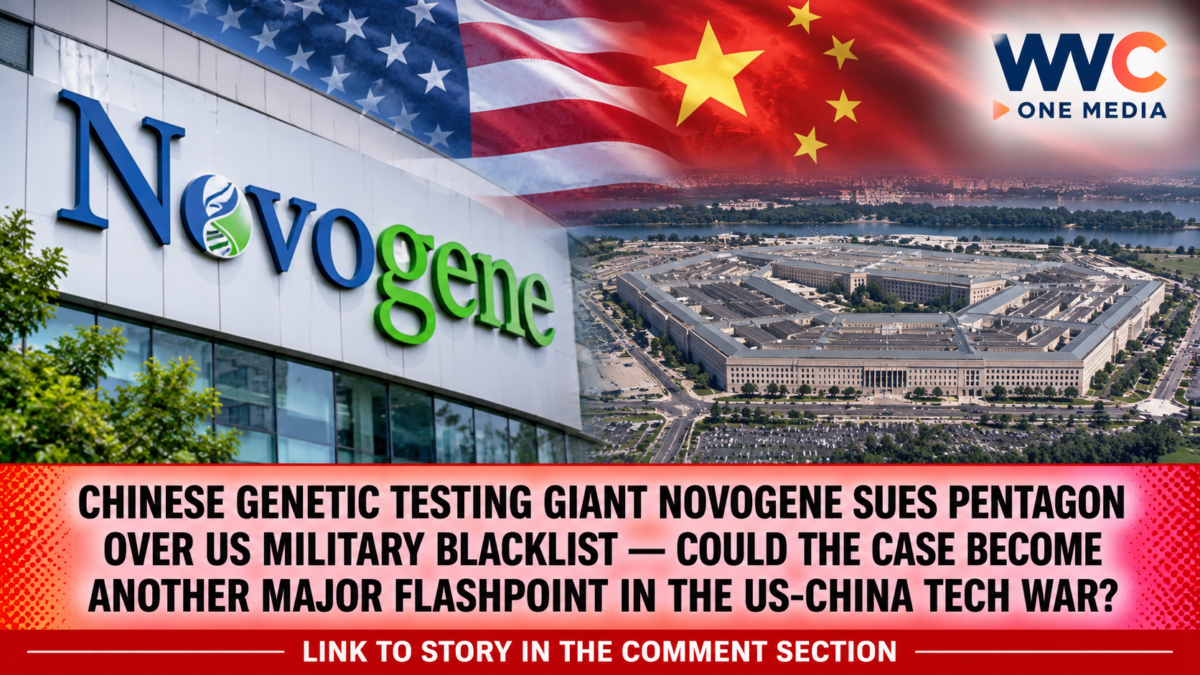
WASHINGTON — A Chinese biotechnology company is taking the US government to court after being labelled a “Chinese military company” by the Pentagon, escalating a dispute that puts genetic sequencing, national security and the future of Chinese businesses operating in America under renewed scrutiny.
Novogene, a Chinese genetic sequencing company, filed a lawsuit against the US Department of Defense in federal court in Washington, D.C., challenging its inclusion on the Pentagon’s list of Chinese military companies.
The legal action, filed late Tuesday, November 3, also involves the company’s US-based subsidiary, according to Bloomberg Law.
Novogene argues that the designation is unlawful, unsupported by adequate evidence and damaging to its business reputation. The company says it does not design, develop or market products for military use.
The Pentagon had not immediately responded to Reuters’ request for comment.
The dispute is bigger than one company’s fight to clear its name. Novogene’s lawsuit comes amid a wider wave of legal challenges by Chinese businesses targeted under Washington’s national-security measures, including major names in e-commerce, electric vehicles, drones and biotechnology.
At the centre of the dispute is a question with potentially far-reaching consequences: How much evidence and procedural protection should the US government provide before publicly identifying a private company as connected to China’s military?
Novogene Challenges Pentagon’s Decision in Federal Court
Novogene is contesting its placement on the US Department of Defense’s Section 1260H list, which identifies companies the Pentagon considers to be Chinese military companies operating in the United States.
The company was among the businesses added to the list in June 2026.
According to Reuters, Novogene’s lawsuit argues that the designation is unlawful and has caused what the company describes as serious and irreparable economic and reputational harm.
Bloomberg Law reported that Novogene and its Sacramento-based US subsidiary are challenging the Pentagon’s decision under the Administrative Procedure Act and the Fifth Amendment’s Due Process Clause.
The legal arguments place the government’s decision-making process under scrutiny, particularly whether the company received sufficient notice and a meaningful opportunity to challenge the allegations behind its designation.
Novogene maintains that it is not a military-associated company and that the Pentagon’s decision lacks a sufficient factual and legal foundation.
These are allegations made by the company in its lawsuit, not findings that a court has already accepted.
The case will require the court to examine the government’s legal authority, the evidence supporting the designation and the procedural protections available to a company placed on the list.
What Is Novogene and Why Does Its Business Matter?
Novogene operates in the biotechnology and genomics sector, specialising in genetic sequencing and related scientific services.
Genetic sequencing allows researchers to determine the order of DNA building blocks in a biological sample. The technology is used in a wide range of fields, including medical research, disease studies, pharmaceutical development, agriculture and other life-sciences applications.
The company’s work is part of a rapidly expanding global genomics industry, where advances in DNA analysis are helping researchers study diseases, understand biological processes and develop new scientific tools.
That makes the Pentagon designation particularly consequential.
Unlike a conventional consumer technology company, a genomics business operates in a field where scientific data, biological information and advanced laboratory capabilities can raise questions about privacy, data protection and national security.
However, the existence of those broader concerns does not establish that Novogene has engaged in military activity.
Novogene has specifically denied designing, developing or marketing products for military use.
In a June 19 statement distributed through PR Newswire, the company described itself as an independent, publicly listed enterprise with no state ownership or control. It also denied having ownership, control, affiliation or other relationships with military or intelligence entities that would justify its inclusion under Section 1260H.
Those statements represent the company’s position and have not, by themselves, resolved the dispute with the US government.
The Pentagon’s Section 1260H List: What Does It Actually Mean?
The Section 1260H list is established under the National Defense Authorization Act for Fiscal Year 2021.
It requires the US Department of Defense to identify companies it determines qualify as Chinese military companies operating directly or indirectly in the United States.
The Pentagon’s designation is intended to address concerns about China’s military-civil fusion system, through which the Chinese government seeks to connect civilian technological and industrial capabilities with national defence objectives.
The list can have significant consequences for companies named on it.
However, one important distinction is often overlooked: being placed on the Section 1260H list does not automatically mean a company has been subjected to conventional financial sanctions.
Reuters reported that the designation prevents the Pentagon from contracting directly with listed companies. Beginning in 2027, restrictions will also limit Pentagon purchases of their products and services through third parties.
Other federal procurement and funding restrictions can also apply under relevant laws.
The designation can nevertheless create substantial commercial difficulties even before those restrictions fully take effect.
Government contractors may reconsider their relationships with listed companies, while private-sector customers, suppliers and business partners may become more cautious about potential compliance and reputational risks.
For a company operating internationally, the label itself can therefore become a major business challenge.
Novogene Says the US Designation Is Factually Wrong
Novogene publicly challenged the Pentagon’s decision shortly after the June announcement.
In its June 19 statement, the company said it had been erroneously included on the Section 1260H list.
It described itself as an independent, publicly listed business and denied having the military or intelligence relationships contemplated by the law.
The company also said it had initiated efforts to seek removal from the list and had engaged with US authorities to clarify its position.
Novogene maintained that its services to universities, hospitals, pharmaceutical companies, scientific institutions and agricultural businesses would continue.
That statement is important because it establishes that the company’s opposition to the designation predates the November lawsuit.
The legal action now moves the dispute into a more formal stage, allowing the company to challenge the government’s decision through the US judicial system.
But the Pentagon’s underlying reasoning has not been fully tested in this new case, and the department has not publicly provided a response to the lawsuit in the initial Reuters report.
US-China Technology Rivalry Expands Beyond Semiconductors and Artificial Intelligence
The Novogene dispute illustrates how the US-China strategic competition is increasingly reaching industries beyond traditional defence manufacturing.
For years, Washington’s concerns about China’s technological rise have focused heavily on semiconductors, telecommunications equipment, artificial intelligence, advanced computing and military-related manufacturing.
Biotechnology and genetic sequencing are now also part of the broader national-security debate.
The reason is that genomics has applications across medicine, agriculture, scientific research and public health. The collection, storage and analysis of biological information can raise questions about who controls sensitive data and how advanced scientific capabilities could potentially be used.
Those concerns have prompted governments to scrutinise the ownership, operations and international relationships of companies working in the sector.
But national-security concerns and proven wrongdoing are not the same thing.
The central issue in Novogene’s case is whether the US government lawfully and adequately justified its decision to place the company on the list.
The dispute also comes as Chinese businesses face increasing scrutiny over technology supply chains, access to sensitive information and their potential connections to state institutions.
WWC ONE MEDIA has previously examined the international commercial pressure facing Chinese companies in China’s Top 500 Brands Are Worth $2.13 Trillion as Global Perceptions Shift — But Could Quality Concerns and Trade Barriers Stop Their Rise?.
The Novogene lawsuit adds another dimension to that debate: the challenge of maintaining international business access when national-security classifications can affect a company’s reputation and commercial relationships.
Alibaba, BYD, DJI and WuXi AppTec Are Also Fighting US Restrictions
Novogene is not the only Chinese company challenging the Pentagon’s designations.
Reuters reported that several major Chinese businesses have pursued legal action against US government measures affecting their operations.
Among the companies involved are Alibaba, BYD, DJI and WuXi AppTec.
Alibaba Wins a Preliminary Court Injunction
Chinese e-commerce giant Alibaba recently secured a preliminary injunction from a US judge after challenging its placement on the Pentagon list.
Reuters reported that the ruling ordered the US government not to deny Pentagon contracts to Alibaba while the legal dispute proceeds.
The decision does not necessarily resolve every issue in Alibaba’s case, but it demonstrates that companies can challenge the consequences of a Section 1260H designation in court.
BYD Subsidiaries Challenge Separate Lobbying Restrictions
Two BYD subsidiaries also sued the Pentagon in October over a federal law restricting Pentagon contractors from hiring lobbyists who also work with listed companies.
The subsidiaries argued that the restriction violated their First Amendment rights.
This is a separate legal dispute from Novogene’s challenge, but it shows how the consequences of the military-company designation can extend beyond direct government procurement.
WWC ONE MEDIA has followed BYD’s international expansion in BYD Philippines Nearly Doubles Sales to 28,399 Units — But One Type of Vehicle Is Driving Almost 80% of the Boom.
The company has also been part of the wider discussion about Chinese electric vehicles entering new markets, as explored in BYD Cars Land at Subic Port for Philippine Buyers — What This Could Mean for the Country’s EV Market.
DJI Continues Its Fight Over the Military Label
Chinese drone manufacturer DJI has also challenged its designation.
In August 2026, the US Court of Appeals for the District of Columbia Circuit sent part of the dispute back for further proceedings after finding merit in DJI’s argument that the unclassified record did not adequately support the Pentagon’s conclusion about its contribution to China’s defence industrial base.
The appeals court’s decision did not simply remove DJI from the list. It ordered further consideration of the case.
WuXi AppTec Secures a Preliminary Injunction
Chinese biotechnology company WuXi AppTec also won a preliminary injunction in August, blocking enforcement of its Pentagon designation while litigation continued.
The ruling was significant because it involved another major company in the life-sciences sector.
WuXi had argued that the designation was unsupported and politically motivated.
The company’s legal victory does not automatically determine the outcome of Novogene’s case. Each company’s circumstances, evidence and legal arguments must be assessed separately.
Nevertheless, these disputes show that the Pentagon’s list is becoming a growing source of litigation between Washington and Chinese businesses.
Why Due Process Is Becoming a Major Issue in Pentagon Blacklist Cases
A particularly important aspect of the Novogene lawsuit is its challenge under the Fifth Amendment.
The Due Process Clause protects people and entities against certain government actions taken without constitutionally adequate procedures.
In disputes involving Section 1260H, companies have argued that public designation can damage their reputations and restrict access to government business, making fair notice and a meaningful opportunity to respond especially important.
Recent appellate decisions have brought that issue into sharper focus.
In August 2026, the D.C. Circuit ruled in a separate case involving Chinese sensor manufacturer Hesai Technology that the company was entitled to notice of the unclassified material on which the government intended to rely and a meaningful opportunity to respond before its designation was finalised.
The court reversed the lower court’s judgment in favour of the government and sent the matter back for further proceedings.
The ruling did not decide Novogene’s case, but it provides relevant legal context for the arguments now being raised by the biotechnology company.
The legal questions are especially important because the Pentagon’s list can have consequences beyond government procurement.
A public designation can influence how suppliers, investors, customers and business partners assess a company.
That creates a difficult balance for the US government: protecting national security while ensuring that companies are not subjected to consequential government decisions without legally adequate procedures.
What the Novogene Lawsuit Could Mean for the Biotechnology Industry
The case could attract attention across the global biotechnology industry because it involves a sector where scientific collaboration and international data flows are essential.
Genetic sequencing companies often work with universities, research institutions, hospitals and pharmaceutical businesses across national borders.
If government restrictions affect access to US contracts or create uncertainty about the use of a company’s services, the consequences may extend to research partnerships and commercial relationships.
For customers, the case also highlights the importance of understanding the legal status of their suppliers and the regulations governing sensitive data.
For biotechnology companies, the dispute is another reminder that business operations can be affected by geopolitical considerations even when their products have civilian applications.
However, the lawsuit does not establish that all Chinese biotechnology companies face identical restrictions or that Novogene’s customers must immediately end their relationships with the company.
Any such decisions would depend on the applicable laws, contractual arrangements and individual risk assessments.
China-US Tensions Could Make the Case More Significant
The lawsuit arrives during a period of continuing strategic competition between Washington and Beijing.
Both countries are seeking to protect critical technologies and supply chains, while companies operating across their markets face increasingly complex regulatory environments.
Washington argues that it must prevent technologies and industrial capabilities from strengthening China’s military.
Beijing and affected companies have repeatedly criticised US restrictions, describing some of them as discriminatory or politically motivated.
The Novogene case adds biotechnology to a growing list of industries caught in the middle of that competition.
It also comes as other Chinese companies challenge restrictions affecting electric vehicles, e-commerce, drones and advanced manufacturing.
WWC ONE MEDIA has examined the wider political and strategic environment surrounding Beijing in Xi Jinping Tightens Grip on China Ahead of 2027 Leadership Shake-Up — But What Is Beijing Really Preparing For?.
While the Novogene lawsuit is a corporate legal dispute, its outcome could contribute to a broader debate about how far the United States can go in restricting Chinese companies on national-security grounds.
What Happens Next in Novogene’s Legal Battle?
The case is now before the US District Court for the District of Columbia.
The court will need to consider the company’s claims, the legal authority behind the Pentagon’s designation and whether the government followed the procedures required by law.
The lawsuit could also lead to further scrutiny of the evidence and reasoning used to classify Novogene as a Chinese military company.
For now, the Pentagon has not publicly responded to Reuters’ request for comment, and the court has not issued a final ruling in the case.
The company remains focused on challenging the designation and defending its position that its business is independent of China’s military.
The outcome could have consequences for Novogene’s US operations, its commercial relationships and the wider biotechnology industry.
It could also influence how future Section 1260H disputes are approached by companies that believe they have been wrongly classified.
THE BIGGER PICTURE: A GENETIC SEQUENCING COMPANY IS NOW PART OF THE US-CHINA SECURITY BATTLE
Novogene’s lawsuit shows how the US-China rivalry is moving into increasingly specialised areas of technology and science.
What began as a dispute over a Pentagon designation has become a legal test involving national security, corporate reputation, due process and the boundaries of government power.
The company insists it has no military role and argues that the US government has wrongly placed it on the list.
Washington, meanwhile, has not yet publicly explained its position in response to this latest lawsuit.
The court will ultimately have to assess the legal arguments and the evidence.
But the broader implications are already clear: as governments treat biotechnology and other advanced industries as strategic assets, companies operating across borders may face growing pressure to prove that their research, data and commercial relationships meet the expectations of multiple national-security regimes.
Novogene is now asking a US court to overturn a label it says could damage its business. With Alibaba, BYD, DJI and other Chinese companies also challenging Washington’s restrictions, could this lawsuit become another major setback for the Pentagon’s blacklist — or deepen the technology divide between the world’s two largest economies?