
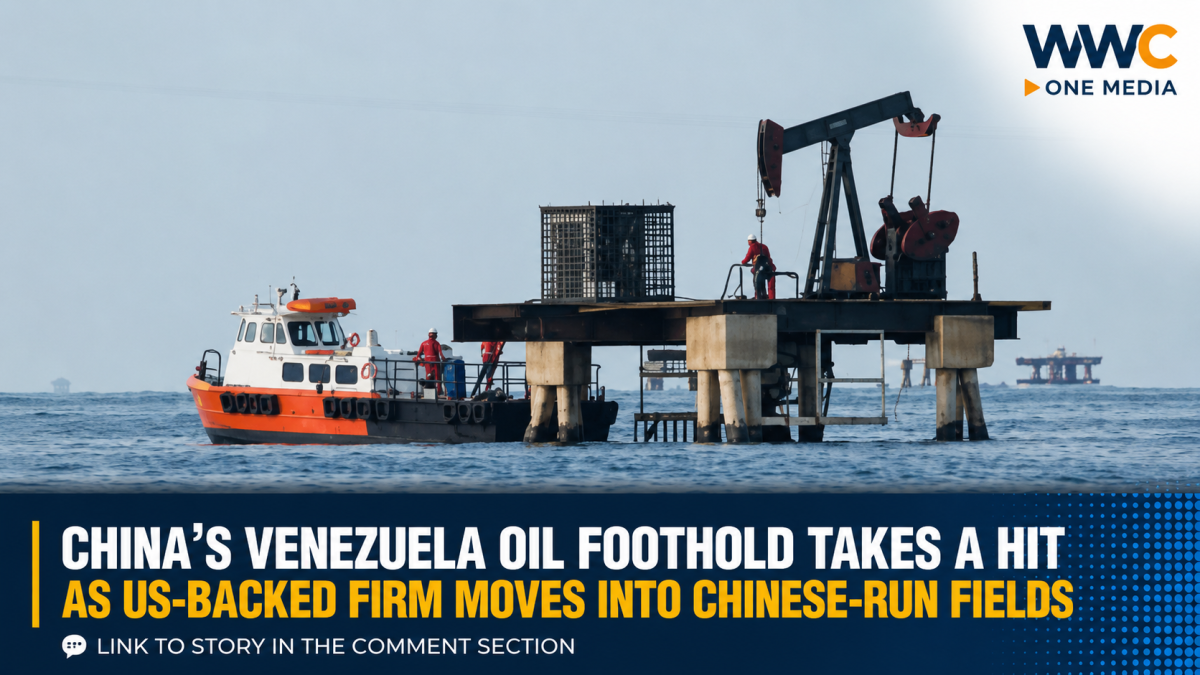
ARACAS/WASHINGTON — A major shift is unfolding in Venezuela’s oil industry, and China is warning that its interests must be protected after a US-backed energy company was awarded long-term concessions involving oilfields previously operated by Chinese and Russian-linked companies.
The development puts one of Beijing’s most important energy relationships in Latin America under fresh pressure — while giving Washington a much larger role in deciding where Venezuelan crude is produced and where it is sold.
At the centre of the controversy is North American Blue Energy Partners (NABEP), a privately controlled energy company that US officials say will take over several Venezuelan oil projects previously operated by five Chinese companies and one Russian firm.
The White House has described the broader agreement as a major step toward restoring Venezuela’s oil industry and reducing Chinese and Russian influence.
Beijing, however, is demanding guarantees.
China: “Our legitimate interests must be protected”
Chinese Foreign Ministry spokesman Guo Jiakun said Beijing’s cooperation with Venezuela is protected by international law and the laws of both countries.
China’s position is that its legitimate rights and interests in Venezuela must be safeguarded, while economic cooperation should follow principles of equality and mutual benefit.
The warning came after the White House announced that Venezuelan authorities had granted NABEP concessions covering 17 oilfields with approximately 65 billion barrels of proven reserves.
That is a massive resource base.
Venezuela possesses the world’s largest proven oil reserves, but years of underinvestment, economic crisis, sanctions and operational problems have left production far below historical levels.
Five Chinese-linked projects are reportedly being displaced
According to US officials cited by Reuters, 14 newly granted contracts form part of NABEP’s wider portfolio of 17 Venezuelan projects.
Five of those 14 projects had previously been operated by Chinese companies.
They include projects associated with:
- China National Petroleum Corp. (CNPC)
- Sinopec
- China Concord Resources Corp.
Another project was previously operated by a Russian company.
This is particularly significant because China’s involvement in Venezuela isn’t new.
Beijing became increasingly important to Caracas after US oil companies were pushed out or saw their assets nationalized during Venezuela’s earlier nationalization drives.
Chinese companies subsequently provided investment, equipment and technical assistance while China became a major buyer of Venezuelan crude.
China had been deepening its oil presence
The timing makes the shift even more striking.
China Concord Resources, a privately owned Chinese company, had been developing two Venezuelan oilfields under a 20-year production-sharing agreement.
Reuters reported that the company planned to invest more than US$1 billion and target production of up to 60,000 barrels per day by the end of 2026.
Chinese workers and drilling equipment had already been deployed to revive production in the Lake Maracaibo region.
That makes the reported transfer of some Chinese-linked projects to NABEP more than a theoretical geopolitical dispute.
Chinese companies had been putting actual money and equipment into Venezuela’s struggling oil sector.
Washington is now changing the rules
The broader US-Venezuela arrangement gives Washington an unprecedented role in the country’s oil industry.
The White House says NABEP will receive long-term concessions covering 17 fields and that the US government will hold a 35% stake in the company’s parent entity.
Washington is also set to receive preferential access to 20% of NABEP’s oil production at cost, along with a right of first refusal over the remaining output, according to the US government’s description of the deal.
The administration has framed the arrangement as a way to bring massive amounts of investment into Venezuela and ultimately increase production.
But critics have raised questions over the structure, transparency and long-term implications of the agreement.
The 100-year question
One of the most controversial elements is the reported duration of the concessions.
The White House says the oilfield concessions will last 100 years.
Venezuelan officials, however, have described a 25-year arrangement, creating an important discrepancy over the precise terms.
That difference matters because the agreement involves some of the world’s largest oil reserves and could shape Venezuela’s energy industry for generations.
For Beijing, the issue isn’t simply about losing individual projects.
It’s about whether Chinese investments and contractual rights will remain protected under a radically changed Venezuelan political and economic order.
Venezuela is caught in the middle
Caracas, meanwhile, is presenting the agreement as a potential economic lifeline.
Venezuelan authorities say increased private investment could help rebuild an oil industry that has suffered from years of declining production and inadequate investment.
The country’s current output remains dramatically below its historical peak.
And that’s where the US strategy becomes particularly important.
Washington isn’t merely seeking to buy Venezuelan oil.
It is trying to rebuild the infrastructure needed to produce more of it — while steering more of that future production toward the United States.
Chevron is making its own major bet
The US push isn’t limited to NABEP.
On September 2, Chevron announced plans to invest more than US$7 billion in Venezuela over the next five years, with the goal of more than doubling its production there to approximately 600,000 barrels per day.
The company also secured additional acreage in Venezuela’s oil-rich Orinoco Belt through its joint ventures with state oil company PDVSA.
That announcement is important because it demonstrates that the US strategy involves both government-backed arrangements and traditional international oil companies.
Chevron has operated in Venezuela for more than a century and remained in the country through periods when other major Western producers withdrew.
Why China should care
Venezuela is not China’s largest oil supplier.
But the relationship has strategic value.
China became one of Venezuela’s most important oil customers after US sanctions disrupted traditional export routes.
Reuters estimates that Venezuelan oil exports to China reached roughly 470,000 barrels per day in 2025, based on Vortexa data.
China has also been a major creditor and investor in Venezuela.
So the new US arrangement threatens more than crude shipments.
It potentially affects Chinese investment, debt arrangements, infrastructure projects and Beijing’s wider influence in Latin America.
This is bigger than one oil deal
The emerging US-China confrontation over Venezuela’s oilfields reflects a much larger geopolitical contest.
Washington sees Venezuela as an opportunity to rebuild Western Hemisphere energy supply chains while reducing the influence of China and Russia.
Beijing sees Venezuela as an established economic partner whose commercial interests should not simply disappear because Caracas has undergone a political transformation.
And Venezuela wants something from both sides:
capital, technology and markets.
The country has enormous reserves but needs enormous investment to turn those reserves into sustained production.
That means Caracas may continue trying to work with multiple powers — even as Washington pushes to make the US the dominant external player in Venezuela’s energy sector.
The bigger question
The immediate dispute is over several oilfields.
The longer-term battle is over who controls the future of Venezuela’s oil industry — and who gets to buy the barrels that come out of it.
China spent years building an energy foothold in Venezuela.
Now Washington is moving in with a dramatically different proposition.
And if the US succeeds in redirecting Venezuela’s oil toward American markets, Beijing could lose far more than a handful of oil projects.
WWC ONE MEDIA J.M.D

Leave a Reply