
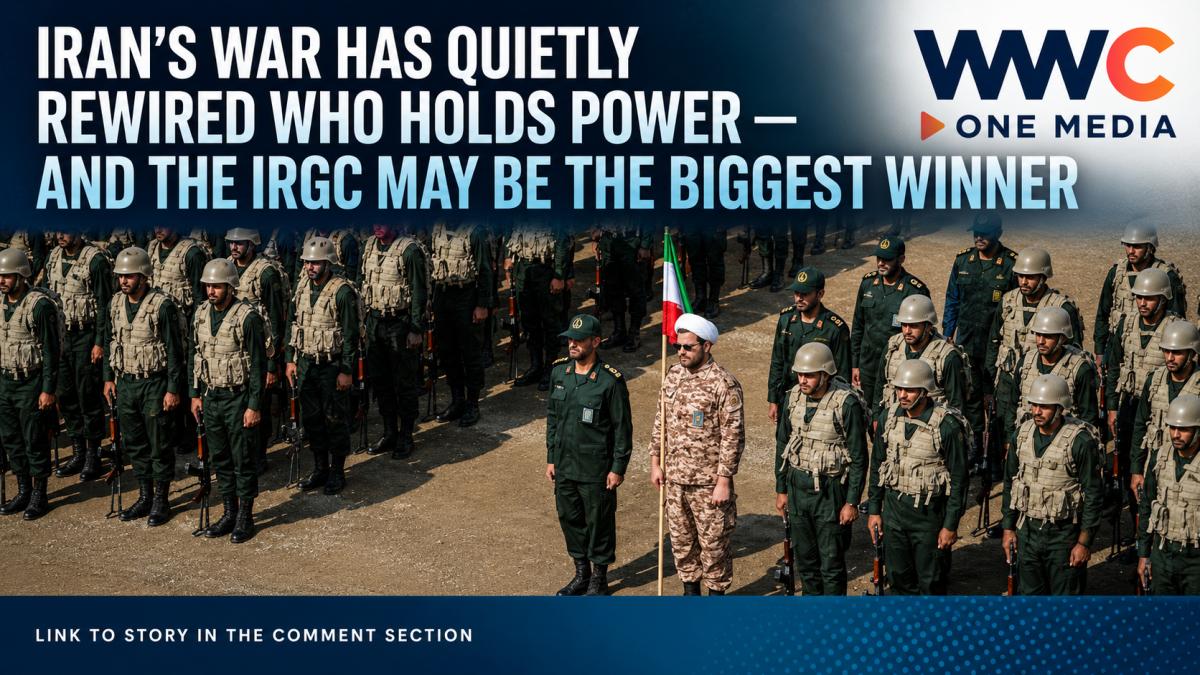
TEHRAN — Iran still has a president, a parliament, a supreme leader and the sprawling institutions that have governed the Islamic Republic for decades. But six months of war have altered something much harder to see: where real power sits when the country faces its most consequential decisions.
The Islamic Revolutionary Guard Corps, or IRGC, has long been one of Iran’s most influential institutions. Now, however, wartime conditions appear to be pushing the Guards closer to the center of national decision-making — potentially reshaping the balance between Iran’s clerical establishment, elected government, security apparatus and diplomatic leadership.
That shift could determine far more than who dominates Tehran’s internal politics.
It could decide whether Iran ultimately negotiates its way out of the conflict with the United States or concludes that permanent confrontation offers the Islamic Republic a better chance of survival.
And with US-Iran fighting intensifying again around the Strait of Hormuz, the answer may be arriving faster than Tehran expected.
A Supreme Leader — But No Longer the Old Power Structure
The death of longtime Supreme Leader Ayatollah Ali Khamenei in the opening phase of the 2026 war created a leadership vacuum unlike anything the Islamic Republic had experienced in decades.
His son, Ayatollah Mojtaba Khamenei, was chosen as his successor.
But inheriting the title did not mean inheriting the political authority his father accumulated during nearly four decades at the top of Iran’s system.
Reuters reported in April that the Revolutionary Guards and Iran’s Supreme National Security Council had taken an increasingly dominant role in wartime decision-making, while Mojtaba Khamenei’s position was considerably less commanding than that of his father.
Reuters has also reported that Mojtaba has remained out of public view since suffering serious injuries during the opening attacks. Iranian authorities maintain that he continues to exercise leadership, but the absence of public appearances has fueled questions about how actively he is personally directing policy.
That distinction matters.
Under Ali Khamenei, competing centers of Iranian power ultimately operated beneath a supreme leader with enormous personal and institutional authority.
Today, the structure appears considerably more distributed.
President Masoud Pezeshkian manages an economy under extraordinary strain. Foreign Minister Abbas Araghchi remains one of Iran’s principal diplomatic voices. Parliamentary Speaker Mohammad Bagher Ghalibaf has become increasingly important in negotiations and wartime politics.
Meanwhile, senior security figures — including IRGC commander Ahmad Vahidi and Supreme National Security Council chief Mohsen Rezaei — occupy increasingly powerful positions in the machinery deciding how Iran fights, negotiates and responds to economic pressure.
The IRGC’s Wartime Advantage
War naturally rewards institutions that control missiles, intelligence, internal security and military operations.
In Iran, that institution is overwhelmingly the Revolutionary Guards.
Reuters reported earlier this year that the IRGC had effectively seized much of Iran’s wartime power following the deaths or incapacitation of senior leaders.
The Guards were already deeply embedded in Iran’s political, economic and security systems before the war. But prolonged conflict has given them something even more valuable: the ability to frame nearly every major national decision as a security question.
Trade policy becomes a war issue.
Oil exports become a war issue.
Shipping through the Strait of Hormuz becomes a war issue.
Negotiations with Washington become a war issue.
Domestic protests become a security issue.
And the longer that continues, the harder it becomes for civilian politicians to make major decisions independently of the military-security establishment.
That does not necessarily mean Iran has become a military dictatorship.
The clerical establishment still provides ideological legitimacy. The presidency still carries responsibility for managing the economy. Diplomats still negotiate abroad. Parliament still plays a political role.
But the center of gravity appears to be moving.
Iran’s Real Debate Is No Longer Simply ‘Moderates vs Hardliners’
The traditional description of Iranian politics — reformists on one side and hardliners on the other — may also be becoming less useful.
The emerging argument inside Tehran appears increasingly focused on a different question:
What strategy gives the Islamic Republic the best chance of surviving the war?
One camp, associated broadly with Pezeshkian and diplomatic officials including Araghchi, has emphasized the need to reduce economic pressure and find a negotiated exit.
Iran’s economy has suffered dramatically during the conflict.
Reuters reported September 1 that Iranian crude loadings had fallen from around 2 million barrels per day in March to roughly 220,000 to 255,000 barrels per day in August, as the US blockade severely restricted Tehran’s ability to export oil.
The International Monetary Fund expects Iranian inflation to approach 70% in 2026, according to Reuters.
That creates an obvious incentive for parts of Iran’s leadership to secure sanctions relief, reopen export routes and stabilize the economy.
But security officials are approaching diplomacy from a different direction.
Their calculation is not necessarily that Iran should never negotiate.
It is that Tehran should negotiate only after maximizing the military leverage it possesses.
That includes its missile arsenal, its ability to threaten shipping and its position around the Strait of Hormuz.
Mohsen Rezaei recently said Iran would consider reopening the strait only under conditions including an end to the war, relief from the blockade and other concessions.
Those demands illustrate the emerging strategy: convert battlefield and maritime leverage into political and economic gains.
Washington Discovered It May Need to Talk to the Guards
Perhaps the clearest evidence of the IRGC’s growing influence came not from Tehran but from Washington.
Axios reported in August that the Trump administration established a secret communications channel directly to Iran’s Revolutionary Guard leadership through Nechirvan Barzani, president of Iraq’s Kurdistan Region.
According to Axios, American negotiators had encountered a fundamental problem during earlier diplomacy: they were uncertain whether the Iranian officials sitting across from them actually had the authority to speak for the increasingly powerful Guards.
Washington’s response was extraordinary.
It attempted to communicate with the IRGC itself.
The episode reportedly helped produce a memorandum of understanding between the two sides, although the arrangement quickly collapsed.
The episode nevertheless exposed one of the biggest complications facing any future peace agreement.
The question is no longer simply:
What does Iran want?
It is:
Which institution inside Iran has enough power to guarantee that the country will actually deliver it?
Then the War Escalated Again
Any internal Iranian faction advocating diplomacy now faces another challenge.
Military confrontation has returned.
The United States carried out another wave of strikes against Iranian military targets around the Strait of Hormuz this week, including air-defense systems, radar installations, maritime capabilities and IRGC infrastructure.
Iran retaliated against US and regional targets.
Reuters described the exchange as the most intense escalation in several weeks, while AP reported that the renewed fighting ended roughly a month-long lull in major hostilities.
Oil markets reacted immediately.
Brent crude climbed to $94.65 a barrel on September 1 as fears returned that fighting around one of the world’s most important energy chokepoints could once again disrupt supplies.
For Iran’s internal politics, however, the consequences may run deeper.
Every renewed military confrontation strengthens the argument of officials who insist Washington cannot be trusted.
Every additional economic sanction gives Iranian hardliners another reason to argue that compromise brings little reward.
And every IRGC military response increases the institution’s importance inside the country’s power structure.
That creates a potentially dangerous cycle.
The Bigger Question Facing Iran
Iran therefore faces something larger than a dispute over negotiations.
It is deciding what kind of state will emerge from the war.
One possibility is that the country eventually converts its wartime leverage into a negotiated settlement, allowing civilian and diplomatic institutions to regain some political space.
Another is that prolonged confrontation makes the current security-heavy structure permanent.
AP recently reported that Iran’s leadership has increasingly consolidated around hard-line military officers and clerics, with security officials expanding their influence and authorities signaling little tolerance for domestic dissent.
That may ultimately become one of the war’s most important consequences.
The conflict was supposed to weaken Iran’s ability to project power.
Instead, inside Iran itself, it may be strengthening the institution built specifically to survive confrontation.
And if the Revolutionary Guards continue moving from powerful participant to indispensable decision-maker, the biggest change produced by the war may not be visible on any battlefield.
It may be happening inside the government in Tehran.
WWC ONE MEDIA MJE

Leave a Reply