
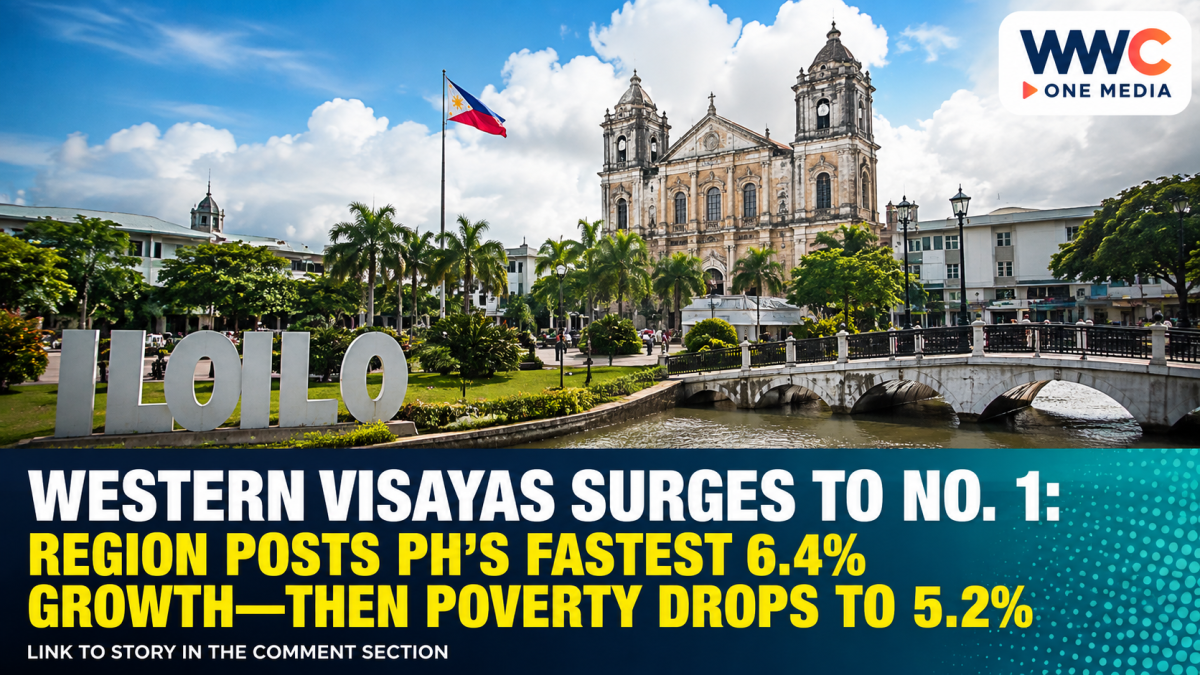
ILOILO CITY — Western Visayas is emerging as one of the Philippines’ strongest regional economic performers after posting the country’s fastest economic growth in 2025—while simultaneously recording a dramatic decline in poverty among families.
The region’s economy expanded 6.4 percent in 2025, accelerating from 4.4 percent in 2024 and reaching ₱683.44 billion at constant 2018 prices, according to the Philippine Statistics Authority (PSA).
That made Western Visayas the fastest-growing among the Philippines’ 18 regional economies for the year, outperforming the country’s overall 4.4-percent GDP growth.
But the economic growth is only part of the story.
The latest PSA poverty statistics show that poverty incidence among families in Western Visayas fell to 5.2 percent in 2025, down sharply from 9.8 percent in 2023.
Officials from the Department of Economy, Planning and Development (DEPDev) Region 6 described the simultaneous improvement in economic growth and poverty reduction as a significant development milestone.
DEPDev-6 chief economic development specialist Joyalita Tigres said poverty reduction should not be viewed solely through household income. Access to education, health services and social protection also forms part of the broader picture of improving living conditions.
Officials also noted that all provinces in Western Visayas recorded reductions in poverty incidence.
SERVICES REMAIN THE REGION’S ECONOMIC ENGINE
The services sector continued to dominate Western Visayas’ economy, accounting for 66.5 percent of regional output in 2025.
Its gross value added increased from about ₱427.29 billion in 2024 to ₱454.19 billion in 2025, with tourism, information technology-business process outsourcing and other service activities helping drive expansion.
The region’s tourism economy remains anchored by destinations such as Boracay, Guimaras, Northern Iloilo and Iloilo City, while Iloilo City’s role as a business and services hub continues to support investment and employment.
The industry sector accounted for 18.6 percent of the regional economy, while agriculture, forestry and fishing contributed 14.9 percent.
AGRICULTURE MAKES A STRONG COMEBACK
One of the biggest turnarounds came from agriculture, forestry and fishing.
After contracting by about 7.4 percent in 2024, the sector rebounded with 9.5-percent growth in 2025, providing an important boost to the region’s overall performance.
The PSA also reported double-digit growth in mining and quarrying at 14.8 percent and human health and social work activities at 14.6 percent.
Not every sector expanded, however. Construction contracted by 0.5 percent, showing that the region still faces pockets of weakness despite its overall strong performance.
NEARLY ₱41 BILLION ADDED TO THE REGIONAL ECONOMY
The 6.4-percent growth translated into an increase of nearly ₱41 billion in the value of goods and services produced in Western Visayas.
The region’s economy rose from roughly ₱642.47 billion in 2024 to ₱683.44 billion in 2025, according to the PSA.
Western Visayas also accounted for approximately 2.9 percent of the Philippines’ total GDP, while remaining the country’s eighth-largest regional economy based on the latest figures.
The growth also exceeded the region’s earlier projection of 5.0 to 5.5 percent, according to DEPDev-6 Regional Director Arecio Casing Jr.
WHAT MADE THE PERFORMANCE MORE SIGNIFICANT?
Officials say the combination of economic expansion and falling poverty is particularly important.
Casing pointed to the decline in poverty alongside strong economic growth as an indication that the benefits of expansion are reaching beyond major business centers.
Government agencies such as the Department of Health and Department of Social Welfare and Development were also credited with helping expand access to essential services and social protection.
The region’s labor market also showed strength. Earlier PSA-linked reporting noted that employment increased by approximately 28,500 workers in 2025, while unemployment stood at 4.1 percent.
BUT WESTERN VISAYAS STILL HAS MAJOR CHALLENGES
Despite the headline-grabbing numbers, officials caution that the region’s progress does not mean development gaps have disappeared.
Remote and geographically isolated communities continue to face challenges involving poverty, infrastructure, access to services and human capital.
Agriculture remains vulnerable to climate change, extreme weather, food-security concerns and nutrition challenges. Infrastructure gaps and workforce limitations could also affect the region’s ability to sustain rapid growth.
Meanwhile, the region’s updated development strategy is putting greater emphasis on agricultural transformation, food security, poverty reduction, social protection, quality jobs, infrastructure, digital transformation, innovation and climate resilience.
THE BIGGER PICTURE
Western Visayas’ 2025 performance stands out because it combines two indicators that do not always move together: rapid economic growth and a substantial decline in poverty.
The PSA data show that the region not only overtook other regions in economic growth, but also continued the downward movement in family poverty—from 9.8 percent in 2023 to 5.2 percent in 2025.
The challenge now is whether Western Visayas can turn that momentum into sustained, broad-based improvements in jobs, household incomes, public services and living standards, particularly in communities that remain vulnerable.
For now, the numbers place Western Visayas firmly in the national spotlight: the region grew faster than every other Philippine region in 2025—and significantly fewer families were living in poverty.
WWC ONE MEDIA MJE




Leave a Reply