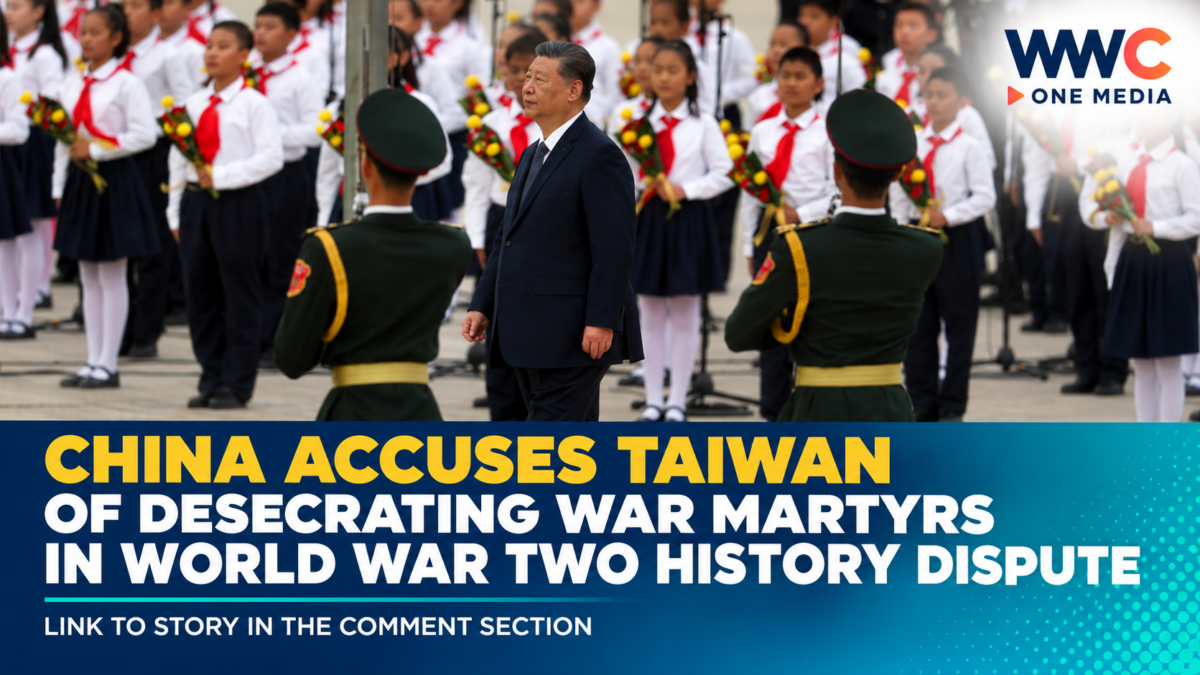
China has accused Taiwan of “desecrating the martyrs” by challenging Beijing’s interpretation of World War Two history, escalating an ongoing dispute over which government should be recognized as representing China’s wartime role.
At a press briefing on September 30, Zhang Han, a spokeswoman for China’s Taiwan Affairs Office, accused Taiwan’s ruling Democratic Progressive Party of distorting the history of the war against Japan. She described the criticism as a betrayal of history, the nation and those who died during the conflict.
The dispute intensified after Chinese President Xi Jinping and US President Donald Trump highlighted the wartime alliance between the United States and China during their recent summit in Washington. Beijing has emphasized the role of Chinese forces in the resistance against Japan, while Taipei argues that the government representing China at the time was the Republic of China, which fought alongside the Allies.
The Republic of China government relocated to Taiwan in 1949 after losing the Chinese civil war to the Communist forces. The People’s Republic of China was established that same year, meaning it did not exist during World War Two, which ended in 1945. Taiwan continues to use the formal name Republic of China.
Beijing maintains that Communist guerrilla forces played a central role in the resistance against Japan, while the Kuomintang-led government conducted much of the fighting on the main battlefields. Zhang said both sides of the Taiwan Strait should share in commemorating what China describes as a national victory and an important part of the wider Allied victory over fascism.
Taiwan has pushed back against Beijing’s version of the wartime narrative. Its officials say the Republic of China was the government that maintained the alliance with the United States during the conflict and that references simply to “China” can obscure the historical role of the government then based on the mainland.
The issue has gained additional attention following Xi’s remarks at the White House state dinner, where he described the United States and China as having fought side by side during World War Two without explicitly identifying the Republic of China as the Chinese government of that period. Taiwan officials have argued that this framing risks altering how the history is understood internationally.
The historical dispute is also connected to Taiwan’s complicated wartime history. Taiwan was a Japanese colony from 1895 until 1945 and was transferred to the administration of the Republic of China after Japan’s defeat. The island later remained under martial law for decades before democratic reforms took hold.
Taiwan’s opposition Kuomintang has also criticized the current government’s handling of the issue, arguing that references to the Republic of China’s wartime history can be used selectively in its political dispute with Beijing. The disagreement therefore extends beyond Beijing and Taipei to competing interpretations within Taiwan itself.
The latest exchange illustrates how World War Two history continues to intersect with present-day tensions across the Taiwan Strait. Beyond questions of historical interpretation, the dispute has implications for how China, Taiwan and the United States frame their respective roles in the region and in their diplomatic relations.