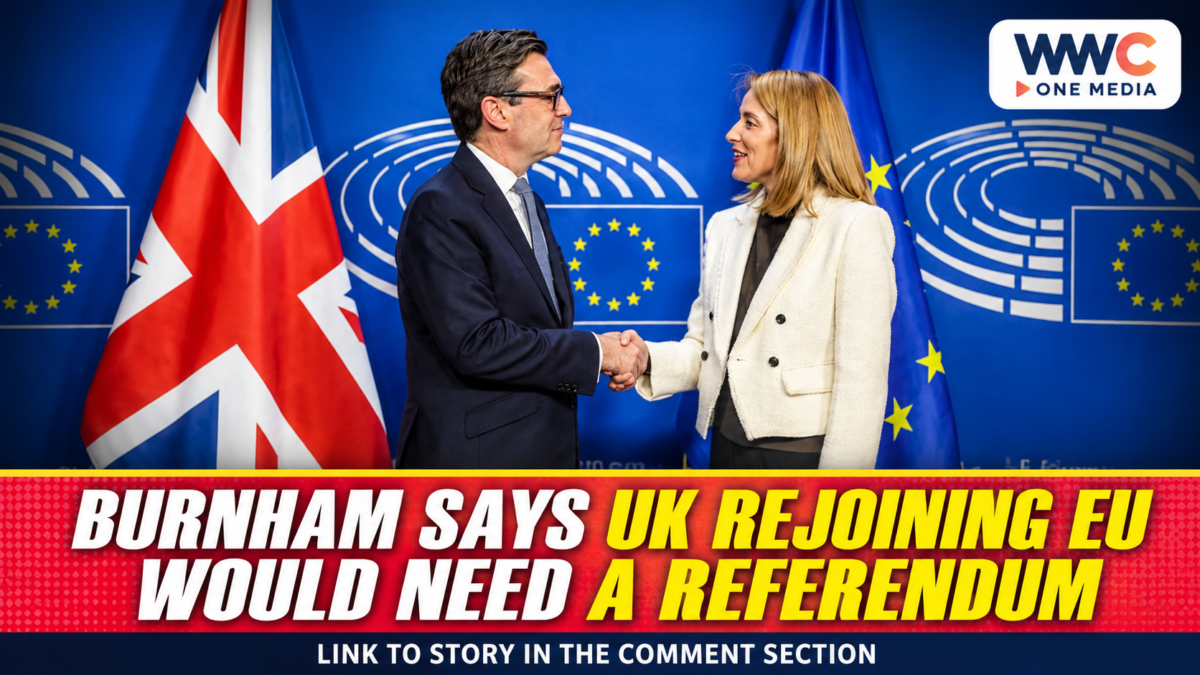
British Prime Minister Andy Burnham told Parliament on November 23, 2026, that taking the United Kingdom back into the European Union without another public vote would be “unthinkable.” But in the same Commons session, he stressed that he was not proposing to rerun the Brexit referendum at this time.
The distinction matters. Britain is moving toward closer cooperation with Brussels through a new package of agreements, while its government is also preparing to examine longer-term options for the relationship. Burnham’s remarks set out a political condition for any future return to EU membership, not an announcement that such a move is underway.
The immediate challenge for the government is to show that closer cooperation can produce practical benefits without reopening the country’s most divisive political decision of the past decade.
UK EU referendum: What Burnham actually told Parliament
The exchange came during a Commons statement on the November 20 UK-EU summit in Brussels.
Conservative MP Sir Bernard Jenkin asked Burnham whether it would be unthinkable for a prime minister to take Britain back into the EU without a referendum. Burnham answered: “Yes, it would be unthinkable.”
The response was direct, but it did not amount to a commitment to hold a new referendum. Labour MP Graham Stringer later challenged the prime minister over whether his approach risked reopening the Brexit debate. Burnham replied that he was “not proposing, at this moment, to rerun the referendum.”
He also defended the new cooperation agreement as consistent with the commitment to establish closer ties with Europe.
Those statements establish two separate points: a future attempt to rejoin the EU would, in Burnham’s view, require a public vote; and his government is not currently proposing to hold one.
The distinction is important because a political declaration in Parliament is not itself a new referendum law. It does not set a date, establish a ballot question or begin a formal process for EU membership.
A closer relationship does not mean Britain is rejoining
The November 20 summit produced a package covering trade, the environment, youth opportunities and security. The joint statement describes a renewed strategic partnership between the UK and EU, while reaffirming existing withdrawal and cooperation agreements.
One of the most practical measures is a planned Common Sanitary and Phytosanitary Area. It is intended to reduce the certificates and controls required for many movements of animals, animal products, plants and plant products between Great Britain and the EU. The joint statement targets March 1, 2028, for its application.
The two sides also concluded negotiations on linking their emissions trading systems, with the aim of applying the agreement from 2028. The arrangement is intended to support mutual recognition of emissions allowances and address certain carbon-border charges, subject to the relevant laws and procedures.
These are significant areas of regulatory cooperation, but they do not restore EU membership or automatically return Britain to the single market or customs union.
WWC’s earlier examination of the UK-EU Brexit reset and its practical trade implications explains why the details of implementation matter more than the political language surrounding a summit.
The youth scheme shows what the reset could deliver
The summit agreement also gives the relationship a people-to-people dimension.
The UK and EU concluded negotiations on a Youth Experience Scheme, which is designed to allow up to 100,000 young people from each side to reside in the other territory for activities such as work, study, volunteering and travel. The agreement aims for implementation no later than 2028, with opportunities intended to become available no later than January 2030.
The scheme is not the same as restoring unrestricted freedom of movement. It is a defined programme with limits and conditions under the respective legal frameworks.
The agreement also confirms the UK’s participation in Erasmus+ in 2027. Separately, the two sides will work toward an agreement on tuition fees for students studying across the relationship, with negotiations targeted for completion within six months of the summit.
For younger Britons, these arrangements could reopen some opportunities for European study and work without requiring the government to restore the full membership framework that existed before Brexit.
The broader policy question is whether limited programmes can deliver enough value to satisfy people who want closer links while addressing concerns among those who supported leaving the bloc.
The economic case still depends on delivery
The British government has presented the summit package as an economic opportunity. Its November 20 announcement said the combined agreements could add up to 0.5% to UK gross domestic product by 2040, equivalent to around £17 billion a year.
That is a projection, not money already generated or a guaranteed outcome. Its value will depend on whether the agreements enter into force as planned, how businesses use them and whether potential savings translate into lower costs or stronger investment.
The food-trade arrangements, for example, could reduce paperwork and controls for eligible products. But businesses will still need to comply with the rules that apply to their goods, and the actual effect on prices will depend on how savings move through supply chains.
The emissions arrangement also requires implementation work. Its potential benefits for industries exposed to carbon costs should be assessed against the final rules and the timing of their application.
For readers in Southeast Asia, the debate is relevant because Britain remains an international trading partner and a destination for investment. Changes in UK-EU trade rules could affect companies that operate across European supply chains. WWC’s coverage of ASEAN-EU commercial negotiations and the Philippines’ trade interests provides a regional perspective on why regulatory access and trade arrangements matter beyond Europe.
Why the next election could become important
Burnham told MPs that the government would consider a range of options for Britain’s long-term relationship with its largest market. He said an informal exchange of ideas with the European Commission would take place, with the results expected around the time of the next UK-EU summit.
He also said the options should inform the next election manifestos and discussions in the following Parliament. That places the longer-term question in the political arena without committing the government to a particular destination.
The debate is likely to involve more than a simple choice between EU membership and the current arrangement. Different forms of cooperation carry different obligations involving trade rules, regulatory alignment, financial contributions and the movement of people.
WWC’s review of the economic and political legacy of Brexit sets out why the referendum result, the subsequent trade settlement and the economic effects of withdrawal should be assessed as distinct questions.
The next test for Burnham is therefore twofold: deliver the practical benefits promised by the reset and explain how any future relationship options would be presented to voters. A referendum pledge may offer political reassurance, but it does not settle what Britain should ultimately seek from Europe.
What happens next
The UK government is expected to publish its 10-year plan for Britain in December 2026. Burnham said the government would use the plan process to consider the country’s long-term options and begin informal exchanges with EU counterparts.
The next UK-EU summit is expected to provide a further point for presenting those discussions. In the meantime, attention will turn to the legislation and implementation steps needed to put the November agreements into effect.
The Youth Experience Scheme, food and agricultural arrangements, and emissions trading link each have their own timetable. Their progress will show whether the reset can produce tangible results before the wider political debate moves toward the next general election.
For now, Burnham has not proposed a new Brexit referendum. He has, however, made clear that any future attempt to return Britain to EU membership should not bypass the electorate.
Frequently Asked Questions
Has Andy Burnham promised a new Brexit referendum?
No. He said the UK could not rejoin the EU without a referendum, but also told MPs he was not proposing to rerun the Brexit vote at this time.
Is the United Kingdom rejoining the European Union?
No. The November 2026 agreements concern closer cooperation in specific areas. They do not constitute a decision to restore EU membership.
What did Burnham mean by saying rejoining without a referendum would be unthinkable?
He was responding to a question about whether a prime minister could take Britain back into the EU without another public vote. His answer indicated that a referendum would be necessary for such a move.
What is the UK-EU Youth Experience Scheme?
It is a planned programme allowing up to 100,000 young people from each side to reside in the other territory for activities including work, study, volunteering and travel, subject to the agreed rules.
When will the UK decide its long-term relationship with the EU?
No final decision or timetable for a membership decision has been announced. Burnham said the government would examine options and use the findings to inform future political debate and election manifestos.