
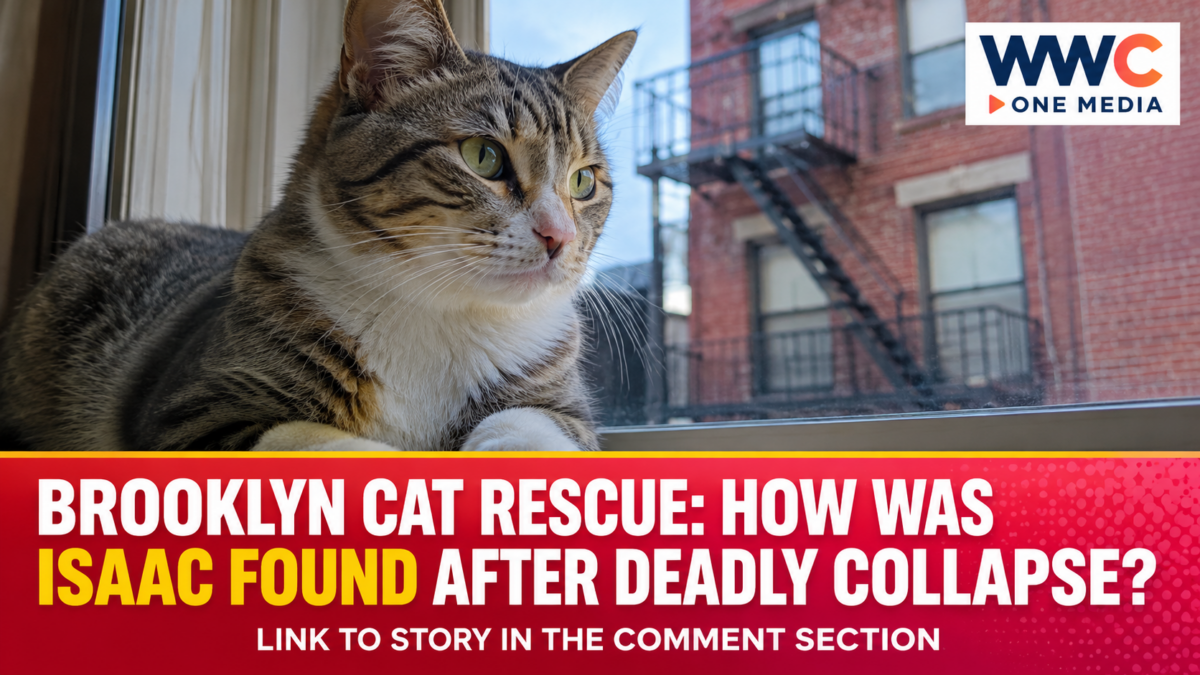
NEW YORK, Nov. 22, 2026 — A cat named Isaac was found alive after a deadly building collapse in Brooklyn, offering one displaced family a moment of relief amid an emergency that killed eight people. The animal’s recovery involved the city’s animal-welfare team, building-safety personnel and the nonprofit Flatbush Cats, while an investigation into the collapse remained open.
The Brooklyn cat rescue highlights an overlooked part of disaster recovery: pets may remain inside damaged homes even after residents have been evacuated. Yet the family’s good news must be understood alongside the wider loss of life, injuries and prolonged displacement caused by the collapse.
Brooklyn cat rescue: What the public updates establish
Flatbush Cats publicly described finding Isaac after searching an apartment and hearing a faint meow from a cabinet beneath a kitchen sink. The organisation said it brought him back to Zariah and her family. Its account provides the essential answer to how the cat was located: a search inside the apartment eventually led rescuers to the sound he made.
A public update attributed to the director of the Mayor’s Office of Animal Welfare identified cooperation among that office, Flatbush Cats and the New York City Department of Buildings. It also described a reunion with Zariah and a veterinary examination at Flatbush Vet. Because the original social-media pages could not be accessed directly during this review, these finer details require a final check against the organisations’ original posts before publication.
The important distinction is where the cat was found. The available rescue account places Isaac inside an apartment affected by the emergency, not under the mass of rubble from the building that collapsed. Confusing those settings would exaggerate the rescue and misrepresent the hazard faced by responders.
What happened on Flatbush Avenue?
On Nov. 11, New York City firefighters responded to a collapse at 1321 Flatbush Avenue. Fire Commissioner Lillian Bonsignore described a three-storey multiple dwelling falling into an adjoining construction-site excavation. People were trapped, and the first emergency units arrived rapidly.
The mayor’s official briefing said more than 250 firefighters and emergency medical personnel were involved in the response that evening. Fire officials warned of unstable debris, dangerous spaces within the wreckage and the possibility of another collapse. Those hazards mattered not only to the search for people but also to later decisions about access to nearby damaged properties.
By Nov. 15, the Fire Department reported eight deaths and 18 injured civilians and firefighters. It said its firefighters and rescue medics had rescued and recovered 12 people from the collapsed building. These figures make clear why the human emergency must remain the central context of any account about the cat’s survival.
Why entering a damaged building was complicated
The city’s initial briefing explained that the adjoining structure remained a possible source of secondary collapse. Emergency personnel therefore had to consider the stability of the wider site rather than simply opening the area to residents. The mayor also asked the public to avoid the neighbourhood so emergency teams could work.
That distinction helps explain why an animal search after a collapse is different from an ordinary missing-pet search. A familiar apartment can become an unsafe place to enter when its neighbouring structure has failed. Access decisions must account for the risks to rescuers, occupants and anyone nearby.
The broader issue is relevant beyond New York. WWC ONE MEDIA previously reported on a Cebu family forced to leave a collapsed house, a separate incident illustrating how structural damage can rapidly interrupt ordinary home life. The incidents have different circumstances and no suggested causal connection.
What Isaac’s recovery says about disaster coordination
The available accounts indicate that recovering Isaac involved more than a person entering a building to look for a cat. Animal-welfare staff, an animal-rescue organisation and officials responsible for the built environment each had a role in arranging a search and caring for the animal afterwards.
This is a practical lesson, not proof that every missing pet can be found. After a serious incident, pet owners may know where an animal was last seen but have no safe way to reach that location. Specialists can sometimes assist, but they must work within restrictions imposed by emergency responders and building authorities.
Risk assessments are equally important in other kinds of ground or structural failure. WWC’s earlier report on hazard warnings around a growing Cebu sinkhole examined why the area surrounding a visible danger may also require restrictions. That story concerns a distinct geological event, not the Brooklyn collapse.
Families face a recovery beyond the rescue
New York City’s emergency information page continues to describe an investigation at 1321 Flatbush Avenue. It directs affected families to the American Red Cross and identifies a relief fund accepting monetary contributions. This shows that the immediate rescue operation and the longer process of helping displaced residents are not the same task.
The collapse also raises questions about construction activity and building safety that cannot be answered by the cat’s recovery. The mayor said the Department of Buildings and law-enforcement partners would investigate the cause. The published records reviewed here do not establish a final cause or assign responsibility.
WWC has separately covered a collapsed electricity transmission tower in Cavite, where the public interest likewise centres on safety and accountability. That incident is unrelated to Brooklyn and should not be treated as evidence about what caused the New York emergency.
What happens next?
For the cat, the reported recovery was a welcome outcome, but the original rescue and veterinary updates should be rechecked before publishing specific claims about his medical condition or release. For the wider neighbourhood, the unresolved matter is the investigation into why the building failed and what further safety measures may follow.
The city’s publicly posted guidance still directs affected families towards assistance. Any future finding about the collapse should be reported from the official investigation itself, rather than inferred from early photographs, commentary or the circumstances of Isaac’s rescue.
Frequently asked questions
Where was Isaac found after the Brooklyn collapse?
Flatbush Cats’ public account said he was discovered in a cabinet under a kitchen sink while rescuers searched an affected apartment. The original organisation post requires final direct verification.
When did the Brooklyn building collapse happen?
The New York City Fire Department said responders were called to 1321 Flatbush Avenue on Nov. 11, 2026.
How many people died in the collapse?
An FDNY announcement dated Nov. 15 reported eight deaths and 18 injuries involving civilians and firefighters.
Has New York City determined what caused the collapse?
Not in the official materials reviewed for this report. The city’s emergency information page continued to describe an ongoing investigation.










