
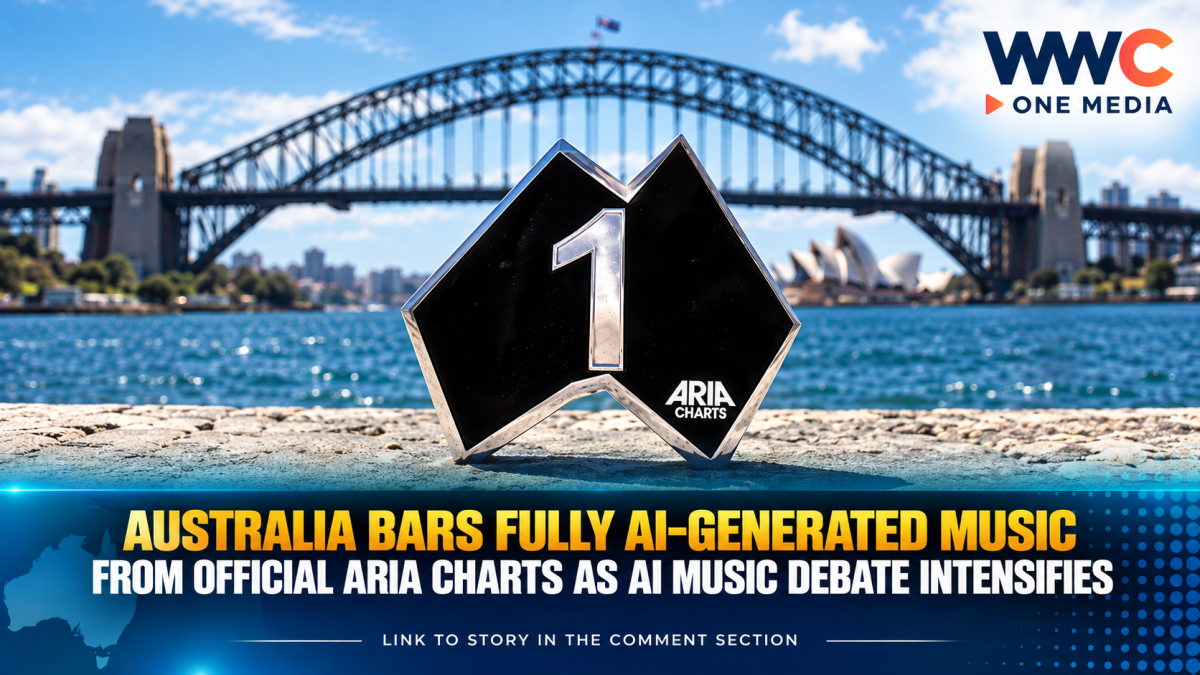
Australia has drawn a new line in the rapidly changing music industry: songs created wholly by generative AI will no longer be eligible for the country’s official ARIA Charts.
The Australian Recording Industry Association (ARIA) introduced new eligibility rules in August, saying recordings must be “substantially human made” to qualify for the charts.
The policy took effect with the ARIA chart dated 31 August 2026, marking one of the clearest moves yet by a national music chart organization to distinguish human-created music from recordings whose primary creative elements were generated by artificial intelligence.
But the change is not a blanket ban on AI-assisted music.
What ARIA’s new AI rule actually means
Under the updated rules, a recording using generative AI can still appear on the ARIA Charts if it remains substantially human-made and does not raise concerns about stream or chart manipulation. It must also comply with applicable copyright, related-rights and AI-labeling requirements.
ARIA divides AI use into three broad categories.
AI-generated: Not eligible.
This covers recordings where generative AI creates the entirety or primary portion of the creative elements. A lead vocal or key instrumental performance generated by AI can make a recording ineligible, even if humans later mix or master it.
AI-assisted: Eligible.
A recording can qualify when humans remain responsible for the lead vocal, primary instruments and songwriting, while generative AI is used for supporting creative elements.
AI in production: Eligible.
Routine or non-material uses of AI—including mastering, stem separation, AI drum machines and certain effects—do not automatically disqualify a recording.
In other words, ARIA is drawing the line between humans using AI as a tool and AI effectively becoming the creator of the recording.
Why ARIA made the change
The new policy comes amid growing concern over fully AI-generated music appearing on streaming services and competing directly with human artists.
ARIA said recordings without human performance behind them are increasingly generating streams, creating concerns for Australian artists competing in an already crowded music market. The organization said its charts are intended to recognize the consumption and success of music made by people.
ARIA chief executive Annabelle Herd has argued that artists already use AI tools, but that music generated wholesale by AI represents a different issue.
The organization has also called on other parts of the music industry, including radio, to consider similar measures supporting human artistry.
The controversy that put AI music in the spotlight
The policy follows a closely watched episode involving Queensland DJ and producer Josh Fawaz.
A version of Madonna’s Like a Prayer produced with AI became Australia’s most-played song on radio in July and reached No. 4 on two ARIA charts, according to ABC reporting.
The track generated criticism within the music industry over the use of AI. Fawaz said he had used AI as a tool and subsequently updated the Spotify listing to identify AI-generated vocals and drums.
The controversy highlighted a difficult question for chart organizations: If listeners stream a song heavily, should it qualify for a chart regardless of whether a human actually performed the music?
ARIA’s answer is now more clearly defined.
The charts still belong to human-made music
ARIA’s decision does not mean artificial intelligence is being removed from the music-production process.
Instead, the organization is establishing a threshold for chart eligibility.
A musician can continue using AI for certain production tasks without automatically losing eligibility. What matters is whether humans remain the primary creative force behind the recording.
That distinction could become increasingly important as AI music-generation technology becomes more sophisticated.
The line between “AI-assisted” and “AI-generated” may become harder to determine as artists use increasingly advanced tools, something ARIA itself acknowledges in its guidance.
ARIA can remove an ineligible song
The new rules also give ARIA the ability to act after a recording has entered the charts.
If a song is subsequently determined to be ineligible, ARIA can correct the chart, adjust positions and withdraw accreditations. It can also revoke or request the return of an ARIA No. 1 Award where appropriate.
Artists and representatives are given an opportunity to provide evidence if ARIA raises concerns, with an appeal process involving the ARIA Chart & Marketing Committee and, ultimately, the ARIA Board.
The global music industry is moving in the same direction
Australia’s decision is part of a broader international conversation about how music organizations should handle generative AI.
ARIA says its updated approach follows global principles developed by the International Federation of the Phonographic Industry (IFPI).
The wider debate involves not only chart eligibility but also copyright, artist consent, transparency, licensing and the labeling of AI-generated content.
That means Australia’s new policy could become a closely watched model as other music markets consider how to respond to AI-generated recordings.
What happens next?
The technology is evolving faster than many existing industry rules.
ARIA says its framework will remain under review as AI develops. For now, the basic principle is straightforward: AI can be part of the creative process, but a recording whose primary creative elements come from generative AI cannot compete for a place on the ARIA Charts.
The policy also sends a broader message to the industry.
As AI-generated songs become easier to produce and distribute, the biggest battle may no longer be whether artificial intelligence can make music.
It may be over what the music industry considers a human-made song—and who deserves credit when a machine does the creating.
WWC ONE MEDIA G.A




Leave a Reply