
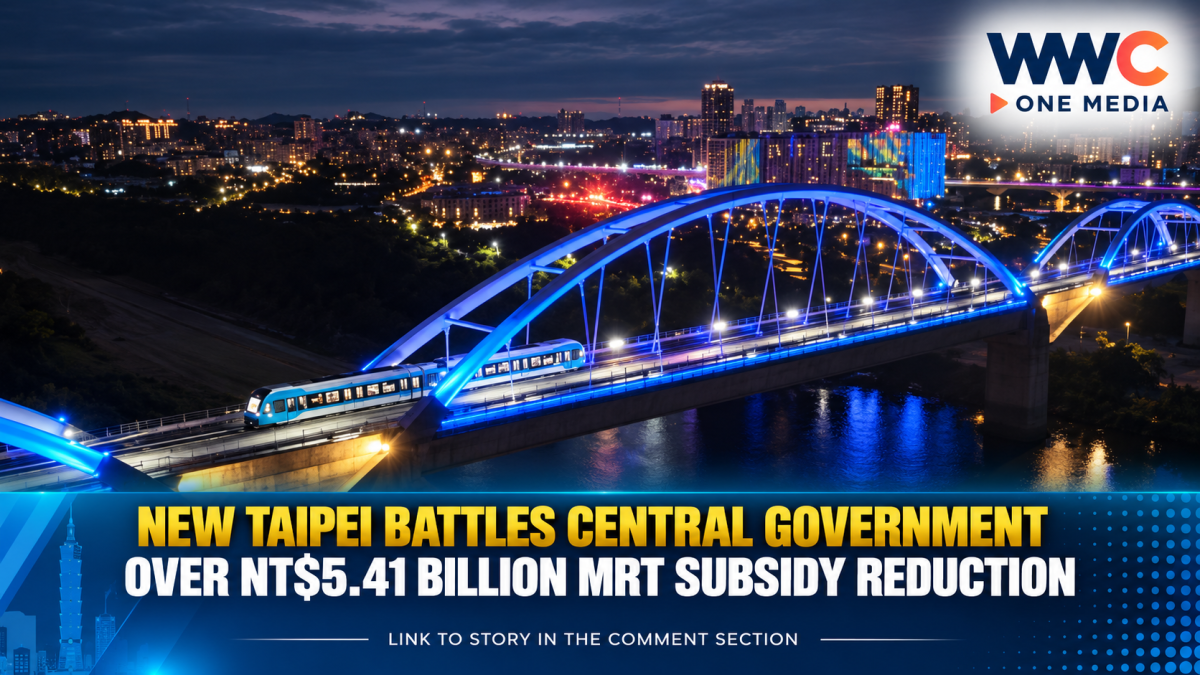
TAIPEI — A growing dispute over Taiwan’s next-year transportation budget has put New Taipei City and the central government at odds, with the city demanding the restoration of NT$5.41 billion (about US$171 million) in MRT-related subsidies.
New Taipei officials say the reduction could put pressure on several major rail projects, including the Sanying Line, the New Taipei section of the Keelung MRT and the Danhai Light Rail.
But the Ministry of Transportation and Communications (MOTC) disputes the characterization that New Taipei suffered a disproportionate or arbitrary cut. The ministry says subsidies are allocated according to individual projects’ construction schedules, tender progress and budget execution.
The disagreement has quickly become both a transportation and political issue.
What New Taipei says was cut
New Taipei says its requested central subsidies for three projects were reduced by a combined NT$5.41 billion for fiscal 2027.
According to the figures cited by Taiwan’s Central News Agency, the reductions include approximately:
- NT$5.7 billion for the Sanying Line;
- NT$47 billion for the New Taipei section of the Keelung MRT; and
- no subsidy allocation for the Danhai Light Rail’s second-phase network in the current budget.
New Taipei Mayor Hou You-yi has called on the central government to restore the funding, arguing that the city is currently at a peak period of transportation construction.
The city has already sent a request to the Transportation Ministry seeking priority additional funding.
The central government says the picture is different
The Transportation Ministry says the reduction should not be interpreted as a broad withdrawal of support for New Taipei’s MRT network.
For fiscal 2027, Taiwan’s Executive Yuan approved approximately NT$49.9 billion in central subsidies for local MRT construction—the highest annual allocation on record, according to Taipei Times.
The ministry says New Taipei’s rail projects submitted requests totaling NT$18.724 billion, of which NT$16.016 billion was approved.
That represents an approval rate of approximately 85.5%, which the ministry says was the second-highest among jurisdictions with MRT construction projects, behind Taipei’s 91.8%.
In other words, the central government’s argument is that New Taipei did not simply lose funding because of a political decision. Instead, officials say individual project requirements and implementation schedules determined how much money was allocated.
Why the Danhai Light Rail is different
The Danhai Light Rail issue has a specific explanation from the ministry.
The central government says funding for the second phase was not included because the revised project plan had not yet received Executive Yuan approval.
That means the absence of funding in the current budget does not necessarily mean the project has been abandoned.
New Taipei officials, however, are urging the central government to move quickly so the city’s wider rail expansion plans can continue without disruption.
New Taipei points to its spending record
New Taipei has also pushed back against the argument that its requested funding was reduced because of weak budget execution.
The city government says its MRT projects recorded a 95.87% implementation rate, compared with an approximately 80% average cited by the Transportation Ministry.
It also says both the Keelung MRT and Sanying Line achieved 100% budget implementation in 2025.
Hou has argued that those figures show New Taipei has demonstrated an ability to use transportation funding efficiently.
The city’s position is therefore straightforward: if projects are progressing on schedule and budgets are being implemented, it wants the central government to restore the requested funds.
Keelung is also worried
The dispute extends beyond New Taipei because the Keelung MRT connects the two cities.
New Taipei had requested approximately NT$9.38 billion in central funding for the Keelung MRT but says NT$4.7 billion was reduced from that request.
Keelung Mayor George Hsieh has warned that the funding reduction could affect the project’s planned completion schedule and called on the central government not to cut the relevant funding.
That makes the disagreement more than a New Taipei budget issue: delays could potentially affect the broader transportation network linking New Taipei and Keelung.
Politics adds another layer
The funding dispute is unfolding ahead of Taiwan’s 2026 local elections, giving the MRT controversy an obvious political dimension.
Opposition politicians have criticized the central government and called on Democratic Progressive Party New Taipei mayoral candidate Su Chiao-hui, who is also a legislator, to press Taipei for additional funding.
Su has responded that the central government treats local transportation projects equally and that she will continue monitoring the budget.
That has turned a technical budget dispute into a broader political argument over who deserves credit—or blame—for New Taipei’s expanding rail network.
What happens next?
The immediate issue is whether additional central funding will be restored and, if so, when.
New Taipei wants the NT$5.41 billion reduction reconsidered, while the Transportation Ministry maintains that funding should follow actual project progress and approved plans.
For commuters, the crucial question is not simply how much money appears in a government budget.
It is whether the dispute affects the construction schedules and delivery dates of the Sanying Line, Keelung MRT and future Danhai Light Rail expansion.
For now, the central government says its record MRT allocation demonstrates continued support for public transportation, while New Taipei argues that its own construction record warrants more funding.
The numbers may be measured in billions of New Taiwan dollars—but the real test will be whether the budget battle stays inside government offices or eventually changes the timetable for the rail lines millions of commuters are counting on.
WWC ONE MEDIA G.A




Leave a Reply