
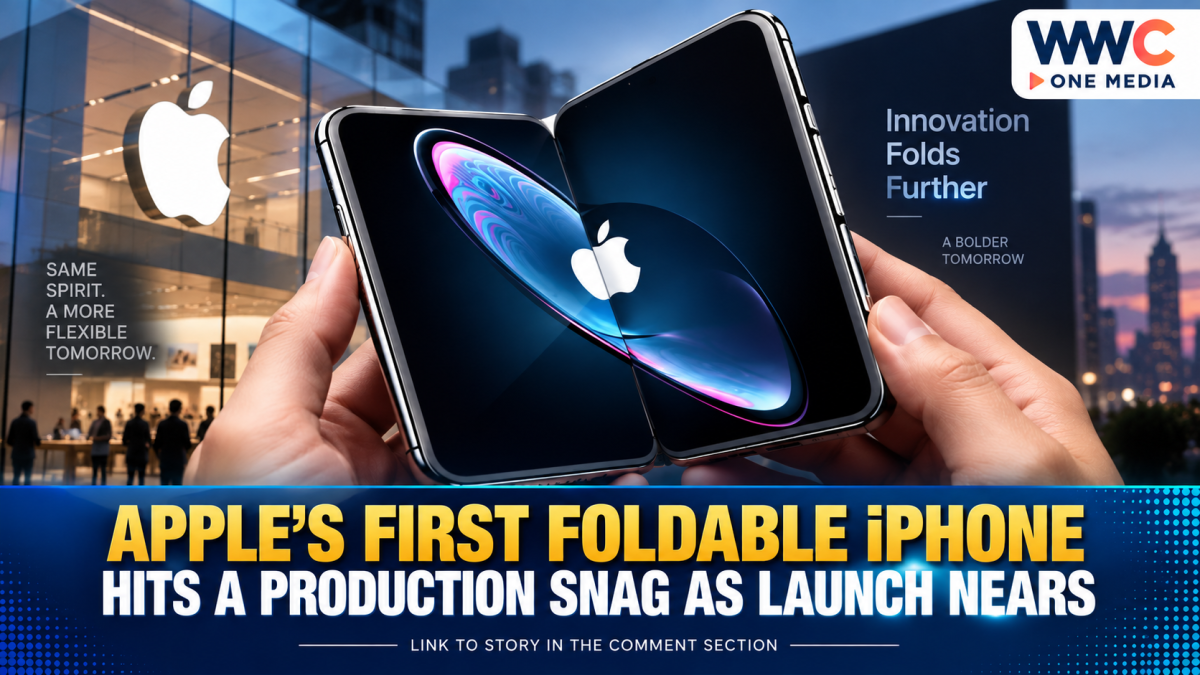
CUPERTINO — Apple’s long-awaited entry into the foldable smartphone market is getting closer, but a new supply-chain report suggests the company still has a major manufacturing hurdle to overcome.
Apple and its suppliers have reportedly begun limited production of the company’s first foldable iPhone, but output is currently only a few hundred devices per day, according to sources cited by Nikkei Asia. The unusually low early production rate highlights the difficulty of preparing a completely new form factor while meeting Apple’s demanding quality standards.
The timing is particularly significant because Apple has officially scheduled its next major product event for September 9, just days away. Apple has not confirmed that a foldable iPhone will be unveiled, but multiple reports expect the device to be one of the event’s headline products.
A production race against the clock
The latest report suggests Apple is prioritizing quality control as it attempts to scale production.
Foldable smartphones are considerably more complicated to manufacture than conventional phones. Flexible displays must survive repeated bending, while hinges need to maintain alignment and durability without adding excessive thickness or weight.
According to the Nikkei-sourced report, Apple has imposed particularly stringent quality requirements, with screen flatness and hinge performance among the areas receiving close attention. An additional validation process reportedly added in August has also pushed back the planned mass-production schedule by several weeks.
That doesn’t necessarily mean Apple will cancel or postpone the product.
Instead, the immediate concern is how quickly production can scale.
The numbers reveal the challenge
A production rate of only several hundred units a day is nowhere near what would be required for a major global smartphone launch.
Previous Nikkei reporting indicated that Apple had raised its intended foldable production target to roughly 10 million units for 2026, up from an earlier estimate of around 7 million to 8 million. The company was also reportedly preparing suppliers for a broader premium-iPhone production push.
The contrast between that ambitious annual target and today’s reported early production rate is striking.
However, there is an important caveat: early production figures do not necessarily represent the final production capacity at launch. First-generation products routinely begin with lower yields while factories refine assembly processes, qualify components and improve manufacturing efficiency.
In other words, the real test isn’t whether Apple can make a few hundred devices today.
It’s whether it can turn that trickle into tens of thousands of units a day quickly enough.
Apple may still unveil it next week
Despite the manufacturing concerns, Bloomberg reporting has maintained that Apple remains on track for a September introduction.
When Nikkei reported engineering difficulties in April, concerns emerged that Apple’s foldable could slip into late 2026 or even 2027. Bloomberg subsequently reported that Apple was still targeting a September launch, although initial supply could be constrained.
That distinction is important.
A product can be unveiled in September without immediately being available in large quantities.
Apple has previously used staggered availability for major products, and a limited first shipment would give the company additional time to increase manufacturing capacity.
September 9 is now the key date
Apple has officially confirmed its “Surprise and shine” event for September 9 at 10 a.m. Pacific Time. In the Philippines, Apple’s website lists the event for September 10 at 1 a.m. PHT.
Reuters reports that Apple is expected to introduce its latest iPhone lineup at the event and potentially unveil its first foldable phone. The event will also be the first major product launch under new CEO John Ternus, who took over from Tim Cook at the beginning of September.
Apple itself has not officially confirmed a foldable iPhone, so claims about its final name, specifications, price and availability should still be treated as reports rather than established facts.
Samsung could play a major role
Ironically, Apple’s entry into foldables could also strengthen one of its biggest smartphone rivals.
Samsung Display is widely reported to be Apple’s primary — and potentially exclusive — supplier of foldable OLED panels for the first-generation device.
In June, reports said Samsung Display had received Apple’s approval to begin module production after meeting Apple’s reported quality requirements. An initial order of approximately 3 million panels was cited, with production and back-end processing involving Samsung Display’s facilities in Vietnam.
That relationship underscores just how difficult Apple’s first foldable will be.
Apple may design the device and control the user experience, but its ability to deliver millions of units will depend heavily on a complex network of display, hinge, semiconductor, battery and assembly suppliers.
What could the first foldable iPhone look like?
Most details remain unconfirmed, but reports consistently point toward a book-style design rather than a clamshell similar to Samsung’s Galaxy Z Flip.
Multiple reports have described a large internal display, with rumors pointing to a screen around 7.8 inches when unfolded and a smaller external display around 5.5 inches. Other reported features include an A20-generation chip and Touch ID rather than Face ID.
These specifications remain rumored, not official.
The same applies to the device’s expected price.
Reports have placed the foldable iPhone well above $2,000, with some analyst estimates reaching around $2,500. That would make it substantially more expensive than Apple’s conventional flagship iPhones and position it as an ultra-premium product.
Apple is entering a market it didn’t create
The company is arriving late to the foldable-phone race.
Samsung has already spent years developing foldable smartphones, while Huawei and Chinese manufacturers including Xiaomi, Oppo and Vivo have also pushed the category forward.
Counterpoint Research expects global foldable smartphone panel shipments to reach approximately 27.5 million units in 2026, representing about 24% growth from 2025. The research firm expects Apple’s entry to be one of the major forces reshaping the premium foldable market.
That means Apple doesn’t need to invent the category.
Instead, it needs to convince consumers that its version is good enough — and different enough — to justify the premium price.
The biggest question isn’t the announcement
The biggest question now may not be whether Apple can show a foldable iPhone on stage.
It is whether Apple can make enough of them.
If the current production bottleneck persists, early customers could face extremely limited availability even if the device is officially unveiled next week.
That could create an unusual situation for Apple: enormous attention surrounding a new iPhone category, but only a fraction of consumers able to buy one immediately.
And after years of waiting for Apple to enter the foldable market, the first chapter could come down to one deceptively simple problem:
Can Apple build the foldable iPhone fast enough to meet the demand it is about to create?
Accuracy note
This story distinguishes confirmed information from reported specifications. Apple has confirmed the September 9 event, but it has not publicly announced a foldable iPhone. The reported “few hundred per day” production figure comes from Nikkei Asia sources and has not been independently confirmed by Apple. Reuters previously noted that it could not independently verify earlier Nikkei reports about foldable-iPhone engineering problems.
Recommended Facebook headline:




Leave a Reply