
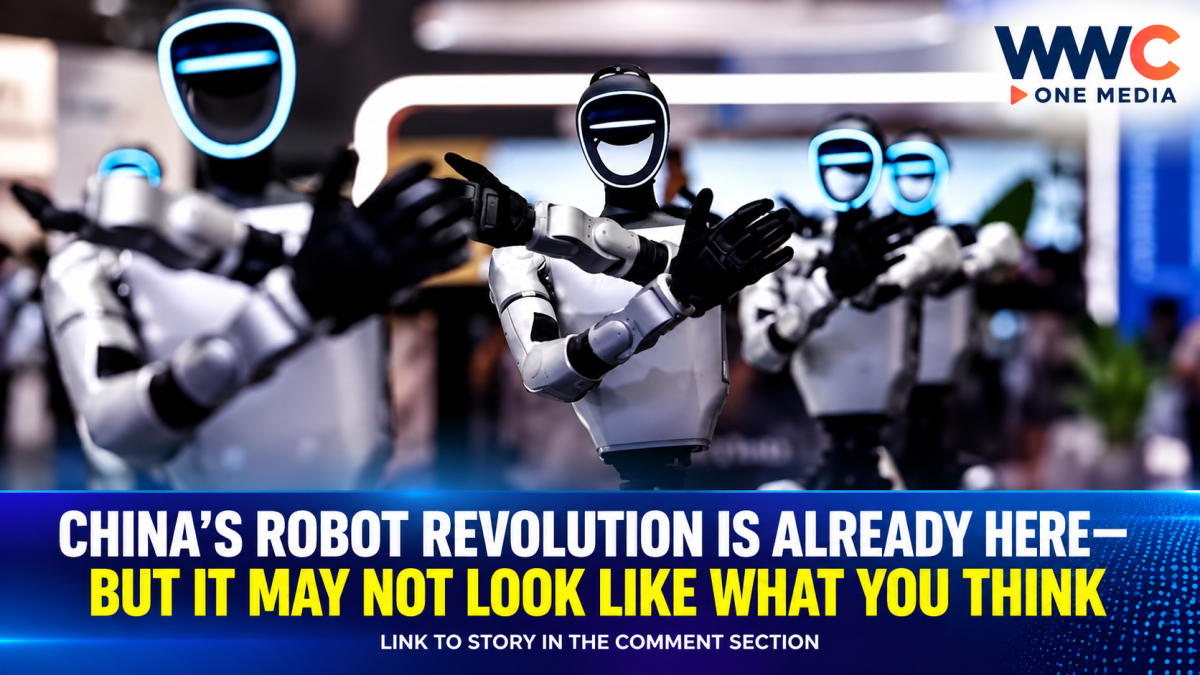
China’s rapidly expanding robotics industry is attracting global attention, with humanoid machines dancing, fighting, running and performing increasingly sophisticated demonstrations. But beneath the viral videos lies a much bigger—and potentially more consequential—robotics revolution.
The real story may not be the rise of human-shaped machines at all.
Instead, China is rapidly scaling industrial robots, autonomous mobile machines and specialized robotic systems that are already working in factories, warehouses, hospitals and other commercial environments.
A recent Channel NewsAsia commentary, based on analysis by Financial Times contributor Zijing Wu, argues that the spectacle surrounding humanoid robots risks obscuring where China has already built a substantial competitive advantage: manufacturing scale and robotics supply chains.
China is already the world’s industrial robotics giant
China installed approximately 295,000 new industrial robots in 2024, accounting for about 54% of global installations, according to figures cited from the International Federation of Robotics.
The country also had more than 2 million industrial robots in operation, roughly 4.5 times Japan’s installed base, according to the CNA commentary.
China’s robotics industry has also expanded rapidly. Industry revenue reportedly surpassed US$44 billion, while industrial robot exports grew 49% in 2025—the first year China became a net exporter of industrial robots, according to figures cited by CNA.
That matters because industrial automation does not need to look futuristic to transform an economy.
A robotic arm welding a car, an automated vehicle transporting components or a warehouse robot sorting packages may attract far less attention than a robot performing kung fu—but these machines can deliver something businesses care about most: reliability, productivity and lower operating costs.
Humanoid robots are grabbing the headlines
Humanoid robots have nevertheless become one of China’s most visible technology bets.
At the 2026 World Robot Conference in Beijing, Chinese companies showcased machines capable of running, boxing, playing sports and performing coordinated movements.
Unitree Robotics, one of the country’s best-known robotics companies, became particularly prominent after its humanoid robots went viral online. Its market debut subsequently generated enormous investor enthusiasm.
But impressive demonstrations do not necessarily translate into useful industrial performance.
Reuters reported in August that Chinese humanoid robots still face significant challenges involving dexterity, intelligence, reliability and their ability to operate outside carefully controlled routines.
In other words, a robot that can execute an impressive choreographed routine is not automatically capable of working an unpredictable factory shift.
The factory floor tells a different story
For manufacturers, the question is not whether a robot looks human.
It is whether the robot can repeatedly perform a task quickly, safely and economically.
That is why conventional robotic arms and automated guided vehicles remain extremely important.
At Xiaomi’s electric-vehicle manufacturing operations, for example, industrial automation already handles a large proportion of production. Reuters reported that robotic systems dominate key manufacturing processes, while humanoid robots are still being tested for more limited tasks.
South China Morning Post reporting from the World Robot Conference similarly found that the industry is increasingly emphasizing practical deployment rather than flashy demonstrations.
At the event, wheeled and specialized robots were being demonstrated for package sorting, production-line work, logistics and food preparation. One Chinese company reported that its two-armed wheeled robot could sort thousands of packages per hour during a controlled test.
The lesson is straightforward: the best robot for a job does not necessarily need two legs.
So why is China investing so heavily in humanoids?
There is a serious argument for human-shaped robots.
The modern world was designed around humans.
Factories, offices, warehouses, hospitals and homes contain stairs, doors, shelves, tools and workstations built for human bodies.
A sufficiently capable humanoid robot could theoretically enter those environments without requiring companies to redesign everything around a specialized machine.
Humanoids could eventually become particularly valuable for dangerous, repetitive or labor-intensive jobs—and potentially in environments such as disaster zones where wheeled machines cannot easily navigate rubble.
The second major argument is artificial intelligence.
If robots become capable of understanding their surroundings, reasoning about physical objects and learning from experience, a single general-purpose platform could potentially perform many different tasks.
That possibility has helped fuel the race to develop so-called embodied AI—AI systems designed to perceive and act in the physical world.
China is trying to move robots from demonstrations into real work
Beijing is now pushing the industry toward practical applications.
A nationwide programme announced in June called for humanoid robots and embodied AI systems to be tested in areas including manufacturing, healthcare and disaster relief.
Chinese authorities said they wanted key humanoid products to undergo application verification and begin regular deployment in representative scenarios by the end of 2026. Beijing also set targets involving more than 100 high-value applications and 10,000 deployed units.
That policy shift is significant.
It suggests China is no longer satisfied with robots winning demonstrations or going viral on social media. The government wants them generating measurable economic value.
But there is a major problem: robots still need to learn how to work
Humanoid robots may be excellent at performing predetermined movements, but real-world work is full of surprises.
Objects are moved.
Lighting changes.
People get in the way.
Products vary in shape.
Machines malfunction.
And seemingly simple tasks—such as picking up a small object—can become extraordinarily difficult for a robot.
Reuters’ investigation found that Chinese humanoid developers are therefore investing heavily in training facilities where robots learn physical tasks and collect data that can be used to improve embodied-AI systems.
The data challenge could become one of the defining battles of the industry.
The more robots operate in real environments, the more physical-world data developers can potentially collect. That data could then improve AI models, creating a feedback loop between hardware deployment and software development.
China has another advantage: the supply chain
This may ultimately be China’s biggest weapon.
China already possesses enormous manufacturing capacity for motors, batteries, sensors, electronics, mechanical components and other technologies needed to build robots.
That industrial ecosystem could allow Chinese manufacturers to produce robots more cheaply and at greater scale than many competitors.
The same strategy has been visible in industries such as electric vehicles and solar technology: build manufacturing capacity quickly, cultivate suppliers, intensify competition and drive down costs.
The humanoid sector, however, remains much less mature than those industries.
Reuters reported that China has more than 150 humanoid-robot companies, while government and state-linked spending has helped stimulate demand. At the same time, analysts have warned about excess competition, subsidies and the possibility of industry consolidation.
The humanoid boom could face a reality check
Investor enthusiasm is already running ahead of current commercial capabilities in some areas.
Reuters reported that Unitree’s market debut generated extraordinary investor interest, while its valuation later experienced significant volatility. Other analysts have warned that the sector could be approaching a period of consolidation as companies compete for capital and customers.
That does not mean humanoid robots are a failure.
Quite the opposite.
The technology is progressing rapidly.
Chinese manufacturers shipped thousands of humanoid robots in 2025, with Chinese companies dominating the global shipment rankings, according to Omdia figures reported by South China Morning Post. AgiBot, Unitree and UBTech were among the leading suppliers.
But the central question is changing.
It is no longer simply “Can China build humanoid robots?”
China clearly can.
The bigger question is:
Can those robots become reliable and inexpensive enough to outperform simpler machines?
The quieter revolution may be the bigger one
China’s robotics story therefore has two parallel tracks.
One is highly visible: humanoids competing in sports, dancing on stages and captivating audiences around the world.
The other is considerably less glamorous: robotic arms manufacturing vehicles, automated machines moving goods, robots operating in warehouses and specialized systems performing repetitive tasks.
That second revolution may have a more immediate economic impact.
CNA reported in July that Chinese robots were already being tested in hotels, retail environments and other everyday settings, including machines capable of moving laundry, retrieving products and assisting with store operations.
Humanoid robots may eventually achieve the flexibility needed to become genuinely general-purpose machines.
But China does not need to wait for that breakthrough to become a robotics superpower.
The robot revolution is already happening. The surprising part is that many of the machines driving it don’t look human at all.




Leave a Reply