
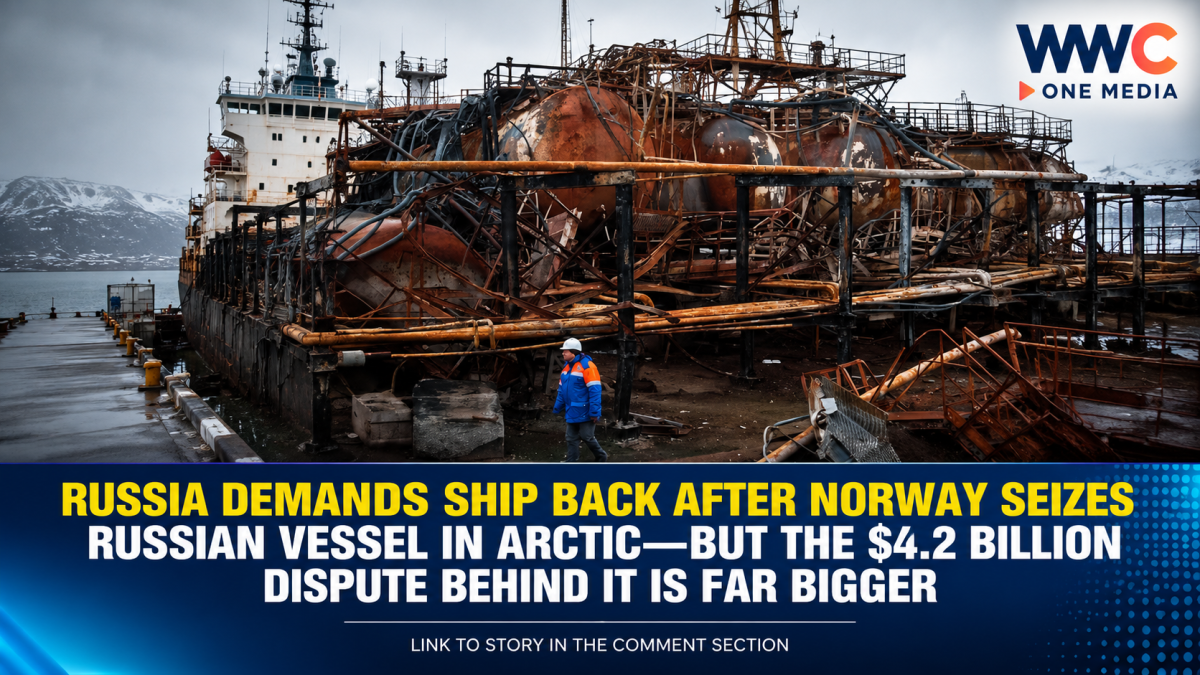
MOSCOW/OSLO — Russia is demanding the immediate release of the Russian vessel Professor Molchanov after Norwegian authorities seized the ship in the Arctic archipelago of Svalbard in a legal action connected to a multibillion-dollar compensation claim by Ukrainian state energy company Naftogaz.
The confrontation has added a new layer to already strained relations between Moscow and Oslo, with the dispute unfolding in one of the Arctic’s most politically sensitive regions.
Norwegian authorities seized the vessel on September 2 after the Nord-Troms District Court issued an order on August 31 allowing Naftogaz to pursue the Russian ship as part of efforts to enforce a US$4.22 billion arbitration award connected to Russia’s seizure of Ukrainian assets in Crimea.
The Svalbard Governor’s Office confirmed that the Professor Molchanov was taken into custody while docked in Barentsburg, a Russian-operated settlement on the Norwegian-administered archipelago. The ship has been ordered to remain there until the governor or Norwegian courts decide otherwise.
Russia demands the ship’s immediate release
Moscow reacted sharply to the seizure.
Russia’s Foreign Ministry summoned Norway’s ambassador and lodged a formal protest, while the Russian embassy in Norway said the seizure was a politically motivated violation of international law.
Russian officials said they would pursue the vessel’s release through legal channels and demanded that the safety of the ship’s passengers and crew be guaranteed.
The Kremlin’s reaction also went beyond the vessel itself. Russian President Vladimir Putin criticized the seizure, saying actions of this kind could complicate the prospects for future peace negotiations, according to AP reporting.
Why did Norway seize the Professor Molchanov?
At the center of the dispute is Naftogaz, Ukraine’s state-owned energy company.
Naftogaz has been pursuing compensation from Russia for the seizure of its assets following Moscow’s 2014 annexation of Crimea. In 2023, a Hague-based arbitration tribunal ruled in Naftogaz’s favor and awarded the company approximately $4.22 billion.
Russia has refused to pay the award.
Naftogaz subsequently began seeking Russian commercial assets in other jurisdictions as part of its efforts to enforce the award. Norway’s courts authorized the seizure of the Professor Molchanov, leading to the action in Svalbard.
Naftogaz has described the seizure as another step toward holding Russia financially accountable for the assets taken in Crimea and has indicated that it intends to continue pursuing Russian assets internationally.
A Russian ship trapped in a strategically sensitive Arctic territory
The Professor Molchanov is a research vessel that is also used for expedition cruises. It had arrived in Barentsburg carrying Russian scientists before Norwegian authorities prevented it from leaving.
No arrests of the crew or passengers have been reported. The Svalbard Governor’s Office said it would take care of those aboard in cooperation with the Russian-operated Arcticugol organization.
The location makes the case particularly sensitive.
Svalbard is Norwegian territory, but its special legal status dates to the 1920 Svalbard Treaty. The treaty recognizes Norwegian sovereignty while giving nationals of signatory states—including Russia—certain rights to conduct economic activities in the archipelago.
Norway maintains that those treaty rights do not exempt Russian individuals or companies from complying with Norwegian laws and court decisions.
Russia, meanwhile, maintains a longstanding presence on Svalbard, including the coal-mining settlement of Barentsburg and the smaller settlement of Pyramiden.
Norway says it was enforcing a court order
Oslo has sought to distance itself from the underlying compensation dispute.
Norwegian authorities say the government itself is not a party to the Naftogaz case. Instead, the Svalbard governor was acting in the role of enforcement authority after the Norwegian court granted Naftogaz the right to seize the vessel.
Norwegian Justice Ministry spokesperson Frank Lynum said the governor was obliged to enforce the court’s ruling and that the matter was being handled through ordinary Norwegian judicial procedures.
That distinction is important: the seizure was not announced as a new Norwegian sanctions measure against Russia, but as enforcement of a Norwegian court order connected to the international arbitration award.
The dispute could become bigger than one ship
The immediate question is whether Russia can successfully challenge the seizure in Norwegian courts.
The broader issue is even more significant.
Naftogaz’s campaign demonstrates how international arbitration awards stemming from the Ukraine war can move beyond courtrooms and into national jurisdictions where Russian-linked commercial assets may be vulnerable to seizure.
Reuters reported that Naftogaz’s legal team is preparing to defend the seizure, while the vessel could potentially face further legal action, including a forced sale, depending on subsequent court decisions.
For Moscow, the case also touches on its longstanding interests in Svalbard and the Arctic.
For Oslo and Kyiv, it represents a test of whether international compensation rulings can be translated into concrete recovery of assets when the losing party refuses to pay.
For now, the Professor Molchanov remains in Barentsburg, unable to leave while the legal battle moves forward.
And what began as a dispute over a compensation award worth billions of dollars has now placed a Russian vessel—and another point of tension between Moscow and the West—at the center of an increasingly consequential Arctic confrontation.




Leave a Reply