
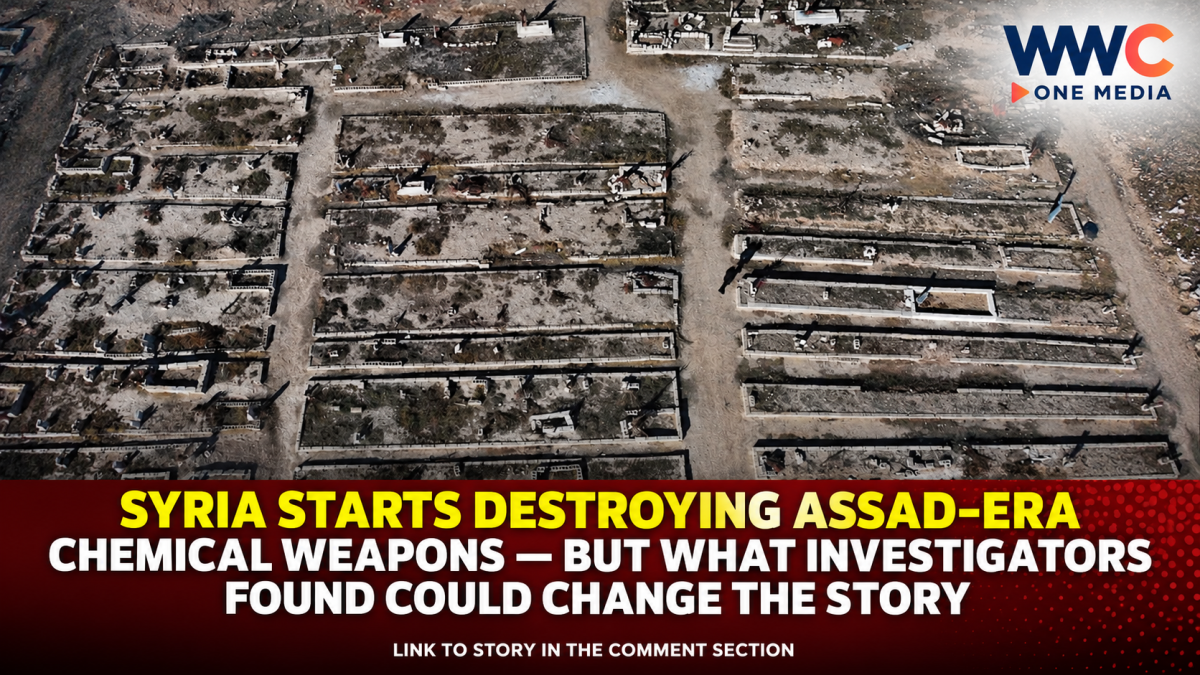
BEIRUT — Syria has begun destroying remnants of the chemical weapons programme inherited from the government of former President Bashar al-Assad, marking the first verified destruction of chemical munitions inside the country in more than a decade.
The development was announced at a United Nations Security Council briefing on September 3, where UN disarmament chief Izumi Nakamitsu said the Organisation for the Prohibition of Chemical Weapons (OPCW) had verified the destruction of chemical munitions in Syria for the first time since 2014.
The operation represents a major step in Syria’s effort to dismantle a chemical weapons programme that international investigators have spent years trying to document.
And what has been uncovered since the fall of Assad’s government suggests the full story is still far from over.
42 aerial bombs destroyed
According to the UN and OPCW, an OPCW team deployed to Syria last month to verify the destruction of so-called Category 3 chemical weapons — a category that includes unfilled munitions and equipment designed to release chemical agents.
The team verified the irreversible destruction of 42 aerial bombs.
The destruction follows discoveries made by Syrian authorities and OPCW experts in May 2026.
The OPCW said its investigation uncovered previously undeclared chemical munitions, chemical substances, equipment and thousands of pages of documents connected to the former Syrian programme.
Among the weapons discovered were dozens of munitions similar to those associated with earlier chemical attacks, including aerial bombs of the type used in the Ltamenah attacks in 2017 and rockets similar to those used in the Ghouta attack in 2013.
The discoveries went beyond weapons
The May investigation did not simply uncover old ammunition.
The OPCW said investigators also identified an additional chemical weapons production facility, a previously undeclared chemical associated with the production of nerve agents, and two chemical weapons storage facilities.
The findings are significant because Syria’s former government had previously submitted declarations concerning its chemical weapons programme but failed to provide what the OPCW considered a complete and accurate picture.
The organisation has repeatedly said that the former Syrian authorities withheld information about the scope of the programme.
A programme linked to some of Syria’s darkest attacks
Chemical weapons became one of the most controversial elements of Syria’s civil war.
The OPCW’s investigations have subsequently identified Syrian government forces as responsible for several chemical weapons attacks.
Its Investigation and Identification Team has identified the Syrian Arab armed forces as perpetrators in cases including Kafr Zeita in 2016, three incidents in Ltamenah in 2017, Saraqib in 2018 and Douma in 2018.
In January 2026, the OPCW said there were reasonable grounds to conclude that the Syrian Arab Air Force carried out the October 2016 Kafr Zeita chemical attack, in which chlorine was released and dozens of people were affected.
Earlier investigations also concluded that Syrian Arab Air Force units used sarin and chlorine during the 2017 Ltamenah attacks.
Importantly, the OPCW’s Investigation and Identification Team is not a criminal court and does not itself determine individual criminal responsibility. Its mandate is to identify perpetrators of specific chemical-weapons incidents based on its investigations.
Syria’s new government takes a different approach
The destruction effort comes after Assad was ousted in December 2024, opening the way for international investigators to revisit suspected chemical-weapons sites that had previously been inaccessible or difficult to investigate.
The new Syrian authorities have committed to cooperating with the OPCW and fulfilling the country’s obligations under the Chemical Weapons Convention.
That cooperation has already produced significant institutional changes.
In July 2026, the OPCW Executive Council reinstated Syria’s rights and privileges under the Chemical Weapons Convention after they had been suspended since 2021 because of the former government’s failure to fully declare its chemical weapons programme and confirmed chemical weapons use.
The decision also established a framework for continued verification and destruction work at facilities including Al Qutayfah and Homs.
Syria says security concerns are complicating the operation
Syria’s UN ambassador Ibrahim Olabi welcomed the destruction programme but also raised concerns about the security environment.
Olabi accused Israel of repeated attacks that he said had disrupted search-and-destruction operations and placed Syrian personnel involved in the work at risk.
Israel did not immediately respond to a Reuters request for comment on the allegations.
The security issue adds another complication to an already difficult operation: investigators must locate, secure, document and safely destroy potentially hazardous remnants while operating in a country still affected by armed conflict and regional tensions.
The bigger question: how much is still hidden?
The latest destruction does not mean Syria’s entire chemical weapons legacy has been eliminated.
The OPCW said in May that it was examining more than 100 locations across Syria considered potentially relevant to the former chemical weapons programme. Investigators have prioritised sites based on information gathered and corroborated over more than a decade.
Thousands of pages of documentation have also been recovered, potentially providing investigators with additional clues about how the programme operated, where materials were stored and who was involved.
That makes the destruction of the 42 aerial bombs only one part of a much larger process.
Accountability moves alongside destruction
Syria’s new authorities are also moving toward legal proceedings involving people suspected of involvement in the former chemical weapons programme.
According to Reuters, Syrian authorities have detained 18 suspects, including senior military, political and technical figures, and are preparing an initial court hearing.
The combination of destruction, international verification and potential prosecutions could therefore mark a major turning point in how Syria deals with the chemical weapons legacy of the Assad era.
For years, the central question was whether undeclared chemical weapons and production capabilities remained somewhere inside Syria.
Now, investigators have confirmed that previously undeclared remnants existed — and the process of eliminating them has begun.
But with more than 100 potentially relevant locations identified and additional facilities, chemicals and documents already uncovered, the biggest question may no longer be whether remnants survived the Assad era.
It may be how much more remains to be found.



Leave a Reply