
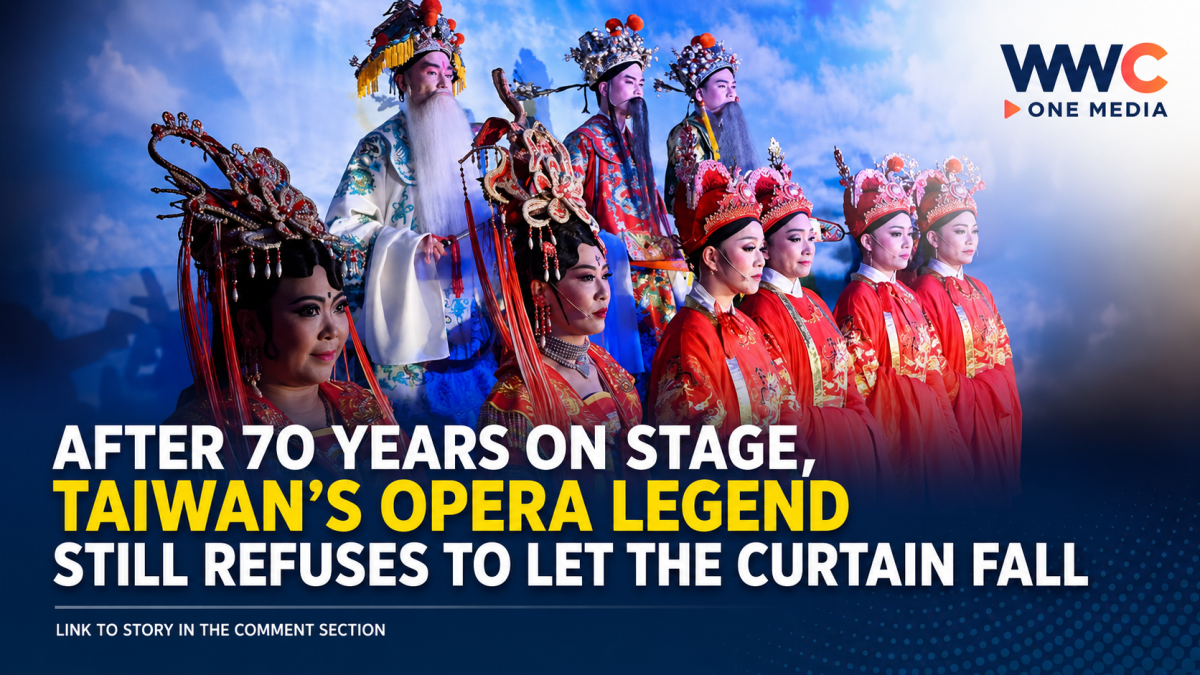
TAIPEI, Taiwan — More than seven decades after first stepping onto a stage as a child, Taiwanese opera icon Wang Jin-ying is still working to keep one of Taiwan’s most distinctive traditional art forms alive.
Now in her 80s, Wang remains active not only as a performer but also as a teacher, script researcher, creator and cultural preserver. Her extraordinary career has followed the evolution of Taiwanese opera — from traveling performance troupes and radio broadcasts to television and modern theater.
Her story is more than that of a celebrated actress. It is also a window into how Taiwanese opera, or koa-á-hì (歌仔戲), survived dramatic changes in the entertainment industry and continued into the modern era.
From a childhood on the road to television stardom
Born Wang Jen-hsin in Changhua County in 1946, Wang was introduced to Taiwanese opera through her older sister, Wang Jin-lian.
According to Taiwan’s National Cultural Memory Bank, she first appeared on stage at just 6 years old, stepping in when a troupe needed someone to perform the role of an elderly woman. She later traveled with a medicine-selling troupe, an experience that helped develop the singing and recitation skills that would become central to her career.
At 17, her distinctive voice brought her to Taichung’s Min-Tien radio station, where she became known by the nickname “Little Kitten.” She recorded Taiwanese opera productions and gained a following that eventually extended beyond Taiwan into Southeast Asia.
Television then opened another chapter.
Wang became one of the prominent performers associated with televised Taiwanese opera, appearing in productions during the period when television helped transform the reach of the traditional art. Her career eventually extended into stage productions and the more theatrical style associated with the Holo Taiwanese Opera Troupe.
A career that mirrors Taiwanese opera’s transformation
Wang’s career is unusual because she experienced almost every major stage of Taiwanese opera’s modern development.
She worked in traditional indoor theaters, traveling troupes, radio, television and contemporary theater. The National Center for Traditional Arts describes her as an artist who has witnessed the evolution of the art form across more than six decades.
Her contribution has also gone beyond performing.
Wang has devoted substantial effort to preserving older scripts, teaching younger performers and passing on the vocal and performance techniques associated with Taiwanese opera. Taiwan’s Ministry of Culture recognized her as a “Living National Treasure” in 2020 for her contribution to preserving the art.
Why her work matters now
Taiwanese opera has faced major challenges as audiences’ entertainment habits changed and traditional performing arts competed with film, television and digital media.
But Wang’s career demonstrates how the art adapted rather than simply disappeared.
A 2026 profile published by Taiwan Panorama and republished by United Daily News highlights how Wang has continued working with scripts, teaching and cultural transmission well into her later years. The profile portrays her disciplined daily life alongside an enduring commitment to the art that has defined her since childhood.
Her story also illustrates the importance of preserving not just performances, but the knowledge behind them — including singing styles, stage techniques, scripts and the traditions passed from one generation of performers to another.
Still passing the tradition forward
Wang’s commitment to Taiwanese opera has remained visible in her later work.
In 2021, she appeared alongside fellow veteran performer Hsiao Mi in the television drama “The Inn of the Afterlife” (孟婆客棧). CNA reported that both performers were recognized as Living National Treasures and continued to view cultural transmission as a lifelong responsibility.
Her work has also been documented by Taiwan’s National Center for Traditional Arts through its oral-history project, preserving memories from a career that began when Taiwanese opera was performed in very different settings from those of today.
And in 2026, the National Culture and Arts Foundation described Wang as one of the artists who has witnessed much of Taiwanese opera’s modern history, noting that she remains involved in teaching, preservation, script creation, education and stage performance despite being more than 80 years old.
The curtain is still up
For Wang Jin-ying, Taiwanese opera is not simply a profession she began as a child. It has been the thread running through virtually every stage of her life.
From a six-year-old filling an unexpected role to a celebrated television performer and now a mentor and guardian of traditional culture, her journey reflects the story of Taiwanese opera itself.
And perhaps that is what makes her story so compelling: after more than 70 years in the art, Wang is still less interested in looking back than in making sure there is a future for the tradition she has spent her life serving.
The performance, in other words, is not over. The next generation is waiting in the wings.




Leave a Reply