
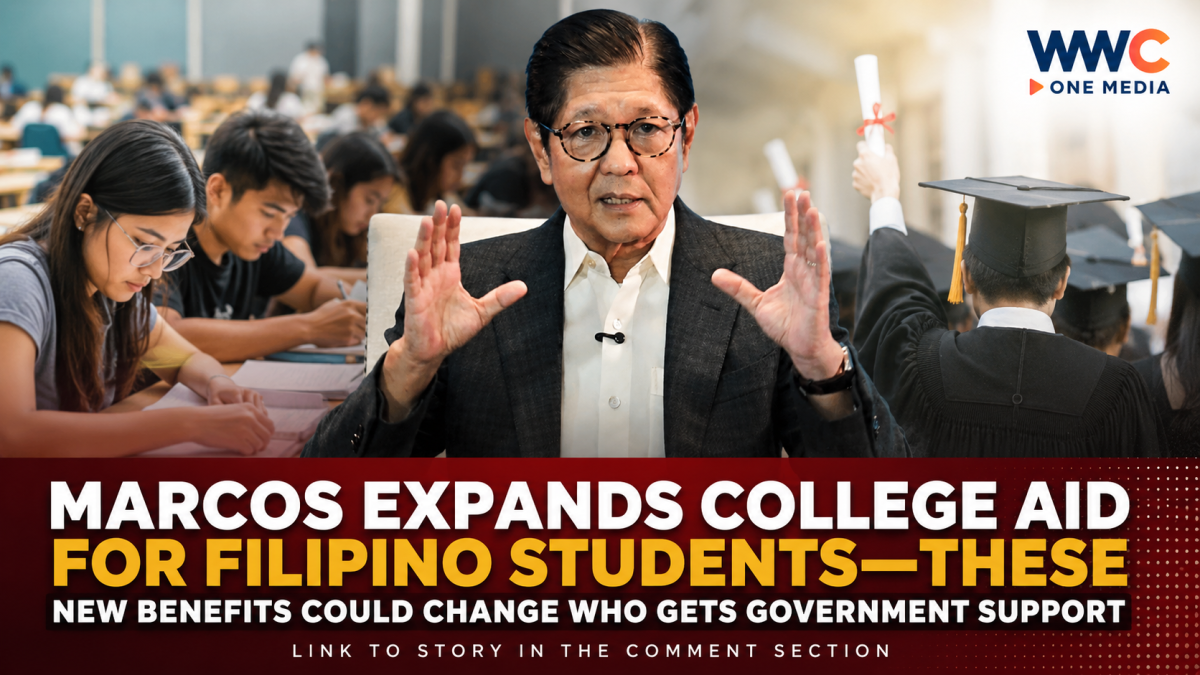
MANILA, Philippines — Filipino students facing financial barriers to higher education and technical-vocational training could get broader government assistance following the expansion of the country’s Tertiary Education Subsidy (TES) program under reforms to the Universal Access to Quality Tertiary Education Act.
The measure amends Republic Act No. 10931, the Universal Access to Quality Tertiary Education Act, which provides free tuition and other school fees in state universities and colleges, qualified local universities and colleges, and state-run technical-vocational institutions. It also established the TES and other forms of student financial assistance.
Congressional records show that House Bill No. 8476, which seeks to expand TES coverage, was approved on third reading and transmitted to President Ferdinand Marcos Jr. on August 4, 2026.
The reform is designed to reach students whose biggest obstacles are not simply tuition fees but also transportation, food, housing, books, equipment and other costs associated with completing their education.
More help for students from poor households
One of the most significant changes is the stronger prioritization of students from Pantawid Pamilyang Pilipino Program (4Ps) households.
Under the measure, qualified 4Ps students who complete senior high school and gain admission to eligible higher education institutions would be automatically prioritized for TES assistance, subject to the program’s requirements and available funding.
The proposal also creates a voucher pathway for qualified students who want to enroll in private higher education or technical-vocational institutions, particularly in areas where there is no nearby state university, local university or college, or public technical-vocational institution.
That provision could be especially important for students in underserved communities, where going to the nearest public institution may require relocating or spending heavily on transportation and living expenses.
Who else could benefit?
The expanded framework also seeks to improve the targeting of TES beneficiaries through socioeconomic data.
For students outside the 4Ps system, the proposed mechanism uses information from the Community-Based Monitoring System (CBMS) to help rank applicants according to household economic circumstances. Students who are not yet included in the database may still qualify through income documentation under rules established by the Unified Student Financial Assistance System for Tertiary Education (UniFAST) Board.
The broader definition of disadvantaged learners also covers groups such as persons with disabilities, Indigenous Peoples, children under foster care, solo parents and their dependents, first-generation college students and learners from geographically isolated and disadvantaged areas.
Assistance goes beyond tuition
The reform is significant because the government’s student assistance system is not limited to tuition.
The TES framework can support expenses such as books and school supplies, transportation, room and board, computers or laptops, disability-related costs, and certain expenses connected with professional licensing or certification.
For students enrolled in nursing and other allied health programs in private institutions, the proposed expansion also addresses costs associated with clinical internships and Related Learning Experience requirements.
This reflects a growing recognition that making tuition free does not automatically make education affordable.
The problem behind the reform
The push for the TES expansion comes amid concerns that existing student assistance has not always reached the poorest learners as originally intended.
During Senate deliberations, Sen. Loren Legarda cited findings from the Second Congressional Commission on Education (EDCOM II) showing a major shift in the profile of TES beneficiaries. According to the figures presented to senators, the proportion of TES grantees from 4Ps and Listahanan households fell from 74% in 2018 to 30% in 2022, while the share of beneficiaries classified under the private-school/no-nearby-public-institution category increased substantially.
Senate discussions also highlighted concerns over the size of the subsidy compared with the rapidly increasing cost of transportation, food, housing and other education-related expenses.
The legislation therefore aims not only to expand assistance but also to improve targeting, prioritization and delivery.
Government already supporting millions of students
The TES expansion comes as the Marcos administration continues to increase funding for tertiary education.
The Presidential Communications Office said in August that the country’s Free Higher Education program was already benefiting approximately 2.62 million students, while the government continued programs such as TES and the Tulong Dunong Program.
The administration has also launched the Bagong Pilipinas Merit Scholarship Program for outstanding senior high school graduates pursuing priority degree programs.
At the same time, technical-vocational education is being positioned as an alternative pathway toward employment and livelihood, with the government emphasizing the complementary roles of CHED and TESDA in providing students with college and skills-training opportunities.
Bigger education budget on the horizon
The expansion is also being backed by increased proposed funding.
The Department of Budget and Management said the proposed FY 2027 budget includes ₱61.10 billion for the Universal Access to Quality Tertiary Education program.
The allocation is intended to support free higher education in state universities and colleges and qualified local universities and colleges, the TES program, and free technical-vocational education and training in public institutions.
The DBM also said the proposed funding for TES and other tertiary education initiatives reflects the government’s goal of accommodating more students as enrollment continues to grow.
What students should watch for
The expansion does not mean every college or technical-vocational student will automatically receive a cash subsidy.
Eligibility, prioritization, available funding and implementing rules remain critical. The program is administered through the UniFAST system, with CHED and TESDA involved depending on the type of institution and program.
The original RA 10931 already provides that TES can support Filipino students enrolled in eligible undergraduate and post-secondary programs in state and local universities, private higher education institutions and technical-vocational institutions.
For students and families, the biggest question now is therefore not simply whether government assistance is expanding—but how many additional students will actually qualify and when the expanded benefits will be fully implemented.
That could determine whether the new reforms translate into real relief for Filipino families struggling to keep their children in college or technical-vocational training.
Leave a Reply