
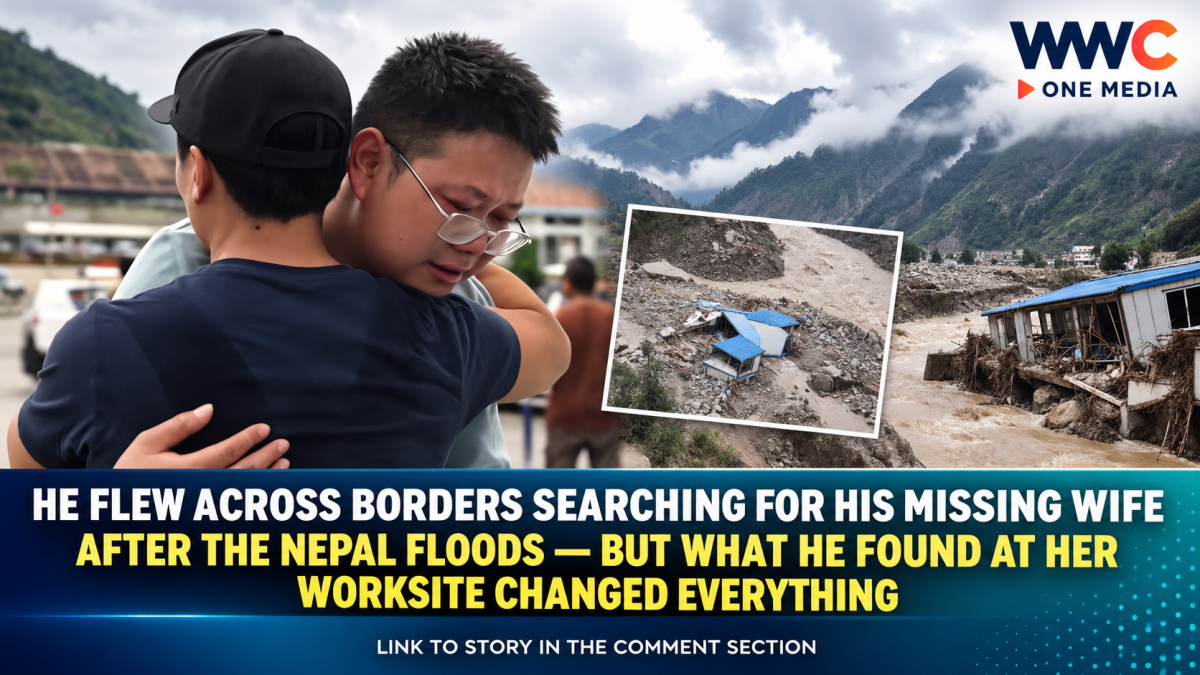
KATHMANDU — For Guan Daoxuan, the disaster began not with the roar of floodwater or the collapse of a mountainside, but with something much quieter: his wife stopped answering her phone.
The 38-year-old Chinese national had spoken with his wife, Li Lisha, the night before catastrophic floods tore through communities along the Nepal-Tibet border on August 26.
They had discussed ordinary family matters. Nothing about the conversation suggested it might be their last.
By the following day, Li was unreachable.
The 37-year-old had been working on a highway project in Nepal near the Gyirong border crossing, an important transport corridor between China and Nepal where several major infrastructure projects operate.
Guan initially hoped the project’s relatively elevated position might have protected workers from the disaster. But repeated unanswered calls quickly turned that hope into fear.
CNA reported that Guan first attempted to reach the area from the Tibetan side, travelling to Shigatse and then towards Gyirong. Damaged and blocked roads prevented him from getting through, forcing him to change course and fly into Nepal instead.
Since arriving, he has searched hospitals and shelters around Kathmandu, contacted the Chinese embassy and tried to gather information from workers and other families.
He has found no sign of his wife.
A video from the disaster zone deepened his fears
Then Guan obtained footage showing what had happened around Li’s workplace.
According to CNA, the video showed the river changing course and eroding part of the project site, with the workers’ camp destroyed. Families of 24 workers from the same project have appealed to authorities in both China and Nepal for help locating their relatives. Around 100 Chinese nationals were still unaccounted for on the Nepali side when CNA published its report on September 4.
For Guan, the search has become about more than finding information.
For several days, he tried to protect his nine-year-old son and his wife’s parents from the scale of the disaster, telling them only that he had urgent matters to handle and that rescue efforts were progressing.
Eventually, the reality became impossible to hide.
His determination, however, has not changed.
“Whether she is dead or alive, she has to come home with me,” Guan told CNA.
His ordeal is being repeated by thousands of families across Nepal, China and countries far beyond the Himalayas.
Thousands remain missing after the August 26 catastrophe
The disaster that swept through the Nepal-China border region has become one of Nepal’s deadliest natural catastrophes in years.
The Associated Press reported on September 4 that at least 1,259 people had been killed in Nepal and more than 5,000 remained missing, citing Nepal’s disaster management agency. China had separately reported 21 deaths and 541 people missing in Tibet as of late Wednesday. More than 4,500 displaced people were staying in 38 relief centres in Nepal.
The figures remain fluid as authorities identify bodies, locate survivors and reconcile lists of people initially reported missing.
Reuters reported the same day that more than 1,200 people had died and more than 4,000 remained missing, underscoring how quickly the official count is changing.
Foreign nationals, pilgrims, construction workers and hydropower employees are among those still unaccounted for.
Some families have travelled thousands of kilometres to Nepal to conduct their own searches.
Australian medical student Sarada Viswanathan, for example, has been trying to reconstruct the movements of her partner Rishab Iyer and his family, who disappeared near the Nepal-Tibet border while travelling on a pilgrimage to Mount Kailash. Reuters reported that 38 Australians remained missing as of September 3. Viswanathan has appealed to technology and telecommunications companies for location data that could help rescuers narrow their search.
Other families have begun confronting an even more painful possibility.
In parts of Nepal, relatives of people still missing have performed symbolic funeral rites without bodies. Authorities are also preserving DNA samples and identifying information from recovered remains so they can eventually be matched with relatives.
How did the Nepal-Tibet flood happen?
Scientists examining satellite images believe the catastrophe began high in the Himalayas.
AP reported that satellite imagery showed a section of bedrock beneath a glacier collapsing, carrying a huge mass of ice and rock down the mountainside. The debris then raced through the steep valley below, mixing with water and sediment and producing devastating downstream flooding.
Reuters has similarly reported that the August 26 disaster was triggered by a glacier collapse, sending ice, rock, mud and water through the Trishuli valley and surrounding communities.
The International Centre for Integrated Mountain Development, or ICIMOD, said the resulting surge carried water, sediment and boulders through the Bhote Koshi and Trishuli river systems. The organisation has stressed the need for stronger cross-border monitoring and early-warning cooperation across the Himalayan region.
Scientists have also warned that warming conditions are increasing instability in high-altitude Himalayan environments. Researchers are still studying the exact chain of events behind this particular collapse, however, so attributing the entire disaster to climate change alone would go beyond what has yet been established.
The desperate race has moved underground
Some of the most difficult rescue operations are now taking place beneath the mountains.
Roughly 900 people associated with six hydropower plants remain missing, according to Reuters. Officials hope some workers may have escaped into underground tunnels or chambers when the flood arrived.
Rescuers face an extraordinary obstacle: an estimated 2.2 million tonnes of mud and debris were deposited through the valley.
At some sites, teams are using engineering drawings and information exchanged through a WhatsApp group involving more than 500 engineers and specialists to identify tunnel entrances, chambers and possible locations where workers could have sheltered.
At the Rasuwagadhi hydropower plant, rescuers reached about 250 metres into one tunnel before encountering another blockage. Officials believe 46 people may have reached a chamber that potentially contained food and water.
No survivors had yet been confirmed inside the hydropower tunnels at the time of Reuters’ September 4 report.
Meanwhile, Nepal is confronting a reconstruction crisis almost as enormous as the search operation.
Authorities estimate about 7,500 homes were completely destroyed and approximately 20,000 houses may ultimately need to be rebuilt, many in safer locations rather than on the same vulnerable ground. More than 9,300 Nepali soldiers have been deployed across affected areas.
For families like Guan’s, however, those numbers remain secondary.
Somewhere among destroyed work camps, hospitals, shelters, unidentified victims and kilometres of debris is the answer they are searching for.
Guan has already crossed from China to Nepal, visited hospital after hospital and begun helping other families looking for missing workers.
He still does not know whether his wife survived.
But until he knows what happened to her, he says his journey is not over.




Leave a Reply