
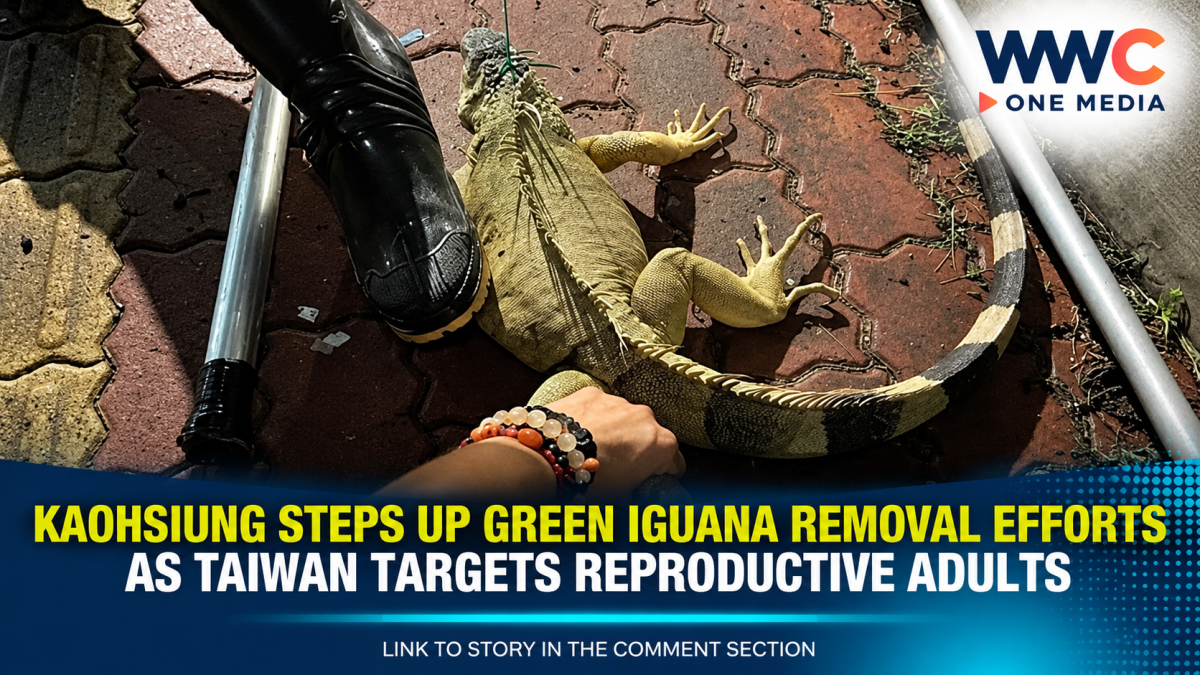
KAOHSIUNG, Taiwan — Kaohsiung is intensifying its campaign against invasive green iguanas, shifting its strategy from simply removing as many animals as possible to targeting the adults most capable of reproducing.
Beginning in September 2026, the Kaohsiung City Government Agriculture Bureau will offer a NT$300 voucher for each qualifying adult green iguana turned over by trained and certified members of the public.
The move reflects a broader strategy being implemented across Taiwan to slow the spread of the invasive species by concentrating limited manpower on mature animals rather than focusing primarily on juveniles.
Why Kaohsiung Is Changing Its Approach
Officials say the key measure of success is no longer simply how many iguanas are removed—but which iguanas are removed.
Kaohsiung is prioritizing green iguanas measuring at least 30 centimeters from snout to vent, a measurement used to identify mature individuals capable of reproduction.
According to the city’s Agriculture Bureau, young iguanas face significant survival pressures from predators, food availability and environmental conditions. By contrast, reproductive adults have a much greater impact on future population growth.
The strategy therefore aims to reduce the number of breeding animals in the wild and slow population expansion.
More Than 27,000 Iguanas Removed in Kaohsiung
The scale of the challenge is already substantial.
As of Aug. 25, 2026, Kaohsiung had removed 27,654 green iguanas.
Niaosong District recorded the largest number, with 9,661 removals, followed by Daliao District with 4,145 and Linyuan District with 3,644.
The numbers are part of a much larger nationwide campaign.
Taiwan’s Forestry and Nature Conservation Agency reported that local governments removed approximately 260,000 green iguanas nationwide in 2025, a record that was roughly three times the number removed in 2024.
Pingtung recorded the highest number of removals at 130,288, while Kaohsiung recorded 62,608 during 2025.
Why Green Iguanas Are a Growing Concern
Green iguanas are native to tropical parts of Central and South America, but have established populations in Taiwan.
The species can grow to roughly 1.8 to 2 meters in total length, with the tail making up a large portion of the animal’s body.
Taiwan considers the green iguana an invasive species because established populations can affect native ecosystems and agriculture. Authorities have been working to prevent the animals from spreading into additional areas.
Recent sightings outside the traditional southern hotspots have increased concerns about further expansion. In August, Hualien authorities reported the first confirmed sighting in Shoufeng Township, prompting increased monitoring along areas around Ji’an, Shoufeng and the Hualien River.
The Forestry and Nature Conservation Agency has also identified Hsinchu and Miaoli as areas requiring heightened monitoring because of occasional green iguana reports in northern Taiwan.
Breeding Season Adds Urgency
Timing is another reason officials are stepping up the campaign now.
Green iguanas generally enter their breeding season from around October through February.
During this period, males can develop more pronounced orange-red coloration and exhibit stronger territorial and courtship behaviors. These characteristics can help authorities and trained personnel identify adult animals and locate potential breeding hotspots.
Females reach sexual maturity at around 2 to 3 years of age and can lay dozens of eggs in a clutch, making reproductive adults a particularly important target for population control.
Public Participation Comes With Training Requirements
Kaohsiung is not simply asking anyone to capture iguanas.
The city has conducted five training sessions, with 626 people completing training and receiving capture identification certificates.
Only people who have completed the required training and hold valid identification are eligible for the NT$300 voucher for qualifying adult iguanas under the new program.
Taiwan’s national strategy similarly emphasizes trained personnel and coordinated removal rather than uncontrolled public activity. Authorities have also been expanding reporting systems, including the use of AI-assisted identification and data analysis to better understand where populations are concentrated.
A Nationwide Fight Against an Expanding Invasive Species
Kaohsiung’s campaign is part of a wider Taiwanese government effort to contain green iguanas before they become even more difficult to control.
The Forestry and Nature Conservation Agency says central and local authorities have been strengthening cross-regional cooperation, patrols and removal operations.
The national program also recognizes that some areas can become difficult removal zones because of geographic boundaries, restricted-access locations or gaps in responsibility between jurisdictions.
The government has therefore moved toward a more coordinated strategy involving multiple agencies and local governments.
The Bigger Challenge
The latest campaign highlights a difficult reality for invasive-species management: removing thousands of animals does not necessarily mean the population is under control if reproductive adults remain.
That is why Kaohsiung’s latest strategy is placing greater emphasis on mature green iguanas.
With the breeding season approaching, officials are hoping that concentrating resources on reproductive animals will slow population growth and give authorities a better chance of containing the species.
For Kaohsiung, the goal is no longer simply to post a bigger removal number.
It is to make every removal count.
And with green iguanas already being reported beyond Taiwan’s traditional southern strongholds, the next phase of the campaign could determine whether the invasive population can be contained—or continues expanding northward.
WWC ONE MEDIA G.A




Leave a Reply