
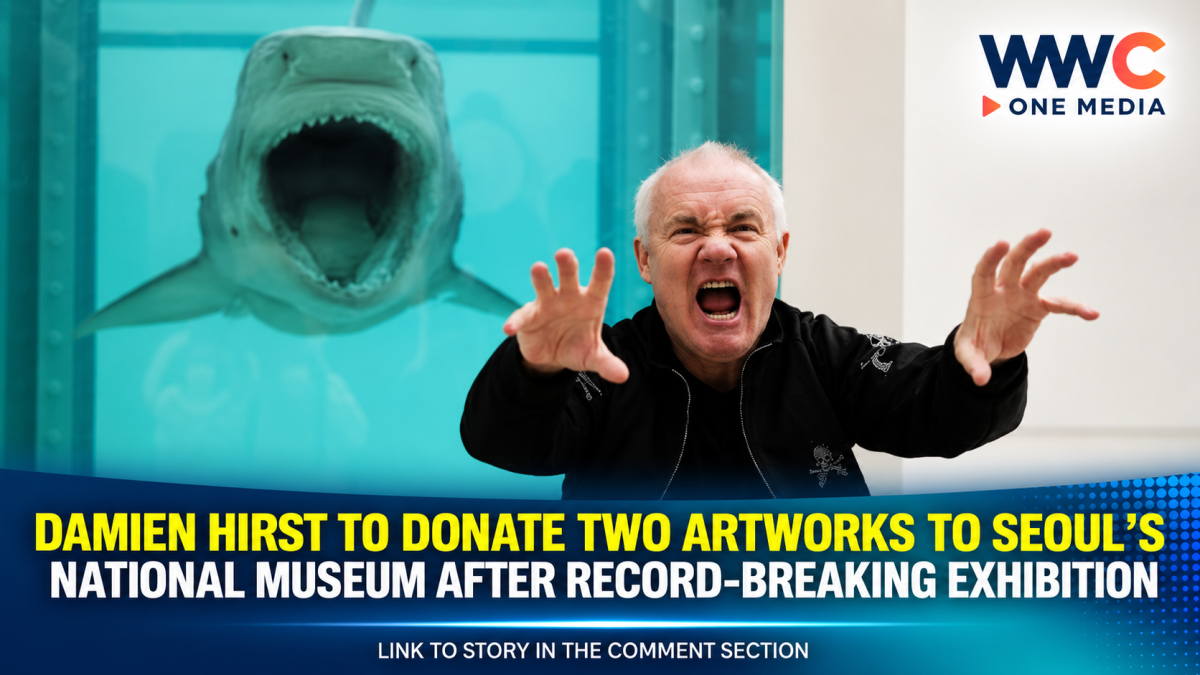
SEOUL, South Korea — British contemporary art star Damien Hirst is preparing to leave a lasting mark on Seoul after announcing his intention to donate two artworks to South Korea’s National Museum of Modern and Contemporary Art (MMCA).
The planned donation follows Hirst’s first major solo exhibition in Asia, held at MMCA Seoul earlier this year, which attracted 541,889 visitors—the highest attendance recorded for a single MMCA exhibition since the museum began compiling comparable exhibition figures in 2023.
The two works Hirst intends to donate were both displayed during the Seoul exhibition, giving the planned gift an especially direct connection to his first major presentation in Asia.
Two works that will become part of the story
The first work is the enormous 1999 “Beautiful Exploding Hell Bent Mayhem and Madness Vortex of Rainbows and Death Volcano Painting,” part of Hirst’s well-known Spin Painting series.
The work uses household gloss paint on canvas and an electric motor to create its distinctive rotating composition. Measuring approximately 365.8 centimeters in diameter, it is one of the large-scale works featured in the Seoul exhibition.
The second is the 2008 triptych “Men Shall Know Nothing.”
The three-panel work reflects themes that have repeatedly appeared throughout Hirst’s career, including life, death and the human body.
MMCA said it is currently carrying out its internal review and donation procedures, meaning the transfer has not yet been finalized.
Hirst’s Seoul exhibition became a cultural phenomenon
The planned donation comes after an extraordinary response to Hirst’s Seoul exhibition, “Damien Hirst: Nothing is True But Everything is Possible.”
Running from March 20 to June 28, 2026, the exhibition presented more than 50 works spanning approximately four decades of the artist’s career. MMCA described it as Hirst’s first major solo exhibition in Asia.
The exhibition brought together several of Hirst’s best-known bodies of work, including his Natural History, Spin Paintings, Medicine Cabinets, Cherry Blossoms, Spot Paintings and Butterfly Paintings.
Among the works shown was the controversial “The Physical Impossibility of Death in the Mind of Someone Living,” Hirst’s famous shark-in-formaldehyde installation, as well as “For the Love of God,” his diamond-covered skull.
Why the donation matters
Hirst is one of the most recognizable—and controversial—figures in contemporary art.
His work frequently confronts ideas about mortality, beauty, science, religion, medicine and human desire, often using materials or imagery designed to provoke strong reactions.
The two planned donations therefore represent more than souvenirs from a successful exhibition. If the transfer is completed, they would give Korea’s national contemporary-art collection permanent access to works representing important parts of Hirst’s artistic career.
The donation would also extend the relationship established between Hirst and MMCA during his Seoul exhibition.
A record-breaking response
The scale of public interest was remarkable.
According to MMCA and Yonhap, 541,889 people visited the exhibition, making it the museum’s most-attended exhibition since comparable attendance data began being compiled in 2023.
That figure underscores the growing appetite among Korean audiences for major international contemporary-art exhibitions.
It also demonstrates Seoul’s increasing importance as a destination for globally recognized artists and major cultural institutions.
From controversy to cultural legacy
Hirst has spent decades challenging conventional ideas about what can qualify as art.
From his early rise in Britain’s Young British Artists movement to his experiments with preserved animals, pharmaceuticals, paintings and monumental installations, his career has consistently generated debate.
His Seoul exhibition brought that provocative artistic language to a new audience while placing it within one of Korea’s most important public museums.
Now, if the donation process is completed, two of those works could remain in Seoul long after the exhibition itself has ended.
Seoul gets more than a temporary exhibition
The significance of Hirst’s announcement may ultimately be measured not by the number of visitors who walked through MMCA Seoul this year, but by what remains after they leave.
The two works could become part of Korea’s permanent contemporary-art landscape, allowing future visitors to encounter Hirst’s work without waiting for another international retrospective.
For MMCA, it is another opportunity to strengthen its collection of internationally significant contemporary art.
For Hirst, it offers a permanent connection to an exhibition that already broke attendance records.
The exhibition may be over—but if the donation is completed, Damien Hirst’s Seoul chapter is only beginning.
WWC ONE MEDIA G.A




Leave a Reply