
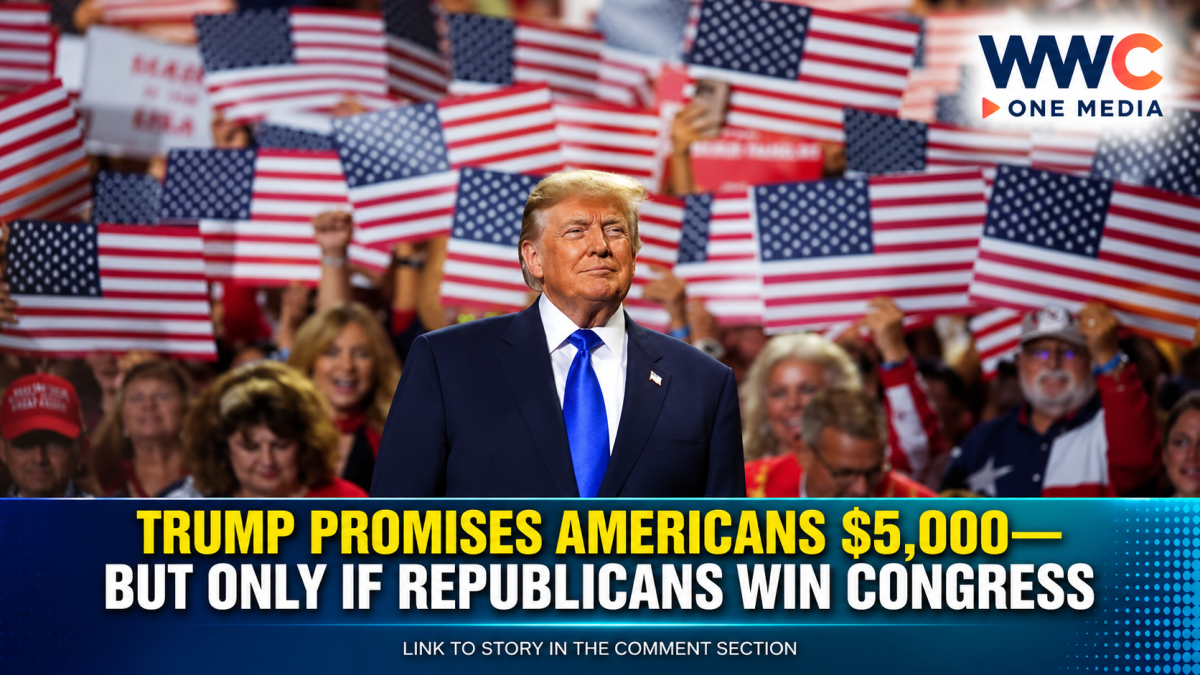
DALLAS, Texas — U.S. President Donald Trump has made one of his boldest midterm election promises yet: a $5,000 payment to every adult American—but only if Republicans retain control of both chambers of Congress.
Trump unveiled the proposal during the Republican Party’s midterm convention in Dallas on September 9, placing the potential payout directly at the center of the GOP’s campaign to hold the House of Representatives and Senate in the November elections.
The president said every adult citizen would receive what he called a “Trump dividend” if Republicans win both chambers, with one condition: the money must be spent inside the United States. However, Trump did not immediately explain how the massive payments would be funded, administered or authorized.
“If the Republicans Win, You Win”
Trump framed the proposed payments as a reward tied to Republican control of Congress and the country’s economic performance.
“If the Republicans win, you win with us and you get $5,000,” Trump told the convention audience, according to multiple reports.
The proposal immediately became one of the biggest talking points from the GOP gathering, which was designed to energize Republican voters with less than two months remaining before the November 3 midterm elections.
But the announcement has also raised major questions.
The biggest question: Where would the money come from?
Trump provided no detailed funding plan during his speech. Reports from Reuters, The Associated Press, CBS News and NPR all noted that key details—including how the proposal would be financed and implemented—were not immediately available.
The potential price tag could be enormous.
The Associated Press estimated that a nationwide $5,000 payment program for American adults could cost more than $1 trillion, while other reports have placed estimates in a similar range. Such spending would likely face intense scrutiny over the federal deficit, national debt and possible inflationary effects.
Could Tariffs Pay for the $5,000 Checks?
Vice President JD Vance suggested that wealthier Americans could potentially be excluded from the program and pointed to tariff revenues as a possible source of funding, according to the Associated Press.
However, tariff revenue alone would fall far short of the amount needed to finance a nationwide $5,000 payout to all eligible adults, based on the scale of the proposal described by Trump.
Trump has previously floated other direct-payment ideas, including proposals involving tariff-funded payments and government savings, but those earlier concepts did not result in a universal nationwide cash distribution.
Would Congress Have to Approve It?
That remains another major unanswered question.
CBS News reported that Trump did not explain whether he would seek congressional authorization for the proposed payments. While the federal government has issued broad payments to Americans before—including economic impact payments approved during the COVID-19 pandemic—those programs involved congressional action and formal legislation.
The new proposal could therefore depend heavily on the outcome Trump himself attached to the promise: Republican control of Congress.
That creates an extraordinary political dynamic.
Trump is not simply campaigning on tax cuts, economic growth or government spending. He is offering voters a specific potential cash payment while explicitly linking it to a Republican victory.
Legal experts cited by the AP said the proposal does not necessarily violate campaign finance laws because the offer is presented as a broad-based government policy rather than a payment restricted to people who vote for a particular candidate. Still, the political and practical implications are likely to face intense debate.
A High-Stakes Midterm Gamble
The $5,000 promise comes as Republicans face a difficult political environment ahead of the midterms.
The GOP is fighting to protect its congressional control while Democrats see opportunities to make gains in both chambers. The Senate battle has become increasingly competitive, with major races drawing billions of dollars in expected campaign spending.
At the same time, Trump has placed himself firmly at the center of the Republican campaign strategy.
The Dallas convention was intended to rally the GOP base, but reports indicated that some Republican candidates in competitive races stayed away, reflecting concerns within parts of the party about Trump’s political standing and whether his dominant role could help—or hurt—candidates in closely contested districts.
Trump Is Putting Himself—and Now $5,000—at the Center of the Campaign
The Dallas event underscored Trump’s strategy for the 2026 midterms: make the election a referendum on his presidency and persuade voters that Republican control of Congress is directly tied to their economic future.
Days before the convention, Trump also said he planned to spend a portion of his substantial political war chest on the midterm campaign, after Republicans expressed concerns about money being held back from competitive races.
Now, the proposed “Trump dividend” adds another powerful—and controversial—element to that strategy.
For supporters, the promise could be seen as a direct economic benefit tied to continued Republican leadership.
For critics, it raises serious questions about cost, inflation, congressional approval and whether the proposal is financially realistic.
The $5,000 Promise Is Still Just a Promise—for Now
At this stage, Americans do not have an approved $5,000 payment program.
Trump has announced a proposal and linked it to a Republican victory in both the House and Senate, but crucial details remain unresolved:
- Who exactly would qualify?
- Would every adult citizen receive the full $5,000?
- Would wealthy Americans be excluded?
- Where would the more than $1 trillion potentially needed come from?
- Would Congress need to pass legislation?
- How would the requirement to spend the money in the U.S. be enforced?
- Could such a large cash injection increase inflation?
Those questions could become increasingly important as the November midterm elections approach.
The Bottom Line
Trump’s $5,000 “Trump dividend” is now one of the most dramatic promises of the 2026 U.S. midterm campaign.
The proposal could energize Republican voters and dominate campaign conversations in the weeks ahead. But with no detailed funding mechanism, legislative framework or implementation plan yet announced, the promise faces a long list of financial and political hurdles.
The biggest question now may not be whether voters like the idea of receiving $5,000.
It’s whether Trump can actually deliver it—and whether Republicans winning Congress is only the first hurdle.



Leave a Reply